QUETTA: The government in Pakistan’s southwestern Balochistan province will intensify its crackdown against illegal immigrants “in the coming days and weeks”, a senior official said on Tuesday, hoping the government repatriates around 100,000-150,000 undocumented individuals from the country by Nov. 30.
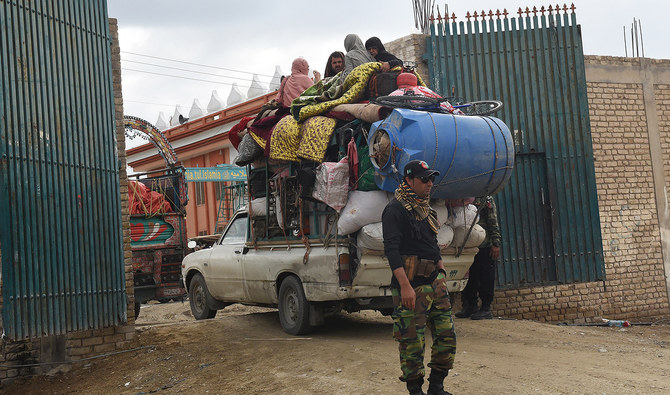
Thousands of Afghans living in Pakistan for decades started returning to their country this month, fearing arrest and deportation. Pakistan’s caretaker government last month handed all illegal immigrants an ultimatum: leave by Nov. 1 or face arrest and deportation.
Around 1.7 million out of a total of four million Afghan nationals in Pakistan are not registered, Pakistani officials say. Pakistan, wary of the presence of illegal immigrants in the country amid a spike in militant attacks as it reels from an economic crisis, has repeatedly accused Afghan nationals of being involved in militant activities and organized crime.
“The provincial government in Balochistan has decided to intensify the process against illegal citizens in coming days,” Jan Achakzai, caretaker information minister of Balochistan, told reporters during a press conference.
“And we are hoping that the government will repatriate around 100,000 to 150,000 illegal immigrants from Balochistan by Nov. 30.”
Achakzai said around 66,000 illegal immigrants returned to Afghanistan through the Chaman border crossing in the last seven days. Of these, he said, 26,000 illegal immigrants had traveled to Chaman from Sindh.
The minister vowed that the government would ensure the implementation of the law against every undocumented person in Pakistan.
“There should not be any misconception that any illegal citizen could hide from law enforcing agencies or that any financially strong illegal immigrant could escape repatriation by bribing our government organizations,” Achakzai said.
“The state has made a clear decision that all illegal citizens will be repatriated indiscriminately.”
Pakistan has hosted millions of Afghans over the decades, including those who fled their country during the 1979-1989 Soviet occupation, and the US invasion of Afghanistan in 2001.
According to the UN Refugee agency, around 600,000 Afghan nationals fled to Pakistan when the Taliban recaptured Kabul in August 2021.
To speed up the repatriation process of citizens, Pakistan has set up holding centers in many parts of the country where undocumented Afghan citizens are kept. Pakistan’s caretaker interior minister has said the government provides food, medicines and shelter to Afghan nationals at holding centers before they are repatriated with dignity to their respective countries.
Achakzai said Pakistan has been repatriating illegal citizens as per international law. He said the government has taken 200 illegal Afghan nationals in custody at a holding center in Quetta.
The minister dispelled the notion that the crackdown against illegal citizens would halt after the upcoming general elections.
“But we will set a roadmap for the coming regime to continue action against illegal citizens in Balochistan,” Achakzai said.
Although Pakistan says it is not targeting Afghan nationals only, who constitute the bulk of foreign nationals in Pakistan, Afghans have complained of harassment by Pakistani authorities.
Many have claimed that despite possessing the legal documents to stay, police and authorities are harassing them to leave Pakistan.
International rights groups have called on Pakistan to ensure the repatriation process is safe and voluntary.


![]()

Balochistan government vows to ‘intensify’ crackdown against illegal immigrants
Short Url
https://arab.news/5bhwd
Balochistan government vows to ‘intensify’ crackdown against illegal immigrants
- Around 66,000 Afghan nationals left Pakistan during last 7 days via Chaman border, says official
- Pakistan last month told illegal immigrants to leave by Nov.1 or face arrest and deportation
Latest updates



© 2026 SAUDI RESEARCH & PUBLISHING COMPANY, All Rights Reserved And subject to Terms of Use Agreement.