WFP chief calls for safe, expanded humanitarian access to Gaza as food runs out

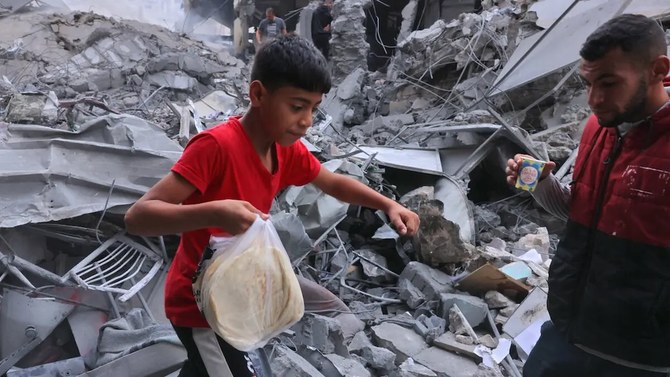
A Palestinian youth carries bread amid the rubble of the city center of Khan Yunis in the southern Gaza Strip following Israeli shelling on October 10, 2023. (File/AFP)
Short Url
Updated 05 November 2023
Follow

WFP chief calls for safe, expanded humanitarian access to Gaza as food runs out

  • Entry points into Gaza have been virtually sealed except through the Rafah border crossing
  • Children and families have practically no access to water, food and medicines

CAIRO: The UN World Food Programme’s Executive Director Cindy McCain issued an urgent plea on Sunday from the Rafah border crossing for safe, expanded humanitarian access to Gaza as humanitarian needs skyrocket and critical food supplies reach dangerously low levels.

Entry points into Gaza have been virtually sealed except through the Rafah border crossing point. While there has been a steady increase in aid entering Gaza, it is nowhere near enough to meet the exponentially growing needs. 

Since the beginning of the current escalation of hostilities in the Gaza Strip, the number of internally displaced people has reached 1.4 million, according to UN refugee agency UNCIEF. Children and families have practically no access to water, food and medicines, and the whole Gaza Strip is living with very little or no electricity, the humanitarian agency reports. 

“Right now, parents in Gaza do not know whether they can feed their children today and whether they will even survive to see tomorrow. The suffering just meters away is unfathomable standing on this side of the border,” McCain said as she returned from the Rafah border crossing in Egypt.

“Today, I’m making an urgent plea for the millions of people whose lives are being torn apart by this crisis,” she added.

McCain is concluding a two-day visit to Egypt, during which she met with Egypt’s President Abdel Fattah El-Sisi and senior government officials and visited the Egyptian Red Crescent’s humanitarian staging hub in Al-Arish.

“We appreciate all efforts to facilitate a steady flow of humanitarian supplies through its border with Gaza, and the work of the Egyptian Red Crescent is remarkable. We need to continue to work together to get safe and sustained access to Gaza at a scale that aligns with the catastrophic conditions facing families there,” McCain noted.

During her visit, McCain explored opportunities for WFP to leverage its extensive expertise in logistics during emergencies to further strengthen collaboration with partners such as the Egyptian Red Crescent and scale up the delivery of humanitarian aid into Gaza. She applauded the efforts of their volunteers who have worked tirelessly to get lifesaving assistance to their neighbors.

“The crisis in Gaza is not just a local tragedy. It’s a stark reminder that our global food crisis is worsening. Not only does this crisis threaten regional peace and stability, it undermines our collective efforts to combat hunger worldwide,” McCain noted.


Trump says Iran government change ‘best thing that could happen’

Updated 14 February 2026
Follow

Trump says Iran government change ‘best thing that could happen’

  • US president's comments come after he ordered a second aircraft carrier to head to the Middle East

FORT BRAGG, United States: US President Donald Trump said a change of government in Iran would be the “best thing that could happen,” as he ordered a second aircraft carrier to head to the Middle East.
“Seems like that would be the best thing that could happen,” Trump told reporters at the Fort Bragg military base in North Carolina when a journalist asked if he wanted “regime change” in Iran.
“For 47 years, they’ve been talking and talking and talking. In the meantime, we’ve lost a lot of lives while they talk,” he told reporters.

Trump declined to say who he would want to take over in Iran from supreme leader Ayatollah Ali Khamenei, but he added that “there are people.”
He has previously backed off full-throated calls for a change of government in Iran, warning that it could cause chaos, although he has made threats toward Khamenei in the past.
Speaking earlier at the White House, Trump said that the USS Gerald R. Ford — the world’s largest warship — would be “leaving very soon” for the Middle East to up the pressure on Iran.
“In case we don’t make a deal, we’ll need it,” Trump said.
The giant vessel is currently in the Caribbean following the US overthrow of Venezuela’s Nicolas Maduro. Another carrier, the USS Abraham Lincoln, is one of 12 US ships already in the Middle East.

When Iran began its crackdown on protests last month — which rights groups say killed thousands — Trump initially said that the United States was “locked and loaded” to help demonstrators.
But he has recently focused his military threats on Tehran’s nuclear program, which US forces struck last July during Israel’s unprecedented 12-day war with Iran.
The protests have subsided for now but US-based Reza Pahlavi, the son of Iran’s last shah, urged international intervention to support the Iranian people.
“We are asking for a humanitarian intervention to prevent more innocent lives being killed in the process,” he told the Munich Security Conference.
It followed a call by the opposition leader, who has not returned to his country since before the revolution, for Iranians at home and abroad to continue demonstrations this weekend.
Iran and the United States, who have had no diplomatic relations since shortly after the revolution, held talks on the nuclear issue last week in Oman. No dates have been set for new talks yet.
The West fears the program is aimed at making a bomb, which Tehran denies.
The head of the UN nuclear watchdog, Rafael Grossi, said Friday that reaching an accord with Iran on inspections of its processing facilities was possible but “terribly difficult.”

Trump said after talks with Israeli Prime Minister Benjamin Netanyahu earlier this week that he wanted to continue talks with Iran, defying pressure from his key ally for a tougher stance.
The Israeli prime minister himself expressed skepticism at the quality of any agreement if it didn’t also cover Iran’s ballistic missiles and support for regional proxies.
According to the US-based Human Rights Activists News Agency, 7,008 people, mostly protesters, were killed in the recent crackdown, although rights groups warn the toll is likely far higher.
More than 53,000 people have also been arrested, it added.
The Norway-based Iran Human Rights (IHR) NGO said “hundreds” of people were facing charges linked to the protests that could see them sentenced to death.
Figures working within the Iranian system have also been arrested, with three politicians detained this week from the so-called reformist wing of Iranian politics supportive of President Masoud Pezeshkian.
The three — Azar Mansouri, Javad Emam and Ebrahim Asgharzadeh — were released on bail Thursday and Friday, their lawyer Hojjat Kermani told the ISNA news agency.