At UN, Pakistan asks Israel to stop ‘genocide’ of Palestinians in Gaza

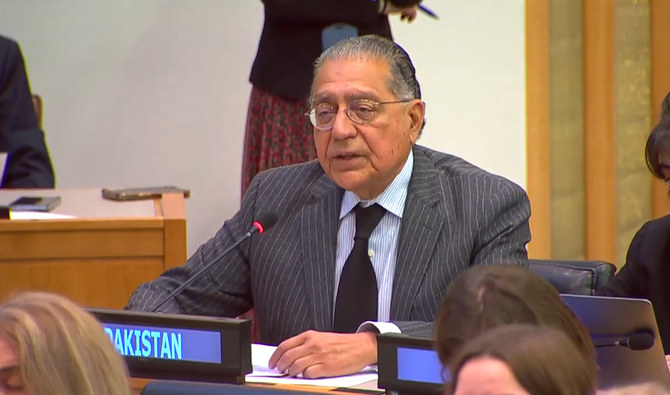
Pakistan's United Nations Ambassador Munir Akram addresses the UN meeting, during a debate on Israeli actions in Gaza at UN headquarters on November 4, 2023. (Photo courtesy: UN)
Short Url
Updated 05 November 2023
Follow

At UN, Pakistan asks Israel to stop ‘genocide’ of Palestinians in Gaza

  • The statement came at a UN briefing on humanitarian situation in Palestinian Territories
  • Ambassador Munir Akram calls Israeli strikes a gross violation of international law, norms

ISLAMABAD: Pakistan’s permanent representative to the United Nations (UN), Ambassador Munir Akram, asked Israel to stop its ongoing “genocide” of Palestinian people and stressed the need for an immediate ceasefire in Gaza, Pakistani state media reported on Saturday.
Akram’s comments came at a UN meeting, wherein UN Humanitarian Coordinator Martin Griffiths, fresh from the war-torn region, and Lynn Hastings, deputy special coordinator for the Middle East Peace Process, were among those who briefed member states about latest developments in the Israeli-Palestinian conflict.
Both UN officials called for humanitarian cease-fires to ensure a safe delivery of food, fuel and other essential items to the people in Gaza.
In his remarks, the Pakistani envoy said the Israelis were committing the “modern genocide” against the Palestinians and “we must call it for what it is.”
“We cannot mince our words,” Ambassador Akram said during the briefing, titled ‘Humanitarian Situation in the Occupied Palestinian Territory.’
“We have to tell the Israelis: stop the genocide,” he was quoted as saying by the state-run APP news agency.
Since a shock Hamas attack on October 7, which Israeli officials say has killed 1,400 people, Israel has bombarded the besieged Gaza Strip. The health ministry in Gaza says more than 9,480 Gazans, mostly women and children, have been killed in Israeli strikes and the intensifying ground campaign.
In this regard, Akram called for respecting and adhering to the international humanitarian law that forbade attacks on civilians and civilian objects.
“Let us, as the international community, adhere to what the General Assembly has said. Let us adhere to what the international humanitarian law says,” the Pakistani envoy said.
“This is what we expect from all those who are leading the United Nations, all those who are speaking for the conscience of the international community.”
He said the deadly Israeli strikes against schools, hospitals and civilian sites in Gaza on the pretext that there were “military targets” in those facilities were a gross violation of international law and norms as well as a “collective punishment” of a helpless people.


Pakistan improves water management but remains highly vulnerable to floods, shortages — report

Updated 9 sec ago
Follow

Pakistan improves water management but remains highly vulnerable to floods, shortages — report

  • Asian Water Development Outlook says national water security score up 6.4 points since 2013 but service delivery still weak
  • ADB-linked report warns that groundwater dependence, urban demand and ecosystem decline remain critical risks

ISLAMABAD: Pakistan has strengthened its water governance and planning capacity over the past decade but continues to face serious risk from climate shocks, declining freshwater availability and weak service provision, according to the Asian Water Development Outlook 2025.

The regional water security assessment linked to the Asian Development Bank evaluates countries across Asia on water supply, governance, climate resilience, urban systems and environmental health. 

The study found that Pakistan has made policy progress since 2013, yet implementation remains inconsistent and the country is still exposed to extreme weather events, rapid population growth and stressed aquifers. The assessment warns that improvement has not kept pace with risk.

“Pakistan’s national water security score improved moderately from 2013 to 2025 by 6.4 points. At the same time, water governance performance, measured through SDG 6.5.1, rose from 50 percent in 2017 to 63 percent in 2023,” the report said. 

Despite these gains, rural supply and service reliability remain uneven. 

“Pakistan’s rural household water security remains under pressure due to ineffective service models, limited surveillance, and persistent contamination,” while economic performance is hampered by “falling per capita water availability, insufficient storage, and heavy reliance on poorly monitored groundwater resources for industrial activity,” according to the report.

Pakistan’s cities remain under pressure, with infrastructure struggling to match population growth and demand: 

“Urban water security has shown only modest gains, with rising demand, untreated wastewater and urban flooding straining infrastructure and service delivery.”

Environmental conditions have also deteriorated, driven by unchecked industrial discharge and limited regulatory enforcement. 

“Environmental water security has declined slightly, as rapid population growth, industrial activity, and untreated wastewater continue to degrade aquatic ecosystems,” the report added. 

Pakistan remains highly exposed to disasters including major floods, droughts and glacial lake outburst floods (GLOFs). The report cites the 2022 monsoon crisis, noting that it “affected over 24 million people.” 

While early-warning systems are improving, infrastructure investment and coordinated management remain inadequate.

The document concludes that Pakistan must convert policy gains into ground-level delivery by expanding financing, strengthening provincial coordination and scaling ecosystem protection to stabilize long-term water security.