Pakistan PM grants three-month extension to Zaka Ashraf-led PCB management committee

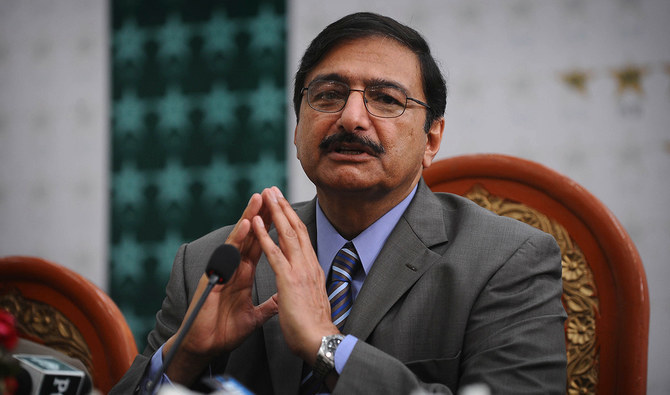
Pakistan cricket chief Zaka Ashraf gestures during a press conference in Lahore on April 18, 2012. (AFP/File)
Short Url
Updated 05 November 2023
Follow

Pakistan PM grants three-month extension to Zaka Ashraf-led PCB management committee

  • Ashraf’s four-month tenure as head of PCB management committee was to end Sunday 
  • Both PM Kakar and the PCB previously ruled out any extension in the committee’s tenure 

ISLAMABAD: Pakistan’s caretaker prime minister, Anwaar-ul-Haq Kakar, has granted three-month extension to the Pakistan Cricket Board (PCB) management committee, led by Zaka Ashraf, the PCB said on Saturday.
The development comes days after PM Kakar told a local news channel that the top PCB official’s future would be determined after the ongoing World Cup in India.
Ashraf’s four-month tenure was scheduled to end today, on November 5.
“Caretaker Prime Minister of Islamic Republic of Pakistan and the patron of Pakistan Cricket Board Mr.Anwaar-ul-Haq Kakar has granted a three-month extension to the PCB Management Committee,” the PCB said in a statement.
“Mr Zaka Ashraf currently heads the 10-member Management Committee.”
Previously, the PCB also denied media reports regarding an extension being given to its management committee.
The board and its top officials recently came under intense criticism due to Pakistan’s poor show at the World Cup, wherein the team lost four back-to-back matches that reduced its chances of getting into semifinals.
However, opener Fakhar Zaman on Saturday cracked a blistering century to save Pakistan from World Cup elimination in a rain-affected, dramatic 21-run victory over New Zealand in Bengaluru.
Pakistan now have eight points from as many games with their last match against England in Kolkata on November 11. They not only need to win that but also hope New Zealand lose to Sri Lanka on November 9 in Bengaluru or the match is hit by rain.


Too warm to freeze: Climate shift threatens ice hockey in Pakistan’s Hunza Valley

Updated 7 sec ago
Follow

Too warm to freeze: Climate shift threatens ice hockey in Pakistan’s Hunza Valley

  • Rising temperatures, falling snowfall disrupt community-run tournament dependent on natural ice
  • Scientists report shorter snow seasons across Hindu Kush-Himalayan region as climate risks grow

HUNZA, Pakistan: Aleena Gul used to watch the pool beside her home in Pakistan’s Hunza Valley freeze solid each winter, transforming it into a makeshift ice hockey rink.

This year, it barely froze at all.

“If we see, there’s a big difference between 2018 and now in 2026,” said Gul, a local player whose family has hosted the community tournament for eight seasons.

“Winter used to begin in November and everything would freeze, . It’s January now and the ice still hasn’t frozen properly,” said Gul, a local player whose family has hosted the community tournament for eight seasons.

The change has disrupted a small but growing winter sports tradition in the mountainous region near the Chinese border, where residents say colder, longer winters once provided reliable natural ice.

Scientists studying the wider Hindu Kush-Himalayan region have reported fewer extreme cold events and shorter snow seasons, with snowfall increasingly failing to settle. Weather data for Hunza shows winter precipitation down by about 30 percent since the late 2010s, with some recent winters two to three degrees Celsius warmer.

That is a challenge for a region reliant on visitors, where winter tourism depends heavily on snowfall and freezing temperatures.

The community-run ice hockey tournament in Hunza depends entirely on natural ice. When Gul’s pool failed to freeze properly this year, organizers scrambled to find an alternative venue nearly two hours north, in a town close to the Chinese border.

Even there, conditions were difficult.

“I expected better ice conditions, but when I saw the rink I felt a bit sad. Many of our players fell. The surface had too many bumps and wasn’t strong,” said Yahya Karim, another player.

Of three matches scheduled on the first day, only one went ahead.

“Today, we got ready at almost around 9 o’clock. When we got called for the match, we saw that the ice was not in a good condition. So, all these things are very unexpected for us. And this is a side effect of climate change,” Gul said.

Naseer Uddin, co-founder of the youth organization SCARF, said volunteers had worked for about a week preparing the arena.

“We worked on this arena for about a week. We had planned [a match] here. Then, suddenly, when the sun came out today, so we had to switch suddenly because the ice in this arena has been spoiled,” he said.

Sadiq Saleem, president of the Altit Town Management Society, said residents were witnessing a noticeable change.

“We are witnessing a sudden shift in Hunza’s weather pattern, [both] in the snowfall and freezing [temperature] here. We are seeing a big shift in the intensity of winter here,” he said.

The girls’ match eventually went ahead, and Gul’s team emerged victorious. But the uncertainty over ice conditions has left many wondering how long the tradition can survive.

Climate change has become a growing concern for Pakistan, which contributes less than 1 percent of global greenhouse gas emissions yet is frequently ranked among the countries most vulnerable to global warming.

This week, Pakistan’s National Disaster Management Authority warned of an elevated risk of glacial lake outburst floods in the north as rising temperatures threaten to accelerate snow and glacier melt. Seasonal forecasts point to higher-than-normal temperatures and possible early heatwave conditions in Gilgit-Baltistan and upper Khyber Pakhtunkhwa, regions that include Hunza.

For now, players in the valley are making do with what winter brings. But as temperatures rise, even a simple backyard rink is no longer guaranteed.