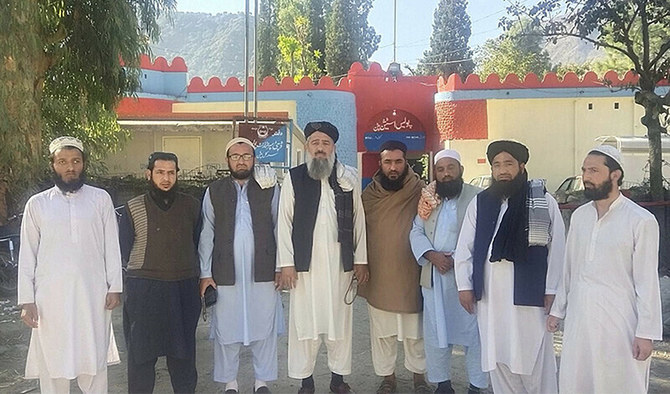
PESHAWAR: A group of clerics in the conservative Kohistan district of Pakistan’s northwestern Khyber Pakhtunkhwa province on Saturday threatened female employees of non-governmental organizations (NGO) not to work in the field or prepare themselves for forced marriages or expulsion from the area.
Over the years, reports have emerged that women living in Kohistan district have faced severe restrictions on their rights and freedoms. Some of them have even been subjected to violence and honor-based crimes in the region.
“If a female worker of an NGO is found roaming on the streets without a male relative, such as her brother or father, and if she is single, we will ask any local to marry her,” Mufti Ahmad Ali, one of the clerics in the area, told Arab News over the phone. “But if a female NGO worker is married then she will be expelled from the area.”
He said religious leaders had approached the police and verbally complained about NGO employees who had been spotted on streets for two consecutive days.
“Our decision is equally binding on locals, foreigners and NGO workers from other districts,” he added.
Ali said the local clerics had set various conditions for development sector organizations, saying their staff members would not be allowed to “preach their religious or preach against our religion.”
“They should respect the local culture and traditions,” he continued, “and not allow women workers to roam freely in the region.”
However, he noted there was no harm in these NGOs carrying out development work in health and education sector, though their female employees must not be seen working on the ground.
Asked about the situation, Buland Iqbal, Station House Officer (SHO) of the police precinct in the area, acknowledged that religious clerics had visited him with their complaint against NGO workers, though he expressed optimism the issue would be tackled amicably.
“It was a non-issue that has been unnecessarily highlighted on social media,” he said. “NGO workers, including female employees, are continuing to work from their offices.”
Meanwhile, Nausheen Fatima, a social activist in the province, said it was “beyond comprehension” that religious leaders were trying to prevent women from performing duties in remote areas where local communities were facing acute health and education challenges.
“This decision is extremely tragic,” she said. “I hope the government will not allow such elements to take law into their hands. It is against the basic human rights.”
Fatima said NGOs should be allowed to promote health and education among vulnerable communities.
“Religious leaders should preach peace and tranquility in society instead of doing this,” she added.

Clerics in Pakistan’s Kohistan district threaten women NGO workers with forced marriages, expulsion
https://arab.news/5he3v
Clerics in Pakistan’s Kohistan district threaten women NGO workers with forced marriages, expulsion
- Police describe the threat as a ‘non-issue,’ saying it has been highlighted on social media for no reason
- A female social activist hopes the government will not let local religious leaders take law into their hands
Pakistan expands pilgrim travel system for Iran, Iraq with licenses to 67 new operators
- New system requires all Iraq-Iran pilgrimages to be organized by licensed groups under state oversight
- Long-running “Salar” model relied on informal caravan leaders, leading to overstays and missing pilgrims
ISLAMABAD: Pakistan has issued registration certificates to 67 additional licensed pilgrimage companies, expanding a tightly regulated travel system designed to curb overstays, undocumented migration and security risks linked to religious travel to Iran and Iraq, the ministry of religious affairs said on Tuesday.
The move is part of a broader overhaul of Pakistan’s pilgrim management framework after authorities confirmed that tens of thousands of Pakistani pilgrims had overstayed or gone missing abroad over the past decade, raising concerns with host governments and triggering diplomatic pressure on Islamabad to tighten oversight.
“The dream of safe travel for pilgrims to Iran and Iraq through better facilities and a transparent mechanism is set to be realized,” the religious affairs ministry said in a statement, quoting Federal Minister for Religious Affairs Sardar Muhammad Yousaf, who announced that 67 new Ziyarat Group Organizers had been registered.
Pakistan’s government has dismantled the decades-old “Salar” system, under which informal caravan leaders arranged pilgrimages with limited state oversight. The model was blamed for weak documentation, poor accountability and widespread overstays, particularly during peak pilgrimage seasons.
Under the new framework, only licensed companies are allowed to organize pilgrimages, and they are held directly responsible for ensuring pilgrims return within approved timelines.
Authorities say pilgrimages to Iran and Iraq will be conducted exclusively under the new system from January 2026, marking a full transition to regulated travel. The religion ministry said it has now completed registration of 24 operators in the first phase and 67 more in the second, with remaining applicants urged to complete documentation to obtain licenses.
The religious affairs ministry said a digital management system is being developed with the National Information Technology Board to monitor pilgrim movements and operator compliance, while a licensed ferry operator has also secured approval to explore future sea travel options.
The overhaul has been accompanied by tighter coordination with host countries. Earlier this month, Pakistan and Iraq agreed to share verified pilgrim data and restrict entry to travelers cleared under the new system, following talks between interior ministers in Islamabad and Baghdad. Pakistan has also barred overland pilgrim travel for major religious events, citing security risks in its southwestern Balochistan province, meaning travel to Iran and Iraq is now limited to approved air routes.
Officials say the reforms are aimed at balancing facilitation with accountability, as tens of thousands of Pakistani pilgrims travel annually to key Shia shrines, including Karbala and Najaf in Iraq and Mashhad and Qom in Iran. Travel peaks during religious occasions such as Arbaeen, when millions of worshippers converge on Iraq, placing heavy logistical and security demands on regional authorities.
The government says the new system is intended to restore confidence among host countries while ensuring safer, more transparent travel for Pakistani pilgrims.