Filipinos unwilling to flee Gaza as Palestinian relatives not allowed to leave

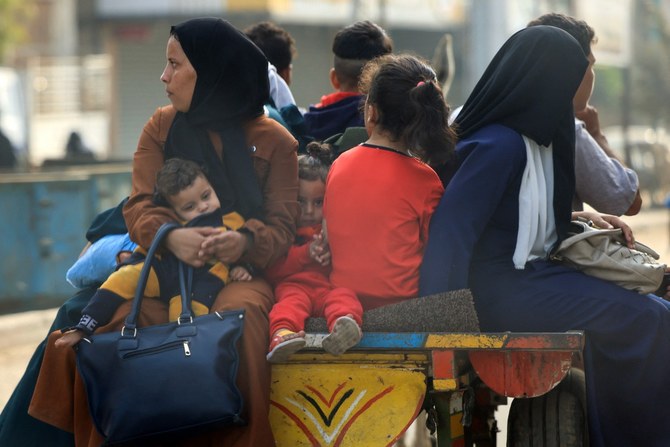
People in Khan Yunis in the southern Gaza Strip use donkey-drawn carts for transportation on Nov. 2, 2023, due fuel shortage amid Israel's siege and attacks on the Palestinian enclave. (AFP)
Short Url
Updated 04 November 2023
Follow

Filipinos unwilling to flee Gaza as Palestinian relatives not allowed to leave

  • Out of 134 Philippine nationals in Gaza, only 43 registered for evacuation
  • So far, two Filipino doctors from MSF have left the besieged enclave

MANILA: Many Filipinos living in Gaza are unwilling to leave because their Palestinian spouses would be unable to join them, the Philippine Department of Foreign Affairs said on Saturday.

Of the 136 Filipinos trapped in Gaza since Israel began its daily bombardment of the densely populated enclave three weeks ago, only two have been evacuated — doctors Darwin Dela Cruz and Regidor Esguerra, from the international aid group Médecins Sans Frontières, who entered Egypt through the Rafah crossing on Wednesday.

The remaining 134 have all received clearance from Israeli authorities to leave, Foreign Affairs Department undersecretary Eduardo De Vega told reporters in Manila.

Evacuation has been complicated, as it requires clearance from Israel’s authorities and poses a risk, since Israeli planes are continuing their deadly strikes on Gaza, where they have already killed at least 9,200 people.

“The first batch of Filipinos will be leaving tomorrow,” De Vega said on Saturday. “There’ll be 20 of them and afterwards — it could be the next day or in the next two days — a batch of 23. We want it to be higher, hopefully.”

However, while 115 Filipinos were ready to return to their country a few days ago, many of them have now changed their minds, having learned that they would have to leave their Palestinian relatives behind, since Israel has not given them clearance to leave.

“So far, only 43 of the Filipinos have signified that they definitely want to leave Gaza,” De Vega said. “A lot of them do not want to leave their Palestinian spouses or parents.”

Most of the Filipinos in Gaza are permanent residents. Two-thirds of them are Palestinian Filipinos who were born or raised there.

There is also a Catholic nun from the Missionaries of Charity who, since the beginning of the attacks, has categorically refused to leave her church in Gaza City, where hundreds of people have taken refuge.

“She is 63. Very brave,” De Vega told Arab News. “She has specified that her name should not be divulged, (asking) only that we pray for her and their safety.”


India rolls out strictest anti-pollution curbs as toxic smog engulfs Delhi

Demonstrator wearing an oxygen mask and holding oxygen tanks takes part in protest.
Updated 14 December 2025
Follow

India rolls out strictest anti-pollution curbs as toxic smog engulfs Delhi

  • Private monitors in several parts of northern Delhi recorded AQI spikes between 550 and 700s
  • Authorities invoked stage four of the capital region’s emergency pollution-control framework

NEW DELHI: India’s capital choked under a thick blanket of smog on Sunday, with the government imposing anti-pollution curbs after monitoring stations in some areas recorded extremely hazardous air quality.

Home to 30 million people, Delhi has not recorded a single “clean air” day in 2025, with Air Quality Index readings hitting high above the 50 score throughout the year.

On the AQI scale from 0 to 500, good air quality is represented by levels below 50, while levels above 300 are dangerous.

Worsening since late October, official records over the weekend were in the severe to severe-plus range of 400–500, but as 24-hour averages, they did not capture the peaks. Private monitors in several parts of North and North West Delhi recorded AQI spikes above 550 and even into the 700s in real-time.

On Saturday evening, the Ministry of Environment’s Commission for Air Quality Management invoked stage four — the highest level — of the Graded Response Action Plan for Delhi and surrounding areas.

To “prevent further deterioration of air quality in the region,” the commission suspended all non-essential construction, shut stone crushers and mining operations, stopped entry of trucks into the capital region, and ordered schools to shift to hybrid classes or online, where possible.

While authorities blamed the pollution on “adverse meteorological conditions,” residents have been demanding more government action.

“The situation is so bad in Delhi that we don’t have any option but to force kids to do online classes. The government has failed us; it has not done anything to address the issue,” said Nabanita Nayak, who decided for her teenage children to attend school online only, despite concerns over their screen addiction.

“If the kids are too much in front of laptops, that’s also an issue. As a mother, I am worried.” 

Delhi’s pollution has been worsening since Diwali in late October, when the average AQI has been above 370, or “very poor.” Since mid-November, it has been over 400, which means “severe” air quality, with certain areas recording 500 and above, which is classified as a “hazardous” level.

“I don’t feel proud living in Delhi. It’s the capital city of the country … We talk about being a developed nation by 2047 — we have deadlines,” said Jagriti Arora, who is keeping her 7-year-old daughter at home to prevent allergy flare-ups caused by air pollution.

“The government has to do something … China had a big problem with pollution, but now they’ve managed to bring it down.”

Delhi’s air quality deteriorates in winter due to local emissions and seasonal weather conditions. Cold temperatures and low wind speeds result in a temperature inversion, which traps pollutants close to the ground instead of letting them disperse. This allows emissions from millions of vehicles, ongoing construction, and nearby industrial activity to accumulate in the air. Urban waste burning and dust from construction sites further add to it.

“This is not a new thing. This has been happening now for over 10 years,” Arora said. “You can see it. You don’t need to actually look at an AQI meter to see how bad the pollution is these days.”