

Trump asks appeals court to lift gag order imposed on him in 2020 election interference case
Trump asks appeals court to lift gag order imposed on him in 2020 election interference case/node/2402411/world
Trump asks appeals court to lift gag order imposed on him in 2020 election interference case
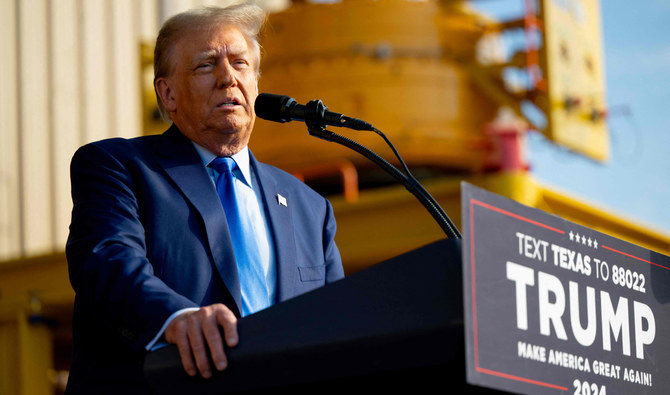
Republican presidential candidate former US President Donald Trump speaks during a campaign rally at Trendsetter Engineering Inc. on November 02, 2023 in Houston, Texas. (AFP)
Trump asks appeals court to lift gag order imposed on him in 2020 election interference case
The order bars Trump from making public statements targeting special counsel Jack Smith and his team, court employees and possible witnesses
Updated 03 November 2023
AP
Former President Donald Trump asked a federal appeals court on Thursday to lift a gag order restricting his speech about potential witnesses, prosecutors and court staff in the case that accuses him of scheming to overturn his 2020 election loss.
Trump’s attorneys urged the US Court of Appeals for the D.C. Circuit to block the gag order ruling from US District Judge Tanya Chutkan while the former president pursues his appeals.
“The Gag Order violates the First Amendment rights of President Trump and over 100 million Americans who listen to him,” Trump’s attorneys wrote in court papers.
Chutkan, an appointee of former President Barack Obama, reimposed the gag order on Sunday after denying Trump’s request to let him speak freely while he challenges the restrictions in higher courts.
The order bars Trump from making public statements targeting special counsel Jack Smith and his team, court employees and possible witnesses.
It does not prohibit Trump from airing general complaints, even incendiary ones, about the case against him. The judge has explicitly said Trump is still allowed to assert his claims of innocence and his claims that the case is politically motivated.
Trump has made verbal attacks on those involved in the criminal cases against him a central part of his bid to reclaim the White House in 2024. Trump has denied any wrongdoing in the case, and cast himself as the victim of a politically motivated justice system working to deny him another term.
In pushing to reinstate the gag order, prosecutors pointed to Trump’s recent social media comments about his former chief of staff Mark Meadows, which they said represented an attempt to influence and intimidate a likely witness in the case.
After accepting US deportees, South Sudan wanted sanctions relief for top official, documents show
Updated 1 sec ago
JUBA: After agreeing to accept deportees from the United States last year, South Sudan sent a list of requests to Washington that included American support for the prosecution of an opposition leader and sanctions relief for a senior official accused of diverting over a billion dollars in public funds. The requests, contained in a pair of diplomatic communications made public by the State Department this month, offer a glimpse into the kind of benefits that some governments may have sought as they negotiated with the US over the matter of receiving deportees. In the documents, the US expresses “appreciation” to South Sudan for accepting the deportees and details the names, nationalities and crimes for which each individual was convicted. In July, South Sudan became the first African country to receive third-country deportees from the US Rwanda, Eswatini, Ghana and Equatorial Guinea have since received deportees. The eight deportees to South Sudan included nationals of Mexico, Cuba, Vietnam, Laos, Myanmar and South Sudan itself. Contentious deportations They arrived in the South Sudanese capital of Juba after spending weeks on a US military base in Djibouti, where they were held after a US court temporarily blocked their deportation. Six of the eight men remain at a residential facility in Juba under the supervision of security personnel. South Sudanese national Dian Peter Domach was later freed, according to the Ministry of Foreign Affairs, while Jesus Munoz-Gutierrez, a Mexican, was repatriated in September. South Sudanese officials have not publicly said what long-term plan is in place for those still in custody. The third-country deportations were highly contentious, criticized by rights groups and others who expressed concern South Sudan would become a dumping ground. Details of the deal between the US and South Sudan remain murky. It is still unclear what, if anything, South Sudan may have actually received or been promised. The documents only offer a glimpse into what the South Sudanese government hoped to get in return. In other cases, Human Rights Watch said it saw documents showing the US agreed to pay Rwanda’s government around $7.5 million to take up to 250 deportees. The US will give Eswatini $5.1 million to take up to 160 deportees, according to the group. For South Sudan, in one communication dated May 12 and marked confidential, South Sudan’s Ministry of Foreign Affairs raised eight “matters of concern which the Government of South Sudan believes merit consideration.” These ranged from the easing of visa restrictions for South Sudanese nationals to the construction of a rehabilitation center and “support in addressing the problem of armed civilians.” Request to lift sanctions But an eye-catching ask was for the lifting of US sanctions against former Vice President Benjamin Bol Mel as well as Washington’s support for the prosecution of opposition leader Riek Machar, the now-suspended first vice president of South Sudan who faces treason, murder and other criminal charges in a controversial case. The allegations against Machar stem from a violent incident in March, when an armed militia with historical ties to him attacked a garrison of government troops. Machar’s supporters and some activists describe the charges as politically motivated. Bol Mel is accused of diverting more than a billion dollars earmarked for infrastructure projects into companies he owns or controls, according to a UN report. He wielded vast influence in the government and was touted by some as Kiir’s likely successor in the presidency until he was dismissed and placed under house arrest in November. Bol Mel was also viewed as a key figure behind the prosecution of Machar, one of the historical leaders of South Sudan’s ultimately successful quest for independence from Sudan in 2011. Machar was Kiir’s deputy when they fell out in 2013, provoking the start of civil war as government troops loyal to Kiir fought forces loyal to Machar. A 2018 peace agreement brought Machar back into government as the most senior of five vice presidents. His prosecution has been widely criticized as a violation of that agreement, and has coincided with a spike in violence that the UN says killed more than 1,800 people between January and September 2025. The UN has also warned that a resurgence of fighting has brought the country “back to the edge of a relapse into civil war.” Machar is under house arrest in Juba while his criminal trial proceeds slowly. In its communications with the US, South Sudan also asked for sanctions to be lifted over South Sudanese oil companies “to encourage direct foreign investments,” and for the US to consider investing in other sectors including fossil fuels, minerals and agriculture. When asked if the US government had provided or promised South Sudan anything in return for accepting the deportees, a State Department official said, “In keeping with standard diplomatic practice, we do not disclose the details of private discussions.” A spokesman for South Sudan’s Ministry of Foreign Affairs, Thomas Kenneth Elisapana, declined to comment. US aid cuts Despite accepting the US request to admit deportees, relations between the two governments have been strained in recent months. In December, the US threatened to reduce aid contributions to the country, accusing the government of imposing fees on aid groups and obstructing their operations. The US has historically been one of the largest donors to South Sudan, providing roughly $9.5 billion in aid since 2011. Over the years, South Sudan’s government has struggled to deliver many of the basic services of a state, and years of conflict have left the country heavily reliant on foreign aid.