Living conditions in Gaza turning grim under Israeli siege

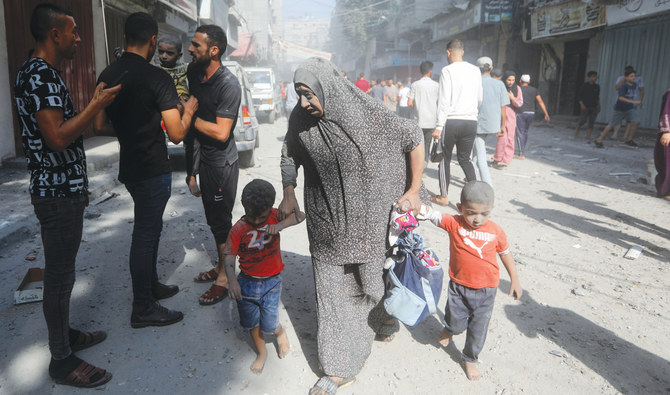
Palestinians evacuate civilians following an Israeli airstrike in the Gaza Strip. The death toll from nearly four weeks of air and artillery strikes has risen past 9,000. (AP)
Short Url
Updated 02 November 2023
Follow

Living conditions in Gaza turning grim under Israeli siege

  • Doctors fear for sanitation and health
  • Clean water is scarcely available

GAZA: Palestinians in Gaza sheltering from an intensifying Israeli bombardment that has killed thousands of people are running out of clean water and face growing health risks with public services at a halt and hospitals closing.

Israel has blocked off all power and fuel supply to Gaza and allowed in only a trickle of food and medicine as it presses its siege and invasion after Hamas’ cross-border attack on Oct. 7.

In Khan Younis, in the south of the tiny, crowded enclave, nine-year-old Rafif Abu Ziyada said she was drinking dirty water and getting stomach pains and headaches.

“There is no cooking gas, no water, we don’t eat well. We are getting sick,” she said. 

“There’s garbage on the ground, and the whole place is polluted.”

Health authorities in the enclave said on Thursday that Israeli bombardment had killed 9,060 people, including 3,760 children. They put several hospitals out of service — even as a mounting ground offensive increases casualty numbers.

Civilians ordered by Israel to leave the northern half of Gaza but also under bombardment in the south are facing ever worse conditions despite the start of some aid deliveries through the Rafah crossing with Egypt last week.

“Water is being used as a weapon of war. Many people are resorting to unsafe sources of water ... Clean water in Gaza is either unavailable or available in very, very small quantities,” said Juliette Touma, a spokesperson for the UN agency for Palestinian Refugees UNRWA.

Israel initially severed all water supply to Gaza after Oct. 7 but says it has restored it in southern areas by reopening lines that provide 28.5 million liters of water a day.

Israeli military officials insist there is enough available water and other supplies for all Gazans, and they were in touch with all UN agencies to track the humanitarian situation.

However, pumps to extract groundwater and desalination plants to treat seawater are out of order because of a lack of electricity. Tankers cannot move water by road without fuel.

“The water is salty. On normal days, you wouldn’t give it to a donkey to drink. But nowadays, you must drink it and let your children drink it,” said Ibrahim Al-Jabalawy, 60.

“There’s no medicine to treat them if they get sick from the polluted water,” he added.

Major hospitals, especially in the northern areas where shelling and fighting are heaviest, are closing because of power cuts, Gaza health authorities say. 

On Thursday, Israel’s army chief signaled a willingness to ease its wartime embargo on fuel for the Gaza Strip imposed over concerns Hamas could seize it, saying that if hospitals there run out they could be resupplied under supervision.

Hospitals that remain open are so full they are turning away some of the wounded and sick or asking them to leave before they are healed. Pharmacies are running out of medicine.

Basic sanitation is deteriorating, with bags of rubbish piling up in the streets between mounds of debris from the rising number of bomb sites.

The population of densely populated Khan Younis, home to a 75-year-old refugee camp, has greatly swelled since hundreds of thousands of people left their homes in the north of Gaza in the teeth of Israel’s offensive.

Hundreds of displaced people cram into UN-run schools, and hospital courtyards function as temporary shelters where people hope the bombardment will be less intense.

Garbage workers fear being out in the streets and cannot reach the main landfills near the frontier with Israel. People forage for firewood to cook depleting reserves of rice and vegetables near mounds of rubbish.

Washing facilities have little water. Toilets get filthier every day. At Nasser Hospital in Khan Younis, people said they struggled to find a working toilet within hundreds of meters of the facility. Those they find are dirty.

Two doctors warned Reuters that there was a growing risk of skin problems such as scabies.


Abbas reiterates opposition to displacement of Palestinians

Russian President Vladimir Putin with Palestinian President Mahmoud Abbas at the Senate Palace of the Kremlin in Moscow. (AP)
Updated 8 sec ago
Follow

Abbas reiterates opposition to displacement of Palestinians

  • During Moscow talks, president calls for immediate halt to Israeli acts of terror
  • Historically, Russia has supported and stood by the Palestinian people at political and diplomatic levels

MOSCOW: The Palestinian National Authority’s President Mahmoud Abbas has reiterated his opposition to all attempts to displace Palestinian people from their land.

Speaking with Russian President Vladimir Putin at the presidential palace in Moscow, Abbas was reported by the Kremlin’s official website as saying that “the Palestinian people are holding on to their land, and we categorically oppose attempts by the Americans and Israelis to expatriate Palestinians beyond Palestinian territory.” 
He said the Palestinian people “will not abandon their land, whatever the cost.” Abbas stressed the need to fully implement US President Donald Trump’s peace plan, leading to the withdrawal of occupation forces and the launch of the reconstruction process.
He emphasized that the Palestinian Authority would assume a central role in administering the Gaza Strip, and that the enclave and the West Bank constituted two parts of a single territorial unit, with a unified and undifferentiated system of civilian institutions.
He stressed the need for an immediate halt to “Israeli settler colonialism and Israeli acts of terror in the West Bank, including Jerusalem, along with the release of withheld Palestinian funds and the cessation of all measures that undermined the Palestinian Authority and the two-state solution.”
He reaffirmed his commitment to continue the struggle for the realization of the Palestinian people’s right to self-determination and of their right to a fully sovereign, independent state based on the borders of June 4, 1967, with East Jerusalem as its capital, while living in security and peace with neighbors.
He told Putin: “What we need is peace, and we hope that with your help and support, we can achieve it — a peace built on the basis of international legal resolutions, decisions of the United Nations, and the principles established following the wars of 1967 and 1973.
“East Jerusalem remains the capital of Palestine, and we know that Russia has always supported — indeed, was the first to support — Palestine, maintaining a firm stance in support of our people.”
Abbas thanked his Russian counterpart for Moscow’s support and commended the bilateral “bonds of friendship” between both countries. He added: “We are friends of Russia and the Russian people. For over 50 years our nations have been bound by a strong friendship that has developed over the decades and continues on the correct path. Russia is a great friend and a nation upon which we rely in many spheres.
“Historically, Russia has supported and stood by the Palestinian people at political and diplomatic levels. Your economic and financial support is both significant in scale and crucial in importance.”
Abbas emphasized moving forward with the implementation of a comprehensive national reform program aimed at consolidating the rule of law, strengthening the principles of good governance, transparency, and accountability, and ensuring the separation of powers.
Putin affirmed Moscow’s “principled and consistent approach” to the Palestinian question.
He said: “We believe that only the establishment and full functioning of the Palestinian state can lead to a lasting settlement of the Middle East conflict.”