

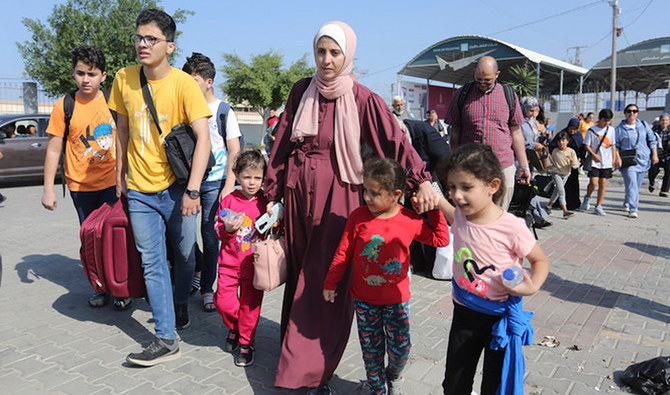
First foreign passport holders leave Gaza for Egypt through Rafah crossing

Palestinians cross to the Egyptian side of the border with the Gaza Strip at Rafah crossing on Nov. 1, 2023. (AP)
Short Url
Updated 01 November 2023
Follow

First foreign passport holders leave Gaza for Egypt through Rafah crossing

  • Convoys of desperately needed aid have passed between Egypt and Gaza but no people have been allowed to cross
  • Some 400 foreigners and dual nationals along with some 90 sick and wounded were expected to leave on Wednesday

RAFAH, Palestinian Territories: Scores of foreign passport holders trapped in Gaza started leaving the war-torn territory on Wednesday as the Rafah crossing to Egypt opened for the first time since the October 7 Hamas attacks, AFP correspondents reported.

Convoys of desperately needed aid have passed between Egypt and Gaza but no people have been allowed to cross. Some 400 foreigners and dual nationals along with some 90 sick and wounded were expected to leave on Wednesday.

Qatar earlier mediated an agreement between Egypt, Israel and Hamas, in coordination with the US, to allow for the movement of foreign passport holders and some critically injured people out of besieged Gaza, a source briefed on deal told Reuters on Wednesday.

The agreement would allow the movement of foreign passport holders and some critically injured people through the Rafah border crossing between Egypt and Gaza, though there is no timeline for how long the Rafah crossing will remain open for evacuation, the source added.

The agreement is not linked to other issues under negotiation such as the hostages held by Hamas, the Palestinian Islamist group that governs Gaza, or pauses designed to ease a humanitarian crisis in the enclave which is suffering from food, water, fuel and medical shortages, said the source.

Israel sent its forces into Gaza following weeks of air bombardments in retaliation for a major attack by Iran-backed Hamas on Oct 7.

Hamas has told mediators it will soon release some of the 200 or so foreign captives it had taken during the attack on Israel, Abu Ubaida, the spokesperson of the group’s armed wing, Al-Qassam Brigades, said in a video on the Telegram app on Tuesday. He gave no further details on the number of captives or their nationalities.


German prosecutors seize assets in Lebanon bank fraud probe

Updated 5 sec ago
Follow

German prosecutors seize assets in Lebanon bank fraud probe

  • They allege that Salameh, acting with his brother Raja, “embezzled funds totalling more than $330 million”
  • The money was laundered through a shell company in the British Virgin Islands

BERLIN: German prosecutors said Thursday they had seized assets worth around 35 million euros ($42 million) as part of a money-laundering probe targeting Lebanon’s former central bank governor Riad Salameh and four other people.
Salameh headed Lebanon’s central bank between 1993 and 2023 and has faced numerous accusations including embezzlement, money laundering and tax evasion in separate probes in Lebanon and abroad.
He has denied any wrongdoing.
Prosecutors in Munich said in a statement that “high-value commercial properties in Munich and Hamburg, as well as shares in a real estate company in Duesseldorf” had been seized as part of their investigation.
They allege that Salameh, acting with his brother Raja, “embezzled funds totalling more than $330 million to the detriment of the Lebanese central bank and thereby at the expense of the Lebanese state, in order to illegally enrich himself” between 2004 and 2015.
The funds originated from financial transactions between the Lebanese central bank and commercial banks in Lebanon.
The money was laundered through a shell company in the British Virgin Islands and used by Raja Salameh and three other co-accused for investments in Germany and elsewhere in Europe, prosecutors say.
A court in Munich will now decide whether the seized property can be permanently confiscated.
German prosecutors opened their investigation in 2021 and have been working with investigators from France and Luxembourg.
Salameh has been accused of being a key culprit in Lebanon’s economic crash, which the World Bank has called one of the worst in recent history, but he has defended his legacy and insisted he is a “scapegoat.”
He was arrested in Lebanon in 2024 and indicted in April 2025 for allegedly embezzling $44 million from the central bank.
In September he was freed after posting more than $14 million in bail and on condition of a one-year travel ban.