

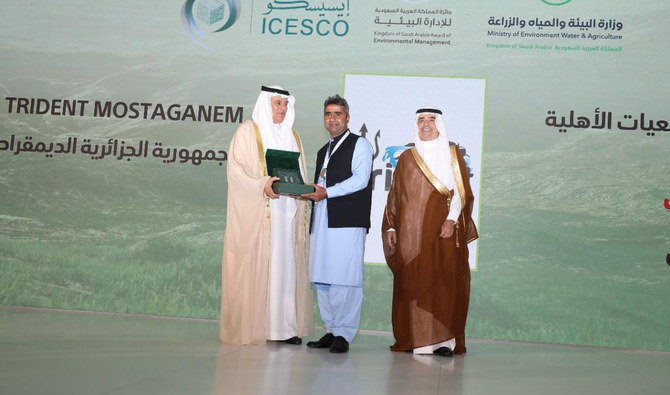

QUETTA: Shams Ullah Durrani, an environmentalist from Pakistan’s southwestern Balochistan province said on Sunday he felt extremely “excited” after becoming the first person from his country to bag the prestigious Kingdom of Saudi Arabia Award for Environmental Management in the Islamic World (KSAAEM) earlier this month.
Durrani, 33, has been involved in planting trees for the past five years in Balochistan’s Quetta, Killa Abdullah and Pishin districts through the ‘Green Balochistan Organization,’ a community volunteer initiative he formed in 2018 to plant trees at schools and other localities, and to spread awareness about the effects of climate change.
Durrani, who hails from Quetta, was among 22 people from 18 Islamic countries who bagged the KSAAEM award on Oct. 19 during the ninth Conference of Environment Ministers in the Islamic World organized by the Islamic World Educational, Scientific and Cultural Organization (ICESCO). The event was hosted by the Saudi government in Jeddah.
Saudi minister for agriculture and environment, Abdulrahman bin Abdulmohsen Al-Fadhli, presented the award to Durrani during the ceremony. His Green Balochistan Organization won the second prize in the category of ‘pioneering practices and activities for public benefit and civil society associations in Member States’ with Yemen’s Environment and Development Organization.
“When I received this award, the level of excitement I felt was too much,” Durrani told Arab News. “I can’t begin to describe my feelings and emotions when I was called to the stage as ‘Shams Ullah from Pakistan.’”
Pakistan has long ranked among the most climate-vulnerable countries, according to the Global Climate Risk Index. It is estimated to have lost nearly 10,000 lives to climate-related disasters and suffered losses amounting to $4 billion from extreme weather events between 1998 and 2018.
Last year, unusually heavy monsoon rains and melting glaciers triggered raging floods in many parts of the country. Over 1,700 people were killed as Pakistan estimated damages from the floods to be around $30 billion.
Durrani said he had been pursuing his “passion” to plant trees and protect the environment from climate-related disasters in Balochistan for five years now.
“I have planted more than 2,000 trees in Quetta and other districts of Balochistan,” he said. “I have been keenly taking care of trees and saplings like [how you care for] small babies which I have planted in various government schools in Balochistan’s capital.”
The environmentalist said he had engaged over 600 students from grade 7-10 in the Government Boys High School Pashtoonabad and the Government Boys High School Hajji Ghaibi Road in Quetta over the past five years to spread climate awareness with various activities and campaigns.
Hafiz Abdul Rehman Kakar, vice principal of the Government Boys High School Hajji Ghaibi Road, lauded Durrani for planting trees within the school’s vicinity and encouraging students to do the same.
“Mr. Shams Ullah has been visiting this school for the last five years and educating our children on [the effects of] climate change,” Kakar told Arab News.
“We have planned to plant additional trees and saplings in the coming spring season to impart a healthy environment to our students.”
Durrani, however, lamented that neither the provincial nor federal government contacted him after he returned with the KSAAEM award.
“I was expecting that I would receive a warm welcome back home after returning from Saudi Arabia, but officials working in the environment sector did not contact me,” he said.
Aftab Ahmed, a 16-year-old ninth grader from the Government Boys High School Hajji Ghaibi Road, said he regularly brings a bottle of water with him to school to plant trees and provide water to existing ones.
“We have been protecting these trees for the last one-and-a-half year,” he told Arab News.
“There wasn’t a single tree inside our school but today there are many, giving us a scenic environment and providing a shadow for us during the hot sunny days of summer.”


