

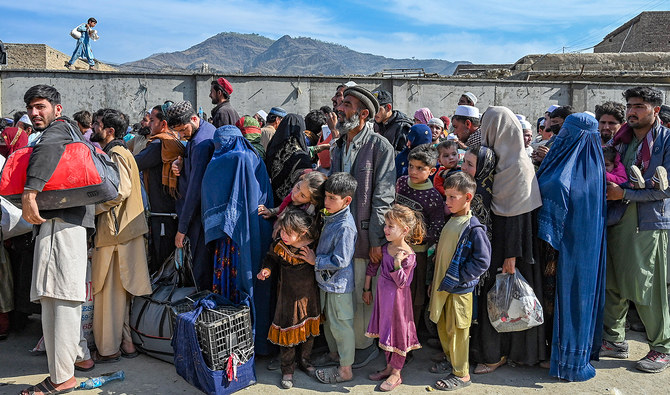

TORKHAM: Maroza Bibi and her children are among hundreds of Afghans waiting at the Pakistani border, hurriedly leaving a country she has called home for decades in fear of arrest.
Islamabad has issued an order to 1.7 million Afghans it says are living in the country illegally to leave by November 1, or be deported.
A series of holding centers are being established across the country in preparation for the Wednesday deadline in what rights groups and lawyers say is an unprecedented crackdown.
“I am taking a lot of good memories. I was expecting Pakistan to give us nationality, but that did not happen, compelling us to go back almost empty-handed,” Bibi, 52, told AFP at the Torkham crossing in Khyber Pakhtunkhwa province on Friday.
She was around 10 years old when her family fled the Soviet war in Afghanistan, settling in Kashmir where she raised a family and where her husband is buried.
Millions of Afghans have crossed the border during decades of conflict, making Pakistan the host of one of the world’s largest refugee populations.
But relations have steadily soured between the two countries since the Taliban government seized power in August 2021 and imposed their austere version of Islamic law.
Hundreds of thousands of Afghans are estimated to have crossed the border since then.
Pakistan has said the deportations are to protect the “welfare and security” of the country, where anti-Afghan sentiment has been growing amid prolonged economic hardship and a rise in cross-border militancy.
Although the deadline to leave is still days away, police have already begun raiding communities and detaining Afghans, with lawyers reporting indiscriminate arrests and extortion.
Zulfiqar Khan was born to refugee parents in a sprawling Peshawar aid camp, where generations of Afghans have settled in semi-permanent homes.
Like many others AFP spoke with, he knew little about the documentation process and believed he would eventually be granted Pakistani nationality.
“To avoid any humiliation by the Pakistani authorities I have decided to leave,” he told AFP at the border.
“I am leaving Pakistan with a heavy heart and a state of acute mental stress. I have no idea about life in Afghanistan, I know nothing about any possibility of re-starting my business there.”
On Friday, hundreds of families carrying bundles of belongings crowded the border post waiting to cross, some hoping to convince officials to let them take live chickens with them.
“Women at the border are facing a lot of problems, especially the pregnant women and people with disabilities, you can see they are waiting for their turn for hours,” Hakeem Ullah, a border official, told AFP.
More than 2,000 people are being processed each day, authorities have said, although most are laborers and traders who cross frequently back and forth.
About 60,000 Afghans have “voluntarily” left the country through the border in recent weeks, Feroz Jamal, a spokesman for the Khyber Pakhtunkhwa provincial government, told AFP.
Around 1.3 million Afghans are registered refugees and 880,000 more have legal status to remain in Pakistan, according to the United Nations.
Islamabad says a further 1.7 million Afghans are in Pakistan illegally.
“Everyone is frightened of arrest and deportation,” Fazal Ahmed, a 40-year-old fruit vendor who came to Pakistan when he was four years old, told AFP at a Karachi aid camp on Thursday.
“I consider myself Pakistani as I have never been back to Afghanistan, but now we are counting down the days in fear.”
Afghans will only be allowed to cross the border with limited belongings and 50,000 Pakistani rupees ($178), and they must leave their livestock behind.
“Our money is stuck here. All our lifetime earnings and savings are stranded here. We have established businesses here, but they don’t care,” said Karachi camp resident Khan Mohammad, pleading for authorities to give Afghans more time to leave.
Afghanistan is struggling through its own economic hardship, cut off from the international banking system and heavily reliant on humanitarian aid, particularly as the bitter cold winter months set in.


