

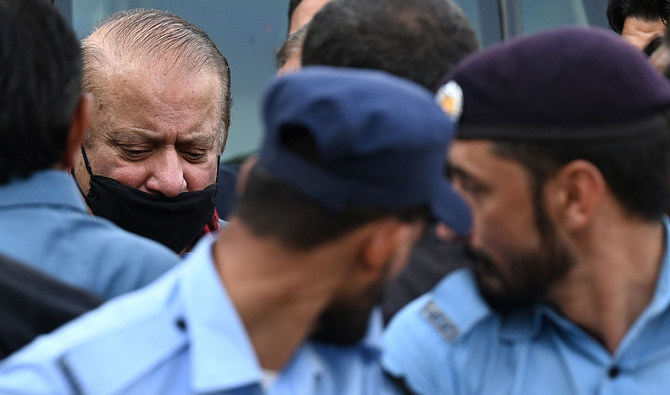

Islamabad: A Pakistani high court on Thursday restored former prime minister Nawaz Sharif’s appeals against his conviction in two separate corruption cases, after the country’s anti-corruption watchdog said it did not object to the decision.
Sharif was sentenced to 10 years in prison in one case and slapped with a seven-year imprisonment sentence in another, namely the Avenfield and Al-Azizia references respectively. His appeals against the convictions were dismissed in 2021 as he did not appear before court hearings.
The former three-time prime minister traveled to London in 2019 for medical treatment after securing an eight-week bail from the court. He returned to Pakistan on Oct. 21 four years later after securing a protective bail in the graft cases and filed appeals in the Islamabad High Court (IHC) requesting the judiciary to revive his appeals.
In the last hearing on Oct. 24, IHC extended Sharif’s bail until Oct. 26 as it sought a response from the National Accountability Bureau (NAB) on the graft cases.
“We will not raise any objection to the revival of [Sharif’s] appeals in the first phase,” NAB Prosecutor General Ihtisham Qadir Shah told a divisional bench, led by IHC Chief Justice Amir Farooq during the hearing.
“If the appeals are restored, we will have a robust stance to present in court after going through the evidence,” the prosecutor general said. He reiterated NAB’s stance that it did not want to arrest Sharif in the two cases.
Shah said that since Sharif, the proclaimed offender, had surrendered before the court, his appeals could be restored for further hearings.
He clarified in court that the accountability watchdog did not harbor any bias against the accused, adding that it was committed to presenting evidence in court, irrespective of whether it favors Sharif or not.
Sharif appeared before the court with his legal team comprising former law minister Azam Nazir Tarar and advocate Amjad Pervez, besides senior leaders of his Pakistan Muslim League-Nawaz (PML-N) party.
During the hearing, Shah argued that the references in these cases could not be withdrawn at this stage as this could only have been done during the trial.
“If an appeal against a judgment is admitted [in a court], then the case cannot be withdrawn as per Pakistani law,” the prosecutor general said. He said the court would have to decide on the matter.
Pervez argued that the court had already acquitted Sharif’s co-accused and his daughter, Maryam Nawaz, in the cases as the prosecution had failed to prove its claims.
“The court had written in the judgment that NAB failed to prove the role of Nawaz Sharif in these cases,” he argued.
Sharif arrived in Pakistan on Oct. 21 to lead the PML-N in the upcoming general elections as it gears up for a tough contest against his jailed rival and ex-PM Imran Khan, arguably the most popular politician in Pakistan currently.
Upon his return to a massive homecoming rally in front of thousands in Lahore on Oct. 21, Sharif assured his supporters he had not returned to exact revenge on his opponents and vowed to work for Pakistan’s progress.


