

‘We are hurt,’ says shaken Pakistan skipper Azam 

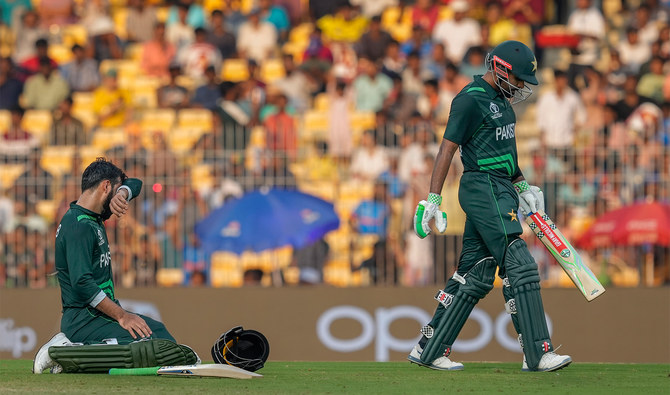
Pakistan's Shadab Khan, left, reacts as his batting partner Babar Adam leaves the ground after being dismissed during the ICC Men's Cricket World Cup match between Pakistan and Afghanistan in Chennai, India, onn October 23, 2023. (AP)
Short Url
Updated 23 October 2023
Follow

‘We are hurt,’ says shaken Pakistan skipper Azam 

  • Afghanistan achieved their first-ever one-day victory over Pakistan in eight attempts as they chased down 283 runs 
  • Despite Monday’s shock, Azam stresses Pakistan can still qualify for semifinals, urges his side to ‘learn from defeat’ 

Chennai: Visibly shaken Pakistan captain Babar Azam admitted “we are hurt” after his team was stunned in an eight-wicket defeat by Afghanistan at the World Cup on Monday which put their semifinals hopes in peril. 

Afghanistan achieved their first-ever one-day victory over Pakistan in eight attempts as they chased down a 283-run target with an over to spare. 

Ibrahim Zadran hit a brilliant 113-ball 87 while fellow opener Rahmanullah Gurbaz made a 53-ball 65 to build a strong platform, putting on 130 for the first wicket. 

Rahmat Shah’s unbeaten 84-ball 77 and skipper Hashmatullah Shahidi’s 48 not out sealed victory against a sloppy Pakistan team. 

“We are hurt as a team,” said Azam whose side now have three defeats and two wins in five matches. 

They face a formidable South Africa at the same Chennai venue on Friday. 

“We must feel the disappointment and my message to my team for the remaining matches will be to learn from this defeat,” said Azam, whose 74 off 95 balls aided by opener Abdullah Shafique’s 58 guided Pakistan to 282-7 after they won the toss and batted. 

“We achieved what we set out to do when we batted but we were not up to the mark in bowling and fielding,” said Azam whose bowlers conceded 17 boundaries in the first 16 overs. 

“We failed to put them under pressure but I congratulate Afghanistan for this victory.” 

Afghanistan, who played four specialist spinners on Monday, also now have two wins in five matches. 

“Afghanistan’s spinners are of good quality so the plan was to not give them wickets until the 40th over and then charge in the last ten but we fell some 10-15 runs short,” said Azam. 

Noor Ahmad, 18, was the pick of the Afghanistan spinners with 3-49 on his World Cup debut while the more experienced slow bowlers, Rashid Khan and Mujeeb Ur Rahman went wicketless. 

Despite Monday’s shock defeat, Azam stressed Pakistan can still qualify for the semifinals. 

“From now on we need to play our best cricket in all departments and must overcome our mistakes.” 

Azam admitted that the team is suffering from the absence at the tournament of fast bowler Naseem Shah who was ruled out of the World Cup with a shoulder injury. 

“Of course, Naseem is missed badly because he had been part of our scheme but overall our bowling has not clicked,” said Azam. 

“We knew there are no margin for error on these grounds and we failed to execute plans.” 

He added: “We have been perfect in training but I think our bowlers over-tried in matches and have leaked runs. We need to focus on positives and adopt a different mind-set.” 


Sindh regulator gives Karachi builders three days to fix fire risks after mall inferno

Updated 4 sec ago
Follow

Sindh regulator gives Karachi builders three days to fix fire risks after mall inferno

  • Sindh Building Control Authority issues the warning after Gul Plaza fire death toll rises to 28
  • The building regulator partially closes an adjacent mall after damage caused by falling debris

KARACHI: Sindh’s building regulator on Tuesday gave owners and builders three days to address fire safety deficiencies in commercial and residential buildings, after a devastating blaze at a multistory shopping plaza in Karachi killed at least 28 people, with dozens still unaccounted for.

The Sindh Building Control Authority (SBCA) issued the ultimatum in a letter to the Association of Builders and Developers (ABAD), a leading body representing construction firms, citing fire safety audit reports by the Karachi Metropolitan Corporation and warning that failure to comply would trigger legal action under provincial building laws.

The move comes as rescue teams continue to search the wreckage of Gul Plaza, where a fire broke out late on Saturday and burned for more than 24 hours before being brought under control.

Large sections of the building collapsed during the blaze, complicating rescue efforts and forcing authorities to deploy heavy machinery to clear debris. Officials say dozens of people, mostly shop owners and customers, remain missing.

“Since SBCA will not be able to achieve the desired objectives [of strengthening fire protection mechanisms] without the cooperation of your members in this matter, you are therefore requested to direct your members to immediately comply with the fire safety deficiencies highlighted in the audit reports within three (03) days, as this is an urgent matter requiring immediate compliance,” the authority said in the letter shared by Karachi Mayor Murtaza Wahab on social media.

Rescuers recovered five more bodies on Tuesday, taking the confirmed death toll to 28, while DNA testing is being used to identify victims burned beyond recognition, police and medical officials said.

The SBCA has also issued a separate notice declaring Rimpa Plaza, another commercial building in the city’s District South, unsafe after damage caused by falling debris during the Gul Plaza fire. Authorities ordered its partial closure until repairs and structural strengthening are carried out under expert supervision.

Karachi, Pakistan’s largest city and commercial hub, has a long history of deadly fires, often blamed on poor safety standards, illegal construction and weak enforcement.

In November 2023, a shopping mall fire killed 10 people, while one of the country’s deadliest industrial disasters occurred in 2012, when a blaze at a garment factory killed at least 260 workers.

Provincial officials say inspections and enforcement will be stepped up in the coming days, but safety advocates argue lasting change will depend on sustained oversight and accountability beyond emergency directives.