

Saudi Arabia’s National Transformation Program drives 750 economic reforms for private sector development

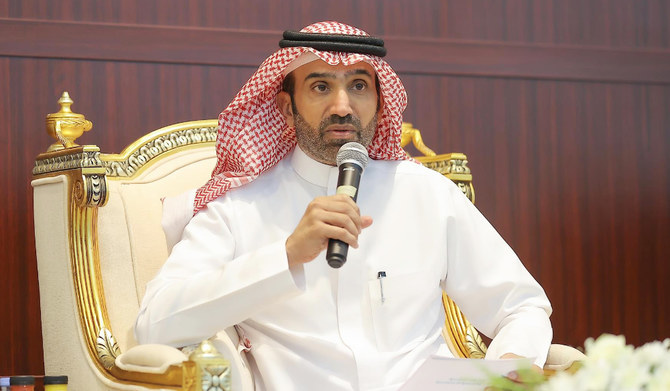
During his address at the UN’s annual Empretec meeting held in Riyadh, Minister of Human Resources and Social Development Ahmed Al-Rajhi discussed the improvements in global indicators through the “Invest in Saudi Arabia” program and the foreign direct investment totaling SR 22.5 billion ($6 billion) by the third quarter of 2022. SPA
Short Url
Updated 23 October 2023
Follow

Saudi Arabia’s National Transformation Program drives 750 economic reforms for private sector development

RIYADH: In an effort to develop the private sector, over 750 economic reforms will be implemented by Saudi Arabia’s National Transformation Program, according to a statement.

Launched in 2016, the initiative was the first Vision Realization Program established under Vision 2030.

During his address at the UN’s annual Empretec meeting held in Riyadh, Minister of Human Resources and Social Development Ahmed Al-Rajhi discussed the improvements in global indicators through the “Invest in Saudi Arabia” program and the foreign direct investment totaling SR 22.5 billion ($6 billion) by the third quarter of 2022, according to a press release.

Al-Rajhi emphasized the impressive achievements under Vision 2030, where the number of small enterprises doubled, exceeding 1.1 million by the end of 2022. 

He also underscored the decline in unemployment to 8.3 percent, resulting in the creation of over 2.3 million jobs in the private sector, with 700,000 of them filled by women, accounting for 36 percent of the workforce.

The meeting, organized by the Social Development Bank, brought together prominent figures such as Rebecca Greenspan, the secretary-general of the UN Conference on Trade and Development, Stephen Groff, the governor of the National Development Fund, and Ibrahim Al-Rashed, CEO of Saudi Arabia’s Social Development Bank, alongside other senior government officials and international experts.

Al-Rashed expressed his gratitude for collaborating with 35 members of the Empretec program, showcasing their diverse experiences.

He emphasized the bank’s role in establishing key pillars, including support for productive families, small and emerging enterprises and developing the bank’s branch system into a business incubator. Six new branches were opened this year, with 17 more projected for the upcoming year and the imminent launch of the largest business centers in Saudi society.

The forum covered dialogues on innovation, technical services, and research skills to enhance economic sustainability and innovation in alignment with Saudi Vision 2030.

Partnerships were formed to support entrepreneurship and logistics services, including educational resources and youth engagement programs, marking a significant milestone in Saudi’s entrepreneurial journey and reaffirming the commitment to Vision 2030 goals.

“Invest Saudi” is Saudi Arabia’s nationwide investment attraction and promotion brand. Under the oversight of the Ministry of Investment, it facilitates investments in the Kingdom that support the country’s economic growth and position it at the forefront of the global business world.

The initiative is designed to provide a clear, unified, and effective message about the Kingdom’s opportunities for foreign and domestic investors and private sector businesses.


Marine insurance companies are considering canceling, repricing policies in the Middle East

Updated 6 sec ago
Follow

Marine insurance companies are considering canceling, repricing policies in the Middle East

RIYADH: Marine insurance companies are considering canceling or repricing policies in the Middle East, according to the Financial Times

This comes after the US and Israeli strikes on targets inside Iran, followed by missile attacks and retaliatory military actions in several countries in the region.

Marine brokers expect insurance premiums for ships to rise by up to 50 percent, given the region’s classification as a “war zone.”

Ship owners are considering rerouting their vessels to avoid the Strait of Hormuz and reduce risks to crews and cargo.

20% of the global oil supply passes through the Strait of Hormuz.

Regarding oil prices, a rise is expected as 20 percent of global oil supply passes through the Strait of Hormuz, amid concerns about continued tensions in the region.

Air traffic in the Middle East was severely disrupted after several countries closed their airspace completely or partially, while regional and international airlines suspended or rescheduled flights.

On the morning of March 1st,  the Iranian capital, Tehran, witnessed several large explosions following Israel's announcement of what it described as a “preemptive strike.”

Flights to countries in the region suspended due to attacks

In a video message, US President Donald Trump announced that the US had begun “major combat operations” in Iran, asserting that the goal was to defend the American people by neutralizing what he described as the “imminent threat” from the Iranian regime.

Several regional and international airlines announced the suspension of their flights to some countries in the region due to the attacks.

These military developments come at a time when major shipping companies had already avoided the Red Sea and Suez Canal routes due to security tensions, reverting to the Cape of Good Hope route, which increases shipping costs and puts pressure on global supply chains.

With the closure of airspace in several countries in the region, the risk of disruption to air traffic and trade is increasing, while oil markets are watching closely for any signs of potential supply disruptions from a region that is one of the world's most important energy production hubs.