

Afghanistan send Pakistan crashing to shock World Cup defeat 

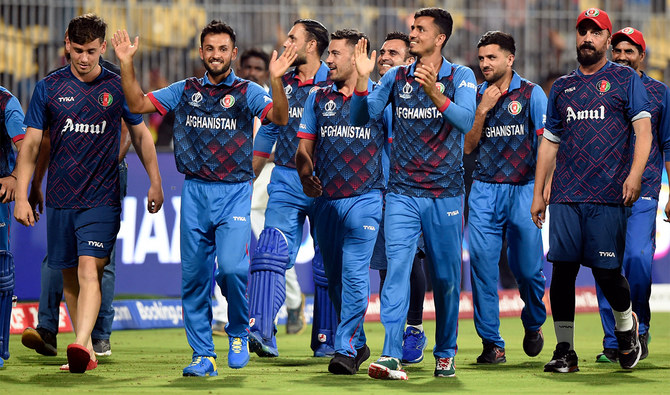
Afghanistan players and staff celebrate after winning the match against Pakistan at MA Chidambaram Stadium in Chennai, India, on October 23, 2023. (REUTERS)
Short Url
Updated 23 October 2023
Follow

Afghanistan send Pakistan crashing to shock World Cup defeat 

  • Chasing 283, Afghanistan were lifted by Ibrahim Zadran (87), Rahmat Shah (77 not out) as they scored 286-2 
  • Pakistan had made 282-7 in their 50 overs with 74 from skipper Babar Azam, 58 from opener Abdullah Shafique 

CHENNAI: Afghanistan put on a superb batting and bowling display to hand Pakistan a stunning eight-wicket defeat in the Cricket World Cup on Monday. 

Chasing a 283-run target, Afghanistan were lifted by Ibrahim Zadran (87), Rahmat Shah (77 not out) and Rahmanullah Gurbaz (65) as they scored 286-2 in 49 overs. 

Pakistan had made 282-7 in their 50 overs with 74 from skipper Babar Azam and 58 from opener Abdullah Shafique but the total did not prove tough enough for a clinical Afghanistan. 

Skipper Hashmatullah Shahidi, with a 45-ball 48 not out, hit the winning boundary as Afghanistan improved upon their highest ODI chase of 274 against the UAE in Dubai in 2014. 

The win is Afghanistan’s first-ever over Pakistan in eight ODIs and came eight days after their shock victory over defending champions England in Delhi. 

The defeat leaves Pakistan’s World Cup campaign in disarray with three defeats in five games and a formidable South Africa to face at the same venue on Friday. 

In contrast, Afghanistan’s campaign is slightly revived with two wins in five matches and struggling Sri Lanka as their next opponents in Pune on Sunday. 

Pakistan were sloppy in the field as they conceded easy boundaries with openers Zadran and Gurbaz taking their side to 100 in the 16th over. 

The pair put on 130 by the 22nd over and it was only a miscued shot from Gurbaz off Shaheen Shah Afridi that brought Pakistan their first wicket. 

Gurbaz hit nine boundaries and a six in his 53-ball knock while Zadran scored 10 boundaries off 113 deliveries before handing a catch behind off Hasan Ali with 93 still needed. 

Rahmat and Shahidi ensured Afghanistan did not collapse. 

Rahmat hit five fours and two sixes in his 84-ball stay at the crease. 

Earlier, Azam hit a stylish half-century to guide his team to a fighting total after he won the toss and batted first. 

Azam’s 92-ball knock was complemented by Shafique’s 75-ball 58 while Shadab Khan and Iftikhar Ahmed scored a valuable 40 runs apiece. 

On a spin-friendly Chidambaram Stadium pitch, Afghanistan fielded four slow bowlers with 18-year-old left-armer Noor Ahmad grabbing a career best 3-49 on his World Cup debut. 

Shadab added a rapid 73 runs with Iftikhar for the sixth wicket as Pakistan took 61 off the last five overs, with Shadab falling off the last delivery. 

Iftikhar cracked four sixes and two fours while Shadab’s innings featured a six and a four. 

Pakistan enjoyed a strong start with a 56-run stand before Azmatullah Omarzai dismissed Imam-ul-Haq for 17 in the 11th over. 

Ahmad struck his first blow when he trapped Shafique for 58 in the 23rd over. 

Shafique hit two sixes and five fours in his third half-century of the World Cup. 

Ahmad then dismissed Pakistan’s top scorer in the World Cup, Mohammad Rizwan, caught sweeping in his next over to leave Pakistan on 120-3. 

Azam also fell to Ahmad when the Pakistan skipper played a tennis-like shot to a delivery that was seemingly out of his reach, ending up hitting it straight into the hands of Mohammad Nabi at extra cover. 

Azam added 43 with Saud Shakeel who made 25. 

Afghan spinner Rashid Khan went wicketless in his 10 overs but conceded just 41 runs, while pacer Naveen-ul-Haq took 2-52. 


Pakistan engages Saudi Arabia, China in bid to ease surging Middle East tensions 

Updated 10 March 2026
Follow

Pakistan engages Saudi Arabia, China in bid to ease surging Middle East tensions 

  • Pakistan’s foreign minister stresses need for de-escalation in conversations with Chinese, Saudi counterparts
  • Tensions in the Middle East continue to remain high as conflict between US, Israel and Iran intensifies

ISLAMABAD: Pakistan’s Deputy Prime Minister Ishaq Dar spoke to the foreign ministers of Saudi Arabia and China on Tuesday, stressing the importance of diplomatic engagement to de-escalate tensions in the Middle East as the Iran war intensifies. 

Pakistan has constantly engaged regional countries in efforts to broker a ceasefire in the Middle East, after the US and Isreal launched coordinated strikes against Iran on Feb. 28. 

Iran launched fresh attacks on Gulf countries on Tuesday morning, where it has targeted US military bases in recent weeks. In addition to firing missiles and drones at Israel and American bases in the region, Iran has also been targeting energy infrastructure which, combined with its stranglehold on the Strait of Hormuz, has sent oil prices soaring worldwide. 

Dar spoke to Saudi Foreign Minister Prince Faisal bin Farhan to discuss developments in the Middle East and ongoing deliberations at the UN Security Council, Pakistan’s foreign office said in a statement. 

“DPM/FM shared Pakistan’s perspective, underscoring the importance of continued coordination and diplomatic engagement to support de-escalation and promote peace and stability across the region and beyond,” the statement said. 

Dar, who also serves as Pakistan’s foreign minister, spoke to Chinese foreign minister Wang Yi over the telephone separately. The two discussed the evolving regional situation and broader global developments.

Dar underscored the need to ease tensions in the Middle East and the wider region during the conversation, the foreign office said. 

Yi appreciated Pakistan’s constructive efforts aimed at promoting de-escalation and stability in the region, it added. 

“The two leaders stressed the importance of de-escalation and emphasized the need to pursue dialogue and diplomacy in accordance with the principles of the UN Charter,” the foreign office’s statement said. 

The conflict in the Middle East has hit Pakistan hard as well, forcing Islamabad to hike petrol and diesel prices by Rs55 per liter last Friday. 

Pakistan’s government has also announced a set of austerity measures, which include closing schools and cutting down on government expenditures, as it evaluates petrol stocks and looks for alternative supply routes.