



KARACHI: Pakistani actress Amtul Baweja, who plays the lead role in the short film ‘Solatia,’ said on Saturday she is “very excited” that the project has gained entry into the Red Sea Film Festival scheduled to begin in Jeddah next month.
Solatia is one of only two Pakistani short films, out of a total of 14 entries, in the Red Sea: Shorts Competition at the festival’s third edition set to take place from Nov. 30 to Dec. 9.
The Pakistani short film, directed by a woman filmmaker and co-produced by another, will compete with entries from Germany, Indonesia, the US, Iran, and South Africa at the festival.
“I’m very, very excited, because it happens to be our first submission,” Baweja told Arab News. “And of course, getting selected on your first submission is, I think, a win in itself.”
Baweja described the festival as one of the most prestigious ones in the world, adding that a win for the short film would be “unbelievable.”
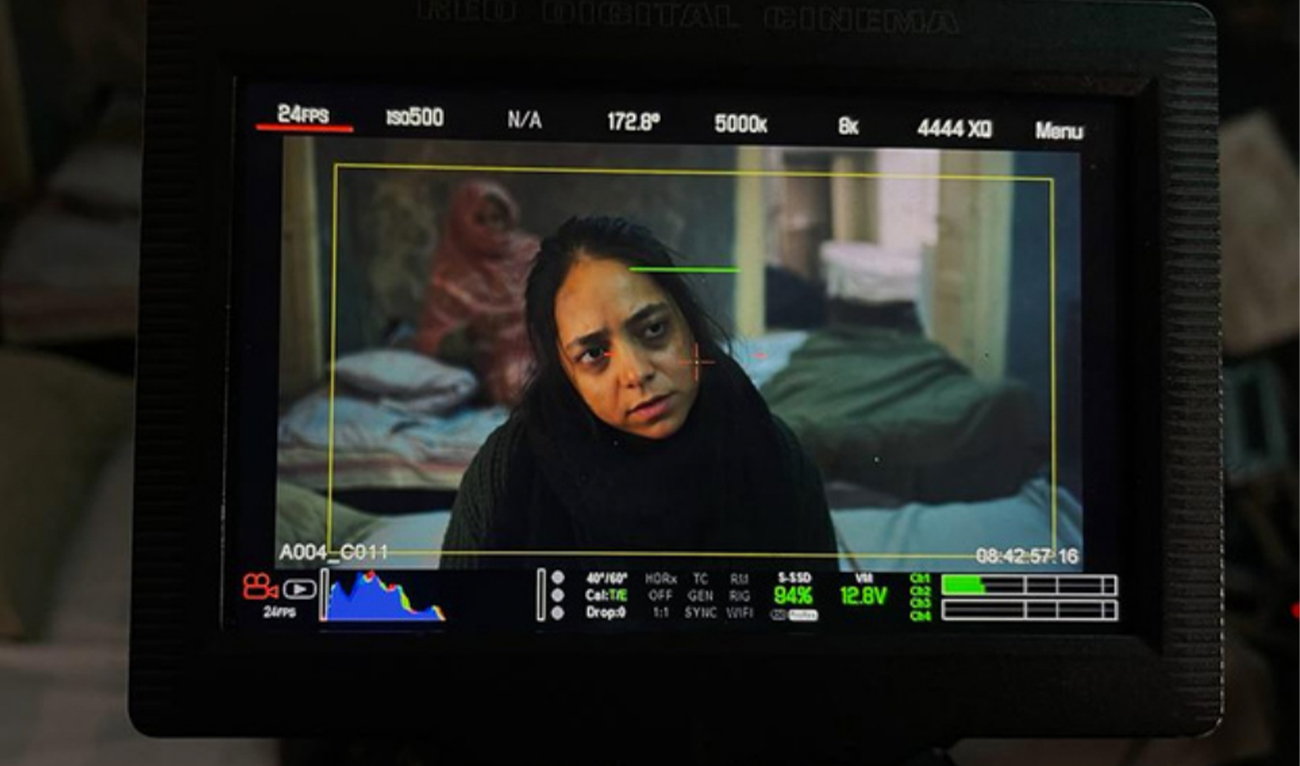
The undated picture shows Amtul Baweja, who plays the lead role in the short film ‘Solatia,’ is seen filming a scene in Lahore, Pakistan. (Photo courtesy: Solatia)
Solatia is a female-led drama directed by Pakistani filmmaker Hira Yousafzai and co-produced by Hirra Farooqi. It focuses on the main character Zamda, essayed by Baweja, who lives in a shelter with other displaced persons. Zamda, in despair, spends her time looking through old photos of her missing husband as she longs for his company.
Despite losing everything, Zamda is a strong character, Baweja said.
“You can see from the start that Zamda is a very, very strong woman,” Baweja explained. “She’s not afraid to stand up for what’s right.”
Farooqi, who said the themes of love, loss, resilience and hope were deliberately included in the film, especially in the context of displacement.
She explained that in most films, women were shown to be waiting for ” a significant other” or their partner to save them.
“Zamda is compelling and different in this context,” Farooqi explained. “She is looking for her husband, she is the one who was asking for answers and demanding them.”
Farooqi, a first-generation Canadian immigrant who has Afghan-Pakistani parents, said displaced people are merely looked at as numbers and often not humanized.
“We wanted to humanize their stories by tying in these themes of hope, love, loss, resilience, through the characters and through the compassion that they feel for one another,” she said.
Baweja said she was drawn to the project not only because of its compelling narrative but also because it was directed and produced by women.
“As soon as I read the script, I was like, ‘Okay, I need to do this, I need to make this happen. I want to do this.’ And I think wherever this film will be played, people will relate to it,” she added.
For Baweja, the Red Sea Film Festival will also provide an opportunity to meet and interact with filmmakers and artists from the kingdom and other parts of the world.
“I think they will bring their own flavor,” she said. “You know, they will learn from us, we will learn from them.”
She said the Red Sea Film Festival was a great way to show the world that the Middle East and the Muslim world were heading in the right direction.
“If you look at Saudi Arabia itself, in recent years, they have been taking a lot of initiatives, they’re collaborating with content creators,” she said.
“They’re opening the country for tourism, for travel. They’re taking a lot of initiatives toward arts, culture.”
Farooqi also praised the Red Sea Film Festival, saying it had become one of the biggest festivals in the Middle East and North Africa (MENA) region and beyond.
She expressed happiness that Muslim countries were finally focusing on representing their narratives.
“It’s so great to see that we are finally recognizing the importance of representation on screen,” Farooqi said.
“These countries are encouraging their filmmakers, the youth to take control of their own narrative and to tell their stories because oftentimes we see our stories are told by other people,” she said.


