

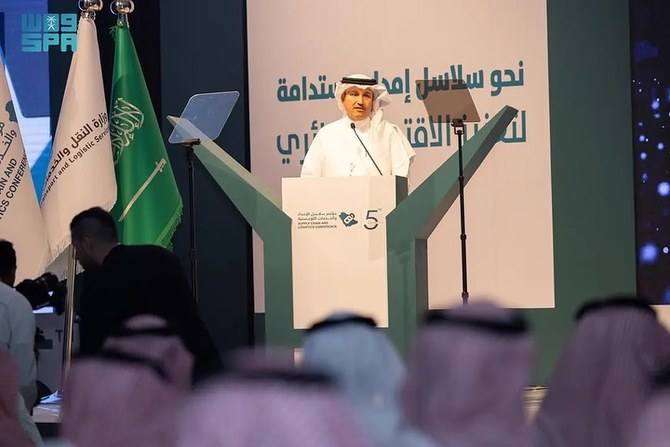

RIYADH: As many as 52 agreements were signed in Riyadh to strengthen the Kingdom’s supply chain and logistics sector which is witnessing “unprecedented” growth, according to Saleh Al-Jasser.
The minister of transport and logistics services, who inaugurated the two-day Supply Chains and Logistics Services Conference, attributed the growth of the sector to the Kingdom’s visionary leadership’s support.
Al-Jasser said progress has been visible in the sector since the launch of the National Transport and Logistics Strategy, which seeks to transform Saudi Arabia into a global logistics hub by effectively utilizing its strategic location.
He said the Kingdom has introduced several initiatives to enhance the sector’s performance, re-engineer processes, and implement international best practices to consolidate its position as a global logistics hub.
The minister said in a short span, “an integrated private zone was launched at King Khalid International Airport, Apple was announced as the first investor in it, and 19 logistics zones were launched in all regions of the Kingdom.”
The integrated logistics zone will contribute to raising Saudi Arabia’s annual cargo volume from the current 0.5 million tons to 4.5 million tons by 2030, in alignment with the Kingdom’s Vision 2030, he said.
Al-Jasser also said the Kingdom’s logistics industry has made considerable strides this year, moving up 17 spots in the World Bank’s Logistics Performance Index from 55th to 38th.
He said international and local investors are taking a keen interest in the sector. “In the past two years, many agreements were signed to establish 12 logistics parks,” Al-Jasser said.
These logistic zones are located at Jeddah Islamic Port, Dammam’s King Abdulaziz Port, and King Fahd Industrial Port in Yanbu, with a total investment of approximately SR4.2 billion, set to create over 13,000 direct and indirect jobs in the logistics sector.
Highlighting developments in the transportation sector, the minister said the Kingdom’s railway sector has also made substantial progress. He said over 12 million tons of goods have so far been transported via rail service in the Kingdom representing a 13 percent growth compared to the same period in 2022.
The expansion of rail transportation also helped reduce around 970,000 truck journeys on the roads, he added.
In the first half of the year, the Kingdom’s air transport sector also experienced substantial growth in air traffic, passenger numbers, and air cargo operations, aligning with the aviation strategy which aims to increase air cargo capacity to 4.5 million tons and expand air connections to 250 destinations by 2030.
Al-Jasser added: “The great progress in the logistics sector came with the support and empowerment of Crown Prince Mohammed bin Salman, and his continuous support to strengthen the Kingdom’s position as a global logistics center in accordance with the targets of the National Strategy for Transport and Logistics.”
He also said the performance of the ports can also be gauged through the London-based maritime journal Lloyd’s List classification of the world’s 100 largest ports by container handling volumes. As per its ranking, Saudi Arabia jumped eight spots internationally, the minister said.
In the opening session, Mohammed Al-Shammary, vice president at Saudi Aramco, said the Kingdom has launched many ambitious plans and programs to achieve sustainability and reach net-zero emissions including the Saudi and Middle East green initiatives.
He said the oil giant fully supports the Kingdom’s strategy to diversify its energy mix.
Talking about the company’s role in the logistics sector, he said: “Saudi Aramco is building the first digital twin in supply chains in the world to maintain our role in innovation and following international standards.”
Speaking during a panel discussion, Minister of Industry and Mineral Resources Bandar Alkhorayef noted how positively surprised he is by the capabilities of the Kingdom, and how proud he is of the efficiency and speed of national companies in delivering their products to the markets.
“The Kingdom is an important player in the fertilizer sector around the world,” Alkhorayef said.
“Supply chains are an essential and enabling part of the industrial sector.”
Alkhorayef further explained the two key factors that the Kingdom’s capabilities are built on: natural resources (oil and gas in Saudi Arabia’s case) and the country’s ability to build on these capabilities for the daily needs of food, medicines, and supplies.
He said it was evident during the coronavirus disease pandemic during which almost all countries around the world were hit by food and medicine shortages but Saudi Arabia remained unaffected by those issues.
Al-Jasser also emphasized the importance of aligning with Saudi Vision 2030, which is centered on achieving economic diversification.
He stressed the need for increased participation in value chains as a key strategy to drive economic growth and development in the Kingdom.
This underscores the government’s commitment to expanding beyond traditional sectors, diversifying the economy, and fostering a more sustainable and robust economic future.
The first day of the conference featured panel discussions and witnessed the signing of many memorandums of understanding.
The MoUs, signed in the presence of both ministers, included a joint cooperation between the University of Tabuk and Saudi Co. for Electronic Information Exchange, known as Tabadul.
An agreement was signed between the General Transport Authority and Saudi-listed National Gas and Industrialization Co., also known as GASCO, to support localization.
The two-day conference also features an exhibition, and specialized workshops, along with a section dedicated to financing solutions, and various additional activities.
Saudi Arabia’s logistics sector is showcasing its most prominent advancements and technical solutions it has developed at the industry event.
Participating in the conference, the Public Transport Authority is exhibiting its unified logistics platform that provides over 70 electronic services to facilitate investors’ access to logistics services through a single window.
Called Logisti, the single window platform is one of the transport and logistics initiatives under the National Industrial Development and Logistics Program that offers critical commercial activities through the land, sea, and rail transport sectors, reported the Saudi Press Agency.
The SPA added that the event is also presenting the Saudi Logistics Academy, a transport authority initiative that creates national competencies on par with the best international standards.
The conference was attended by several ministers, senior officials, and heads of companies operating in the supply chains and logistics sector.
It featured over 100 organizations from the public and business sectors, as well as 64 speakers from different nations.


