

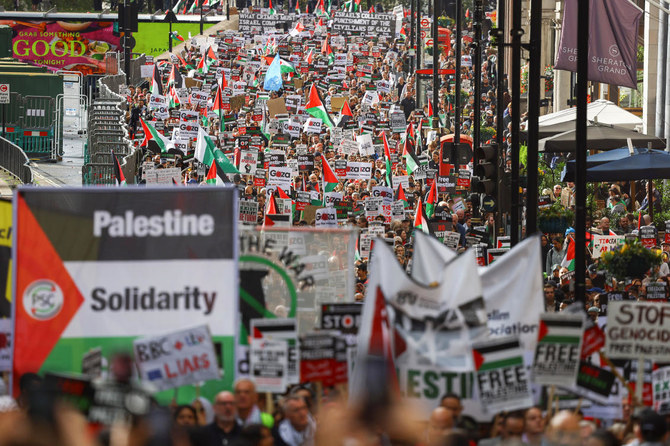

LONDON: Police in London said nearly 100,000 people marched in the capital Saturday in an event organized by pro-Palestinian groups calling for “an end to the war on Gaza.”
Marchers held signs reading “Freedom for Palestine” and “Stop Bombing Gaza” and “End Israeli Apartheid.” Many waved Palestinian flags and some chanted “5, 6, 7, 8, Israel is a terrorist state” and “Free Palestine.”
Hamas militants stormed into Israel from the Gaza Strip on Oct. 7, and killed at least 1,400 people, mostly civilians who were shot, mutilated or burnt to death on the first day of the raid, according to Israeli officials.
Israel says around 1,500 Hamas fighters were killed in clashes before its army regained control of the area under attack.
More than 4,300 Palestinians, mainly civilians, have been killed across the Gaza Strip in relentless Israeli bombardments in retaliation for the attacks by the Palestinian Islamist militant group, according to the latest toll from the Hamas health ministry in Gaza.
The march brought traffic at the Marble Arch landmark to a standstill, and police said on X (formerly Twitter) that almost 100,000 had attended. It broke up peacefully close to Downing Street.
However, organizers said the number of protesters was closer to 300,000 and described it as the largest pro-Palestine demo in British history and one of the 10 largest protests in the kingdom’s history.
“As we stand united in our thousands on the streets of London, this marks a watershed moment, a turning point in the history of British solidarity with Palestine,” said Ismail Patel, founder of Friends of Al-Aqsa.
“The climate surrounding Palestine is shifting. Today, the British people are standing in solidarity with Palestinians like never before,” he told Arab News.
“Communities from across the UK have come together to send a clear message to the British government: the era of complicity in Israeli war crimes must end,” Patel said and called for political and economic sanctions to be imposed on the apartheid state.
“We will not stop until Israel has stopped violating international law and Palestine is free,” he added.
The demonstration has been organized by a coalition of anti-apartheid organizations, including FOA, Palestine Solidarity Campaign, Stop the War, Campaign for Nuclear Disarmament, Muslim Association of Britain and Palestinian Forum in Britain.
“I attended today’s demonstration, like many I’ve attended before in London, on behalf of the millions of Palestinians across the world who don’t have a voice,” said Yasmine Say.
“My father is Palestinian and fled from Palestine with his entire family during the Nakba of 1948, and with the latest tragic events that have unfolded over the last couple of weeks in Gaza, he is witnessing what they are calling now the second Nakba,” added the personal trainer from London.
“I marched for my father and to be part of a collective voice for justice for Palestine. I marched for those millions of Palestinians who for decades have lived under an apartheid system. I marched to put pressure on our government to call for a cease-fire of this conflict and an end to a cruel blockade by the Israeli State where 2.2 million people live in the largest open-air prison on this planet.”
Say added: “There were so many people who marched today who, unlike me, don’t have a personal connection to Palestine, but they have all been emotionally affected by this tragedy we are witnessing. We marched for the future of humanity.”
“We came to show our support because we can’t stay silent, watch the news, and then do nothing,” Mariam Abdul-Ghani, an 18-year-old student whose family is from the Palestinian territories, told AFP.
David Rosenberg, a member of the Jewish Socialists Group, said he was there “to give solidarity and to disrupt that narrative that says it’s Muslims versus Jews, Palestinians versus Israelis.
“I’m 65 but there’s people here in their 20s and 30s, who have grown up in mainstream Jewish households, who cannot stand what is supposedly done in their name,” he added.
“I do have cousins, family and friends (there),” said Nivert Tamraz, a 38-year-old marketing consultant, who came with her children so they “understand that sometimes everyone has to stand for humanity and not just shy away.”
“I have a friend whose family is in Gaza, they can’t even get in touch with them, it’s horrible for them, they don’t know if they are dead, if they are alive,” she added.
Other demonstrations took place in Birmingham, central England, Cardiff in Wales and in other European cities.
The first aid trucks arrived in the war-torn Gaza Strip from Egypt on Saturday, bringing humanitarian relief to the Hamas-controlled Palestinian enclave suffering.
(With AFP)


