Air exercise ongoing in Pakistan with participants from 14 nations including Saudi Arabia, UAE

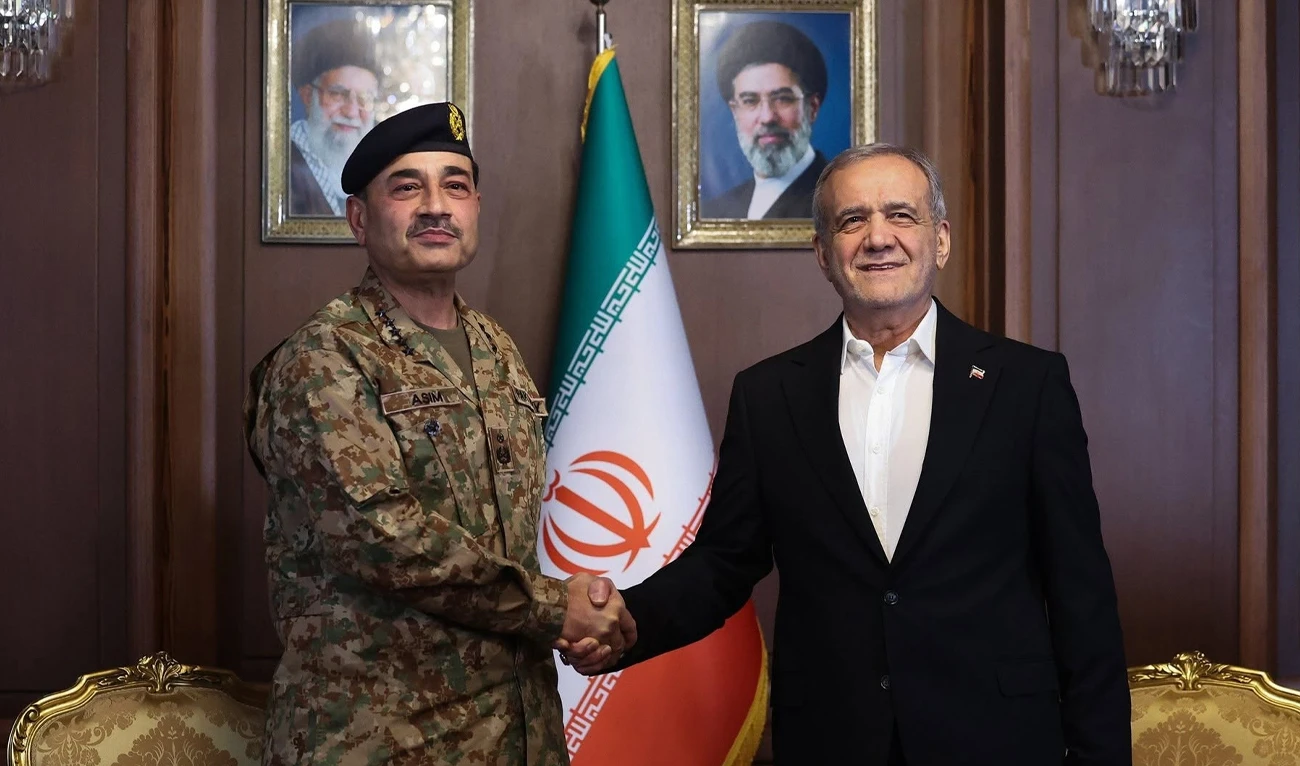
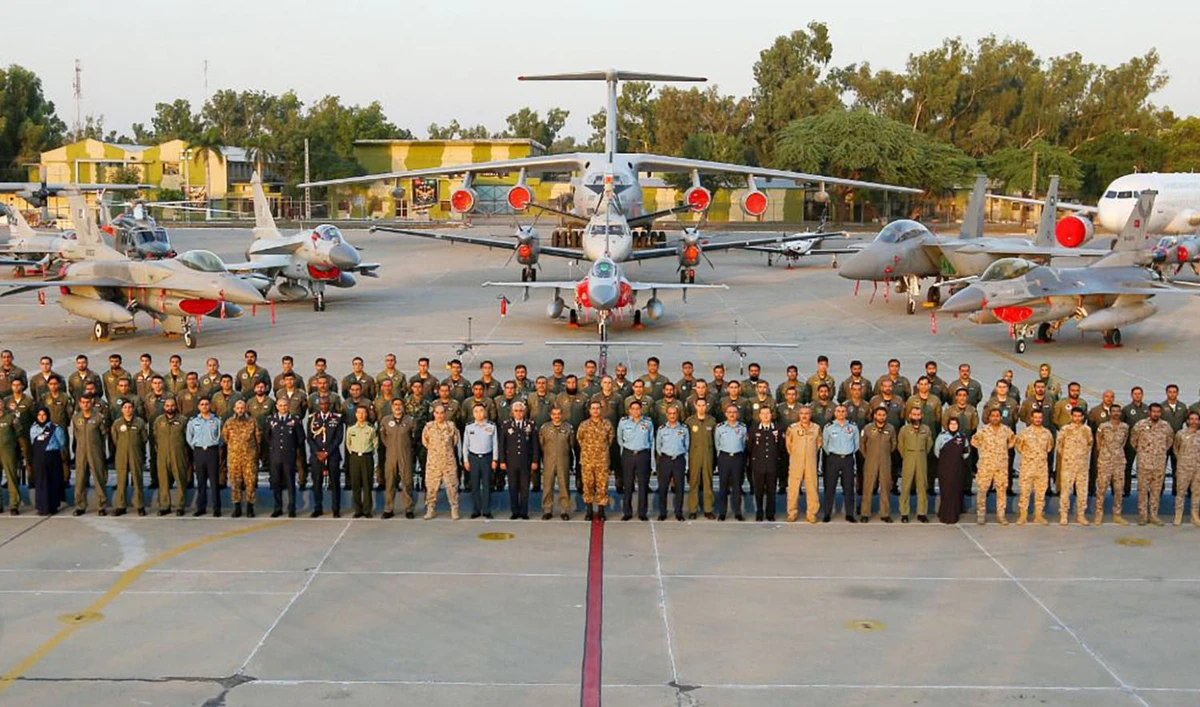
Pakistan's army chief General Asim Munir, center front, stands alongside participants and other guests during the ongoing Indus Shield exercise at one of country's operational bases on October 19, 2023. (Photo courtesy: social media)
Short Url
Updated 20 October 2023
Follow

Air exercise ongoing in Pakistan with participants from 14 nations including Saudi Arabia, UAE

  • The exercise is aimed at consolidating modern concepts of aerial warfare, fostering mutual cooperation and enhancing interoperability
  • Gen Asim Munir reiterates his support to the vision of Pakistan's air chief to incorporate smart inductions, cutting-edge niche technologies

ISLAMABAD: Pakistan's army chief, General Asim Munir, on Thursday witnessed the ongoing Indus Shield air exercise at one of the country's operational air bases, where he lauded the air warriors for their prowess in aerial combat, the Pakistani military said. 

The exercise, aimed at consolidating modern concepts of aerial warfare, fostering mutual cooperation and enhancing interoperability, is being participated in by Saudi Arabia, United Arab Emirates (UAE), Qatar, Turkiye, Egypt, Oman, Bahrain, Azerbaijan, Indonesia, Morocco, Uzbekistan, China and Hungary. 

Upon arrival, the army chief was received by the Pakistan Air Force (PAF) chief, Air Chief Marshal Zaheer Ahmed Baber Sidhu, and introduced to foreign dignitaries and principal staff officers of the PAF. Air chiefs of Türkiye, Azerbaijan and Hungary were also among the distinguished guests 

Addressing the participants, Gen Munir highlighted the importance of multinational air exercises in pursuit of common objectives amid the ever-evolving dynamics of air warfare, according to the Inter-Services Public Relations (ISPR), the Pakistani military's media wing. 

"He lauded the professionalism of the exercise participants and extended heartfelt appreciation to the Air Power Centre of Excellence for its state-of-the-art facilities and instrumental role in orchestrating such largescale air exercise," the ISPR said in a statement. 

"General Syed Asim Munir acknowledged that the Centre's expertise and dedication have contributed to the development of highly skilled and proficient air warriors, who are ready to meet the challenges of modern warfare." 

He reiterated his commitment to support the vision of the Pakistani air chief to incorporate smart inductions, cutting-edge niche technologies in the domains of artificial intelligence, information technology, space and specialized innovations. 

Organized by the PAF, Indus Shield aims to bolster regional security by fostering cooperation among allied nations. The exercise serves as a platform for enhancing operational capabilities, promoting mutual understanding and advancing the shared goals of peace and stability, in addition to showcasing the PAF's commitment to secure its skies through innovative and disruptive technologies. 

Highlighting the significance of the exercise, Air Chief Sidhu said the exercise offered a unique opportunity to participating air forces to showcase their unparalleled skills and operational capabilities. He commended the dynamic role played by the PAF's Air Power Center of Excellence in successfully orchestrating the mega drill, ensuring meticulous supervision, conduct, analysis and assessment of aerial warfare missions.  

"The successful execution of an aerial mission requires the effective utilization of all components of combat efficiency, including electronic warfare operations, force multipliers and support elements," he said. 

"These crucial aspects are diligently taught at Air Power Center of Excellence, creating a cohesive impact on operational capabilities." 

IMF Executive Board to review $1.2 billion loan disbursement for Pakistan today

Updated 4 sec ago
Follow

IMF Executive Board to review $1.2 billion loan disbursement for Pakistan today

  • Pakistan, IMF reached a Staff-Level Agreement in October for second review of $7 billion Extended Fund, climate fund program
  • Economists view IMF bailout packages as essential for cash-strapped Pakistan grappling with a prolonged macroeconomic crisis

ISLAMABAD: The Executive Board of the International Monetary Fund (IMF) is set to meet in Washington today to review a $1.2 billion loan disbursement for Pakistan, state media reported on Monday.

Pakistan and the IMF reached a Staff-Level Agreement (SLA) in October for the second review of a $7 billion Extended Fund Facility (EFF) and the first review of its $1.4 billion Resilience and Sustainability Facility (RSF). 

The agreement between the two sides took place after an IMF mission, led by the international lender’s representative Iva Petrova, held discussions with Pakistani authorities during a Sept. 24–Oct. 8 visit to Karachi, Islamabad and Washington D.C.

“The International Monetary Fund’s (IMF) Executive Board is set to meet in Washington today to review and approve $1.2 billion in loan for Pakistan,” state broadcaster Pakistan TV reported. 

Pakistan has been grappling with a prolonged macroeconomic crisis that has drained its financial resources and triggered a balance of payments crisis for the past couple of years. Islamabad, however, has reported some financial gains since 2022, which include recording a surplus in its current account and bringing inflation down considerably.

Economists view the IMF’s bailout packages as crucial for cash-strapped Pakistan, which has relied heavily on financing from bilateral partners such as Saudi Arabia, China and the United Arab Emirates, as well as multilateral lenders including the IMF, World Bank, Asian Development Bank and Islamic Development Bank. 

Speaking to Arab News last month, Pakistan’s former finance adviser Khaqan Najeeb said the $1.2 billion disbursement will further stabilize Pakistan’s near-term external position and unlock additional official inflows.

“Continued engagement also reinforces macro stability, as reflected in recent improvements in inflation, the current account, and reserve buffers,” Najeeb said.

Pakistan came close to sovereign default in mid-2023, when foreign exchange reserves fell below three weeks of import cover, inflation surged to a record 38% in May, and the country struggled to secure external financing after delays in its IMF program. Fuel shortages, import restrictions, and a rapidly depreciating rupee added to the pressure, while ratings agencies downgraded Pakistan’s debt and warned of heightened default risk.

The crisis eased only after Pakistan reached a last-minute Stand-By Arrangement with the IMF in June 2023, unlocking emergency support and preventing an immediate default.