

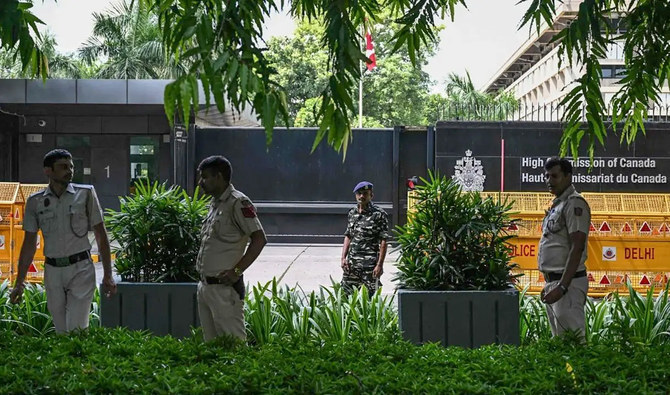

TORONTO: Canada has recalled 41 of its diplomats from India after the Indian government said it would revoke their diplomatic immunity, the foreign minister said Thursday, in an escalation of their dispute over the slaying of a Sikh separatist in Canada.
The moves come after Canada’s allegations that India may have been involved in the June killing of Canadian citizen Hardeep Singh Nijjar in suburban Vancouver. India has accused Canada of harboring separatists and “terrorists,” but dismissed the allegation of its involvement in the killing as “absurd” and has taken diplomatic steps to express its anger over the accusation.
Foreign Minister Mélanie Joly said Thursday that 41 of Canada’s 62 diplomats in India have been removed, along with their dependents. Joly said exceptions have been made for 21 Canadian diplomats who will remain in India.
“Forty-one Canadian diplomats and their 42 dependents were in danger of having their immunity stripped on an arbitrary date and this would put their personal safety at risk,” Joly said. “Our diplomats and their families have now left.”
Joly said removing diplomatic immunity is not only unprecedented but contrary to international law, and said for that reason Canada wouldn’t threaten to do the same thing with Indian diplomats.
“A unilateral revocation of the diplomatic privilege and immunity is contrary to international law and a clear violation of the Geneva Convention on diplomatic relations. Threatening to do so is unreasonable and escalatory,” Joly said.
Joly said India’s decision will impact the level of services to citizens of both countries. She said Canada is pausing in-person services in Chandigarh, Mumbai and Bangalore.
India’s Ministry of External Affairs ministry spokesperson Arindam Bagchi had previously called for a reduction in Canadian diplomats in India, saying they outnumbered India’s staffing in Canada.
Canadian Prime Minister Justin Trudeau said last month that there were “credible allegations” of Indian involvement in the slaying of Nijjar, a 45-year-old Sikh leader who was killed by masked gunmen in June in Surrey, outside Vancouver.
For years, India had said that Nijjar, a Canadian citizen born in India, had links to terrorism, an allegation Nijjar denied.
India also has canceled visas for Canadians, and Canada has not retaliated for that. India previously expelled a senior Canadian diplomat after Canada expelled a senior Indian diplomat.
Trudeau has previously appeared to try to calm the diplomatic clash, telling reporters that Canada is “not looking to provoke or escalate.”
The allegation of India’s involvement in the killing is based in part on surveillance of Indian diplomats in Canada, including intelligence provided by a major ally, a separate Canadian official previously told The Associated Press.
The official said that the communications involved Indian officials and diplomats in Canada and that some of the intelligence was provided by a member of the “Five Eyes” intelligence-sharing alliance, which includes the United States, Britain, Australia and New Zealand, in addition to Canada. The official spoke on condition of anonymity because they were not authorized to discuss the matter publicly.
The latest expulsions by India have escalated tensions between the countries. Trudeau had frosty encounters with Indian Prime Minister Narendra Modi during the recent Group of 20 meeting in New Delhi, and a few days later, Canada canceled a trade mission to India planned for the fall.
US Secretary of State Antony Blinken has met with India’s foreign minister amid the simmering row. A US official said the topic was raised. US officials have acknowledged that the fallout from the allegations could have an impact on relations with India, but have been careful not to cast blame in the killing of Nijjar.
Nijjar, a plumber, was also a leader in what remains of a once-strong movement to create an independent Sikh homeland, known as Khalistan. A bloody decade-long Sikh insurgency shook north India in the 1970s and 1980s, until it was crushed in a government crackdown in which thousands of people were killed, including prominent Sikh leaders.
The Khalistan movement has lost much of its political power but still has supporters in the Indian state of Punjab, as well as in the sizable overseas Sikh diaspora. While the active insurgency ended years ago, the Indian government has warned repeatedly that Sikh separatists were trying to make a comeback.
Canadian Immigration Minister Marc Miller noted that in 2022 India was the top country for permanent residents, temporary foreign workers and international students in Canada. Miller said as a result of India’s decision to remove immunity Canada’s immigration department will be significantly reducing the number of Canadian employees in India. Miller said the lower staff levels will hamper the issuing of visas and permits.
Senior Canadian officials said India was firm on the number and rank of Canadian diplomats for whom it would lift diplomatic immunity. India also indicated it would cancel various permits, such as those permitting spouses to work in India and allowing the use of diplomatic plates on cars, officials said.
Nelson Wiseman, a political scientist at the University of Toronto, said there would be no point in Canada retaliating over India’s latest move.
“The expulsions of the Canadian diplomats reveal the thin skin of the Indians; it suggests that they know they are complicit in the murder of a Canadian in Canada,” Wiseman said. “They are trying to deflect attention from their lack of cooperation with Canada in the investigation of the murder.”


