


DUBAI: The livelihoods of over half a billion people in the Middle East and North Africa are under threat if current projections are realized of a 4 Celsius temperature increase by 2050.
This is according to the World Economic Forum’s report “Closing the Climate Action Gap: Accelerating Decarbonization and the Energy Transition in MENA,” which highlights sustainability challenges in the region, while also laying out a plan to fuel new economic opportunities.
Developed in collaboration with Bain & Company, the report features contributions from more than 40 policymakers, climate actors, business leaders, as well as banking and industry experts from the private and public sectors who form the WEF’s Leaders for a Sustainable MENA.
“The MENA region has been one of the fastest growing regions over the past decade and there is a pathway for the region to position itself at the forefront of sustainability efforts while maintaining its upward economic trajectory,” said Borge Brende, president of the WEF.
“As global markets continue to shift, and energy demands rise, the region requires bold and coordinated action from policymakers and businesses to lead a just energy transition and meet both climate- and development-related goals,” he added.
The report’s research found that temperatures in MENA are rising at twice the global average rate, presenting myriad challenges that could threaten the livelihoods of the region’s population of 575 million people — 70 percent of whom live in low-income countries.
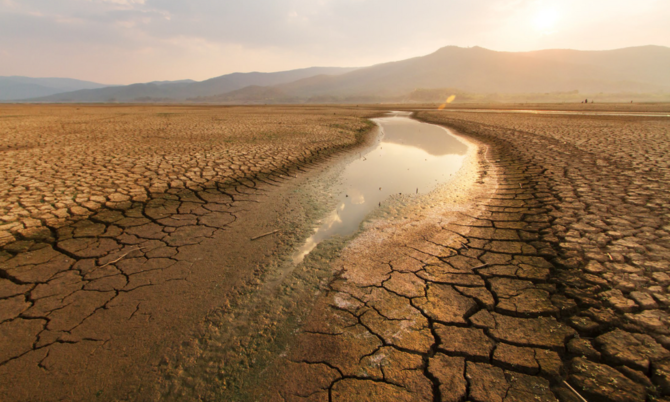
Rising temperatures and prolonged droughts are among the climate shocks that could impact agriculture and livability in the MENA region, the report indicates.
It also found that MENA countries trail behind comparable regions in terms of their sustainability progress. While local governments have pledged to bring 60 percent of MENA’s emissions under the net-zero ambition in the last two years, businesses overall have yet to follow suit and bridge the gap with comparable global markets.
In the past two years, an estimated 60 percent of the region’s emissions and gross domestic product have come under net-zero pledges. However, when it comes to businesses, only 12 percent have set up a net-zero target and 6 percent have established a roadmap to reach net zero.
“Successfully transitioning to a sustainable future will hinge on bold measures from policymakers and companies, raising awareness and multi-stakeholder partnerships,” said Tom De Waele, managing partner of Bain & Company Middle East.
Although sustainability action for the region requires “significant investment of time and resources, it also represents a significant economic opportunity, which could well position the MENA region at the heart of global energy transition and unlock doors to economic diversification, high-quality job creation, and global leadership in low-carbon technologies,” he added.
The MENA region contains almost half of proven global oil reserves and delivers around 30 percent of global oil production, making it crucial for it to take responsibility in leading decarbonization efforts on conventional energy.
Moreover, its key export markets, such as the EU, China and the US, among others, are tightening emissions-related regulations.
Thus, while decarbonization could be seen as an added cost or risk, it also provides a huge opportunity for MENA, the report asserts.
The region also has abundant natural resources like solar and wind energy, as well as land availability, which paves the way for it to become a global leader in new energy, such as renewables and clean hydrogen.
To safeguard economic growth and global energy influence, Gulf nations should focus on technology-based solutions that reduce emissions in challenging sectors, optimize consumption, transition to renewables and implement carbon capture at scale, the report suggests.
The report added that non-Gulf countries should prioritize affordable energy, particularly in low-income areas, by increasing renewable energy usage, phasing out regressive fossil fuel subsidies and supporting carbon credit projects.


