

OIC condemns Israeli bombing of Al-Ahli Hospital in Gaza

1 / 2
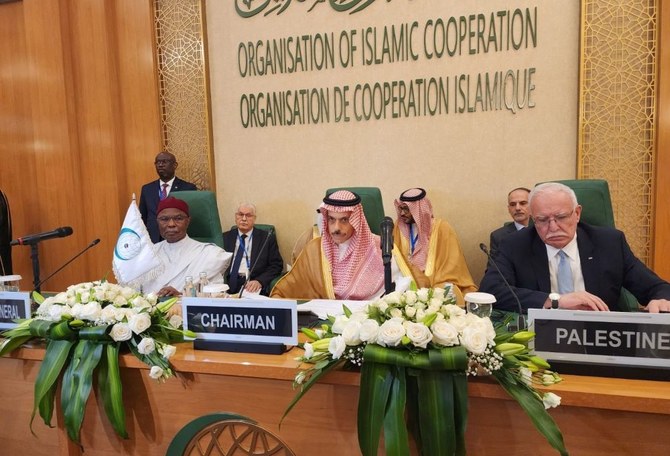
OIC extraordinary meeting of the executive committee condemns Israeli state bombing of Al-Ahli Hospital in Gaza. (Supplied)
2 / 2
OIC extraordinary meeting of the executive committee condemns Israeli state bombing of Al-Ahli Hospital in Gaza. (Supplied)
Short Url
Updated 18 October 2023
Follow

OIC condemns Israeli bombing of Al-Ahli Hospital in Gaza

  • Brutal massacre is a war crime that deserves punishment, says secretary-general
  • Hussein Ibrahim Taha repeated his call to the international community, especially the UN, to urgently intervene to halt war crimes committed by Israel in the Gaza Strip

RIYADH: Secretary-General of the Organization of Islamic Cooperation Hussein Ibrahim Taha on Wednesday strongly condemned the horrific massacre by the Israeli occupation forces at Al-Ahli Baptist Hospital in Gaza, which killed hundreds of people.

He said Israeli forces should be held fully responsible for the consequences of their terrorism and brutal attacks on the Palestinian people, which he said contradicted all human values and constituted a flagrant violation of international humanitarian law. He also repeated his call to the international community, especially the UN, to urgently intervene to halt war crimes committed by Israel in the Gaza Strip and provide protection for the Palestinian people.

Speaking at the OIC’s emergency ministerial meeting discussing Israeli aggression on Gaza, Taha said the latest incident represented a war crime. He added that it was incompatible with all human values and emphasized that organized state terrorism deserved accountability and punishment.

In his speech at the extraordinary open-ended meeting of the executive committee at the OIC’s headquarters in Jeddah, the secretary-general expressed full solidarity with the Palestinian people. He also pledged steadfast support for their legitimate struggle to achieve the right to self-determination and the establishment of an independent, sovereign state.

Taha went on to note the need for combined efforts to stop such unprecedented Israeli aggression — and to ensure the opening of humanitarian corridors to facilitate the arrival of medicine, food, and essential items to the Gaza Strip.

He stressed that the OIC had warned on more than one occasion of the seriousness of the repercussions of continuing the war against the Palestinian people. The official said these would not have been repeated had there not been a lack of legal and political deterrence from the global community. He added that there had also been a lack of respect for the rule of international law and that Israel’s actions had not been punished.

“The occupation is free from accountability and punishment for its policies based on settlement, forced displacement, ethnic cleansing, murder, organized terrorism, attacks on sanctities, and other practices against the Palestinian people,” he said.

The secretary-general added that the ongoing aggression on the Gaza Strip had violated all rightful principles and values through the killing and wounding of thousands of Palestinians, including children, women, and the elderly. He added that the forced displacement of families — and the indiscriminate destruction of residential, educational, health, and media facilities, including those of the UN Relief and Works Agency for Palestine Refugees, and civilian infrastructure — flagrantly violated international law.

“I hope this meeting will succeed in taking effective measures in order to stop this Israeli aggression, protect the Palestinian people, and provide them with assistance in this ordeal,” said the OIC chief. “We stress that there will be no peace or stability in the region without finding a just and comprehensive solution to the Palestinian issue, ending the Israeli colonial occupation, and embodying the right of the Palestinian people to establish their independent, sovereign state on the 1967 borders with East Jerusalem as its capital, in accordance with the relevant UN resolutions and the Arab Peace Initiative.”
He thanked Saudi Arabia for its invitation to hold the meeting, which endorsed the Kingdom’s support of Islamic nations and most notably the Palestinian cause.

Saudi Arabia’s Foreign Minister Prince Faisal bin Farhan said at the meeting: “We call on the international community to take action to establish safe humanitarian corridors.”

He emphasized that the Kingdom was making every possible effort to communicate with all international and regional parties to stop the ongoing escalation. Prince Faisal also expressed his deep concern about the seriousness of humanitarian conditions in Gaza and the harm being caused to innocent people.

He stressed the Kingdom’s firm support of efforts to achieve a comprehensive and just peace that ensures the Palestinian people attain their legitimate rights.

All 57 member countries of the OIC were invited to attend the meeting.


US presses missile issue as new Iran talks to open in Geneva

Updated 37 min 13 sec ago
Follow

US presses missile issue as new Iran talks to open in Geneva

  • New round of negotiations in Geneva comes after the US carried out a massive military build-up in the region
  • Iran’s president reiterates Tehran is not seeking nuclear weapons in line with policy

GENEVA: The United States and Iran are set to hold indirect talks in Switzerland on Thursday aiming to strike a deal to avert fresh conflict and bring an end to weeks of threats.
The new round of negotiations in Geneva comes after the US carried out a massive military build-up in the region and President Donald Trump repeatedly threatened to strike Iran if a deal is not reached.
In his State of the Union address on Tuesday, Trump accused Iran of “pursuing sinister nuclear ambitions.”
He also claimed Tehran had “already developed missiles that can threaten Europe and our bases overseas, and they’re working to build missiles that will soon reach the United States of America.”
The Iranian foreign ministry called these claims “big lies.”

Iran president says ahead of US talks not seeking nuclear weapon ‘at all’

TEHRAN: Iran’s President Masoud Pezeshkian reiterated on Thursday that Tehran was not seeking nuclear weapons in line with the policy set by the country’s supreme leader.

“Our Supreme Leader has already stated that we will not have nuclear weapons at all,” Pezeshkian said in a speech.

“Even if I wanted to move in that direction, I could not — from a doctrinal standpoint, I would not be permitted.” — AFP


The maximum range of Iran’s missiles is 2,000 kilometers according to what Tehran has publicly disclosed. However the US Congressional Research Service estimates they top out at about 3,000 kilometers — less than a third of the distance to the continental United States.
The dispute between the countries mostly revolves around Iran’s nuclear program, which the West believes is aimed at building an atomic bomb but Tehran insists is peaceful.
However the US has also been pushing to discuss Iran’s ballistic missile program, as well as Tehran’s support for armed groups hostile toward Israel.
Secretary of State Marco Rubio warned that Iran must also negotiate on its missile program, calling Tehran’s refusal to discuss ballistic weapons “a big, big problem” on the eve of the talks.
He followed up by saying “the president wants diplomatic solutions.”
Iran has taken anything beyond the nuclear issue off the negotiating table and has demanded that the US sanctions crippling its economy be part of any agreement.
‘Neither war nor peace’
Iranian President Masoud Pezeshkian said on Wednesday he had a “favorable outlook for the negotiations” that could finally “move beyond this ‘neither war nor peace’ situation.”
Foreign Minister Abbas Araghchi, who is leading the Iranian delegation at the talks, has called them “a historic opportunity,” adding that a deal was “within reach.”
In a foreign ministry statement that followed a meeting with his Oman counterpart, Araghchi said the success of the US negotiations depend “on the seriousness of the other side and its avoidance of contradictory behavior and positions.”


The US will be represented by envoy Steve Witkoff and Jared Kushner, who is married to Trump’s daughter Ivanka.
The two countries held talks earlier this month in Oman, which is mediating the negotiations, then gathered for a second round in Geneva last week.
A previous attempt at negotiations collapsed when Israel launched surprise strikes on Iran last June, beginning a 12-day war that Washington briefly joined to bomb Iranian nuclear sites.
In January, fresh tensions between the US and Iran emerged after Tehran engaged in a bloody crackdown on widespread protests that have posed one of the greatest challenges to the Islamic republic since its inception.
Trump has threatened several times to intervene to “help” the Iranian people.
Emile Hokayem, senior fellow for Middle East security at the International Institute for Strategic Studies, said that “the region seems to expect a war at this point.”
In January, there was “a big push by a number of Middle Eastern states to convince the US not to” strike Iran.
“But there’s a lot of apprehension at this point, because the expectation is that this time” a war would be “bigger” than the one in June.
Tehran residents who spoke to AFP were divided as to whether there would be renewed conflict.
Homemaker Tayebeh noted that Trump had “said that war would be very bad for Iran.”
“There would be famine and people would suffer a lot. People are suffering now, but at least with war, our fate might be clear,” the 60-year-old said.