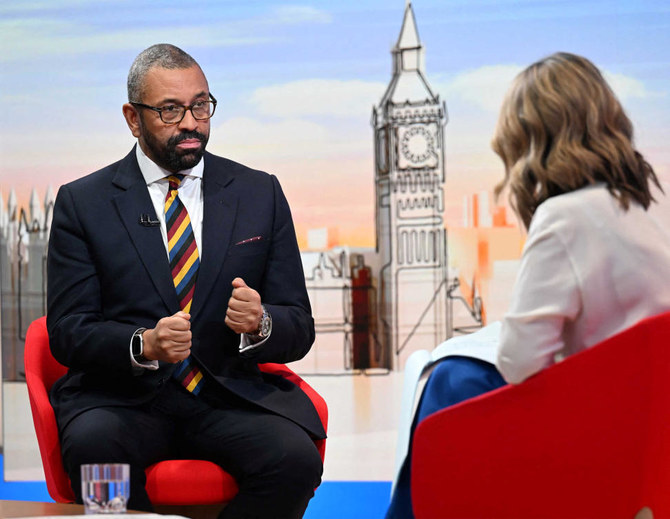
LONDON: British foreign minister James Cleverly told parliament he would travel to the Middle East on Wednesday, outlining a diplomatic push which a British source said would include a visit to Egypt and possibly Qatar and Turkiye.
Britain has called for “cool heads” following a blast at a hospital in Gaza that killed huge numbers of Palestinians and repeatedly said the Israel-Hamas conflict must not escalate to the wider region.
“I have traveled to Israel, I’ve engaged with G7 allies, regional partners, and will be visiting the region again later on today, because we recognize that this will require intensive efforts,” he told parliament.
Cleverly visited Israel last week following attacks by Palestinian militant group Hamas. He did not set out details of the itinerary of his latest trip.
In Egypt, he is expected to discuss the opening of a border crossing between Gaza and Egypt to allow humanitarian aid in and citizens to leave, the source said.

British foreign minister to travel to Middle East, including Egypt
https://arab.news/zszzj
British foreign minister to travel to Middle East, including Egypt
- Britain has called for “cool heads” following a blast at a hospital in Gaza
- The Israel-Hamas conflict must not escalate to the wider region
Chinese visitors to Japan slump as spat rumbles on
TOKYO: Mainland Chinese visitors to Japan tumbled 60.7 percent in January year-on-year, figures showed Wednesday, in the continued fallout from the countries’ diplomatic spat.
“Last year, the lunar new year began in late January, but this year it fell in mid-February,” the Japan National Tourism Organization said as it published the data.
“Additionally, the Chinese government issued a warning advising against travel to Japan. Factors such as reduced flight frequencies also contributed to the number of foreign visitors to Japan falling below the level of the same month last year,” a statement said.
Previously Chinese visitors were the biggest contingent, contributing to a tourism boom in the land of cherry blossom and Mount Fuji that was fueled by a weak yen making shopping cheap.
But in January this year, South Korea was the biggest source with 1.2 million visitors, up 21.6 percent, compared with 385,300 from mainland China, down from 980,520 in January 2025.
Visitors from Hong Kong also tumbled 17.9 percent.
Overall the number of visitors to Japan fell 4.9 percent to 3.597 million in January compared to the same period last year.
Prime Minister Sanae Takaichi suggested in November that Japan could intervene militarily if Beijing sought to take Taiwan by force.
China, which regards the democratic island as part of its territory and has not ruled out force to annex it, was furious.
Beijing summoned Tokyo’s ambassador and on November 14 warned Chinese citizens against visiting Japan, citing “significant risks to the personal safety and lives of Chinese citizens.”
The number of Chinese visitors to Japan already tumbled 45 percent in December to 330,000.
In December, J-15 jets from China’s Liaoning aircraft carrier twice locked radar on Japanese aircraft in international waters near Okinawa, according to Japan.
China also tightened controls on exports to Japan for items with potential military uses, fueling worries that Beijing may choke supplies of vital rare-earth minerals.
Japan’s last two pandas were even returned to China last month.
Takaichi, 64, was seen as a China hawk before becoming Japan’s first woman prime minister in October.
She won a landslide victory in snap elections on February 8, putting her in a strong position for the next four years to stamp her mark on Japanese domestic and foreign policy.
Takaichi said after her election win that Tokyo would bolster its defenses and “steadfastly protect” its territory.
She also said she was “open to various dialogues with China.”
But China’s foreign ministry said “genuine dialogue should be built on respect for one another.”
“Proclaiming dialogue with one’s mouth while engaging in confrontation — no one will accept this kind of dialogue,” foreign ministry spokesman Lin Jian said Tuesday.
Beijing’s top diplomat Wang Yi told the Munich Security Conference on Saturday that forces in Japan were seeking to “revive militarism.”