


TEL AVIV: President Joe Biden said Wednesday that an explosion at a Gaza Strip hospital appears to not have been caused by Israel.
“Based on what I’ve seen, it appears as though it was done by the other team, not you,” Biden told Israeli Prime Minister Benjamin Netanyahu during a meeting. But Biden said there were “a lot of people out there” who weren't sure what caused the blast.
He added that Washington would provide Israel with everything it needed to defend itself as it wages war against the Palestinian militant group Hamas.
Biden said Hamas was worse than Daesh for its killings of Israeli civilians in a surprise attack on Oct. 7 which sparked the latest Israel-Palestinian violence.
The US president said he was “sad and outraged” by an explosion at a hospital in the Gaza Strip on Tuesday which Hamas said killed hundreds of people.
Biden said 31 Americans were among the more than 1,300 Israelis killed in Hamas’s Oct. 7 attack.
Netanyahu told Biden that Israel would try to avoid civilian casualties in its Gaza war, which he described as challenging due to the tactics of Hamas.
“This will be a different kind of war because Hamas is a different kind of enemy,” Netanyahu said in televised remarks. “As we proceed in this war, Israel will do everything it can to keep civilians out of harm's way.”
Biden touched down in Israel on Wednesday for a diplomatic scramble to prevent the war with Hamas from spiraling into an even larger conflict, a challenge that became more difficult as outrage swept through the Middle East over an explosion that killed hundreds in a Gaza Strip hospital.
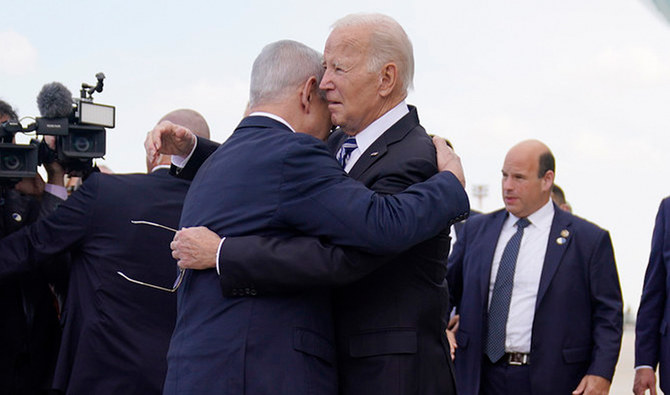
Netanyahu personally welcomed Biden on the tarmac, putting his arms around the US president who then clasped his hands around Netanyahu in a sign of the newfound bond between the two leaders.
Biden was originally scheduled to visit Jordan as well, but his meetings with Arab leaders were called off as he was leaving Washington, costing him an opportunity for the face-to-face conversations that he views as crucial for navigating this fraught moment.
Now Biden’s only stop is Tel Aviv, where he’s expected to push for allowing critical humanitarian aid into Gaza during meetings with Prime Minister Benjamin Netanyahu. Israel has been preparing for a potential ground invasion of Gaza in response to Hamas’ attacks on Oct. 7, which killed 1,400 Israelis.
John Kirby, a White House national security spokesman, told reporters aboard Air Force One that Biden “wants to get a sense from the Israelis on the situation on the ground” and will “ask some tough questions.”
“He’ll be asking them as a friend,” Kirby added.
The president also planned to meet Israeli first responders and the families of victims killed and hostages taken when Hamas made its incursion into Israel.
Roughly 2,800 Palestinians have been reported killed by Israeli strikes in Gaza. Another 1,200 people are believed to be buried under the rubble, alive or dead, health authorities said.
Those numbers predate the explosion at the Al-Ahli hospital on Tuesday. No clear cause has been established for the blast.
The Hamas-run Gaza Health Ministry said an Israeli airstrike caused the destruction. The Israeli military denied involvement and blamed a misfired rocket from the Palestinian Islamic Jihad, another militant group. However, that organization also rejected responsibility.
Biden said in a statement that he was “outraged and deeply saddened by the explosion at the Al Ahli Arab hospital in Gaza, and the terrible loss of life that resulted.” He also said he “directed my national security team to continue gathering information about what exactly happened.”
Protests swept through the region after the deaths at the hospital, which had been treating wounded Palestinians and sheltering many more who were seeking a refuge from the fighting.
Hundreds of Palestinians flooded the streets of major West Bank cities including Ramallah. More people joined protests that erupted in Beirut, Lebanon and Amman, Jordan, where an angry crowd gathered outside the Israeli Embassy.
Outrage over the hospital explosion scuttled Biden’s plans to visit Jordan, where King Abdullah II had planned to host meetings with Palestinian President Mahmoud Abbas and Egyptian President Abdel Fattah El-Sisi. But Abbas withdrew in protest, and the summit was subsequently canceled outright.
Kirby said Jordan had declared three days of mourning after the hospital explosion and that Biden understood the move and was part of a “mutual” decision to call off the Jordan portion of his trip. He said Biden would have an opportunity to speak to the Arab leaders by phone as he returned to Washington.
Ayman Safadi, Jordan’s foreign minister, told a state-run television network that the war is “pushing the region to the brink.”
There are also fears that a new front could erupt along Israel’s northern border with Lebanon, where Hezbollah operates. The Iran-backed organization has been skirmishing with Israeli forces.
The visit to Israel coincides with rising humanitarian concerns in Gaza, where Israel has cut off the flow of food, fuel and water. Mediators have been struggling to break a deadlock over providing supplies to desperate civilians, aid groups and hospitals.
US Secretary of State Antony Blinken, bouncing back and forth between Arab and Israeli leadership ahead of Biden’s visit, spent seven and a half hours meeting Monday in Tel Aviv in an effort to broker some kind of aid agreement and emerged with a green light to develop a plan on how aid can enter Gaza and be distributed to civilians.
“We’re optimistic that we’ll be able to get some humanitarian assistance in,” Kirby said.
Although only a modest accomplishment on the surface, US officials stressed that Blinken’s talks led to a significant change in Israel’s position going in — that Gaza would remain cut off from fuel, electricity, water and other essential supplies.
US officials said it has become clear that already limited Arab tolerance of Israel’s military operations would evaporate entirely if conditions in Gaza worsened.
Their analysis projected that outright condemnation of Israel by Arab leaders would not only be a boon to Hamas but would likely encourage Iran to step up its anti-Israel activity, adding to fears that a regional conflagration might erupt, according to four officials who spoke to The Associated Press on condition of anonymity to discuss internal administration thinking.


