

Pakistan to push for ‘collective demand’ for cease-fire in Gaza at OIC meeting today

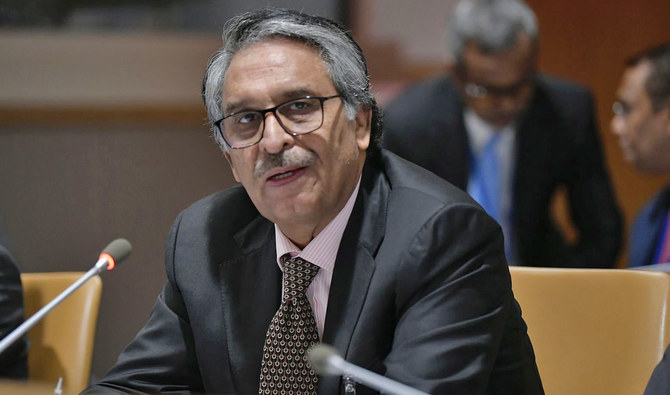
Pakistan's interim foreign minister Jalil Abbasi Jilani is addressing a United Nations Alliance of Civilizations Group of Friends meeting in New York, US, on September 22, 2023. (Photo courtesy: UNAOC/File)
Short Url
Updated 18 October 2023
Follow

Pakistan to push for ‘collective demand’ for cease-fire in Gaza at OIC meeting today

  • Pakistani foreign minister to attend extraordinary session of OIC executive committee in Jeddah 
  • Will discuss escalating conflict, humanitarian crisis in Gaza where over 3,000 Palestinians killed since Oct. 7

ISLAMABAD: Pakistani Foreign Minister Jalil Abbasi Jilani will attend a meeting of the Organization of Islamic Cooperation’s (OIC) executive committee today, Wednesday, to discuss the escalating crisis in Gaza and push for a collective demand by the OIC for a cease-fire, the foreign ministry said.

Saudi Arabia, the chair of the OIC’s executive committee, last week called an urgent meeting of the body in Jeddah on Oct. 18 to discuss the “escalating military situation in Gaza and its environs.”

At least 3,000 Palestinians have been killed in Israeli airstrikes and over 9,500 injured since Oct. 7 when Hamas carried out a cross-border rampage against communities in southern Israel in which at least 1,300 people perished.

Israel has intensified its attempts to destroy the Hamas group, relentlessly bombing the Gaza Strip and amassing tens of thousands of soldiers near the enclave ahead of an expected ground offensive, sparking fears of a wider, regional conflict.

On Tuesday night, a blast at a hospital in Gaza City killed some 500 Palestinians in the deadliest single incident since Israel launched its unrelenting bombing campaign.

“In respect of tomorrow’s session of the Executive Committee, the Foreign Minister has underlined Pakistan’s priority for a collective demand by OIC for a cease-fire,” a statement from the Ministry of Foreign Affairs (MoFA) said.

In the days leading up to the OIC meeting, Jilani spoke to his counterparts in the UAE, Iran, Egypt and Turkiye over the siege of Gaza and the ensuing crisis.

“He will continue these consultations with in-person meetings in Jeddah,” the foreign ministry added.

Pakistan will also push for humanitarian assistance to reach Gaza without further delay.

Israel imposed a blockade of the densely populated Gaza last week, preventing food, fuel and water from reaching the area. International agencies have warned of the risk of water-borne diseases and shortage of clean drinking water for millions in the territory.

“Subsequent efforts should be directed toward a just, comprehensive, and lasting solution to the Palestinian question anchored in international law and in line with relevant United Nations and OIC resolutions,” MoFA said.

Pakistan does not recognize the state of Israel and calls for an independent Palestinian state based on “internationally agreed parameters” and the pre-1967 borders with Al-Quds Al-Sharif as its capital.


Government says Pakistan preparing Cyber Security Act as digital expansion raises risks

Updated 10 sec ago
Follow

Government says Pakistan preparing Cyber Security Act as digital expansion raises risks

  • The proposed legislation will create Cyber Security Authority to oversee the country's cyber defenses
  • IT minister warns misuse of genetic and digital data could enable targeted cyber and biological threats

ISLAMABAD: Pakistan is preparing a Cyber Security Act and a dedicated regulatory authority to strengthen defenses against rising digital threats as the country rapidly digitizes government services and economic systems, IT Minister Shaza Fatima said while addressing a ceremony in the federal capital on Wednesday.

The planned legislation is part of Islamabad’s broader “Digital Nation Pakistan” initiative, which aims to expand e-governance, a cashless economy and online public services while safeguarding national cyber infrastructure.

“The more we move toward digitization, with the kind of opportunities that are opening up for us, it is also bringing an equal, or even greater, set of challenges,” the minister said. “This does not mean that we stop digitization. It means that we must make our cybersecurity systems robust.”

She said Pakistan had already activated its National Computer Emergency Response Team (CERT) and provincial CERTs to detect and respond to cyber incidents, while a multi-agency digital monitoring framework known as the National Threat Intelligence System (NTIS) operates around the clock.

“We have a Cyber Security Act coming up, under which a Cyber Security Authority will be established.”

The minister said cybersecurity was not a “generic” concept and required multiple technical specializations as well as comprehensive monitoring and regulation. She warned that the rapid expansion of data-driven technologies was creating new risks even as it opened opportunities in areas such as health and biotechnology.

Referring to advances in genomics and precision medicine, she said the same technologies that help treat diseases could also pose security risks if sensitive biological data were misused. She warned that access to large-scale genetic data could potentially allow hostile actors to develop targeted viruses or other biological threats against populations.

The minister also highlighted Pakistan’s cyber defense capabilities, saying government and military systems remained secure during last year's war with India despite sustained cyber warfare attempts.

She said multiple institutions, including the IT ministry, the National Telecommunication Corporation (NTC), national cybersecurity teams and the armed forces’ cyber command structures, worked together to defend critical systems.

“Despite that massive war ... we did not face a single communication breakdown and we did not allow any penetration into our government systems,” she said, adding that the experience demonstrated the need to further strengthen cybersecurity coordination across institutions.