CAIRO/WASHINGTON/GAZA/ DUBAI: Egyptian Foreign Minister Sameh Shoukry said on Monday that the Israeli government had yet to take a stance that allowed the Rafah border crossing between Egypt and the Gaza Strip to open.
Egypt has aimed since the conflict broke out to keep the Rafah crossing operational, Shoukry said, calling the situation faced by the Palestinian people in Gaza “dangerous.”
The Egyptian-controlled border crossing into Gaza was earlier expected to reopen amid diplomatic efforts to get aid into the enclave that has been under intense Israeli bombing since the rampage by the militant group Hamas killed 1,300 people.
UN aid chief Martin Griffiths said on Monday he would be traveling to the Middle East to support negotiations on getting aid into the blockaded Gaza Strip.
Griffiths said his office was in “deep discussions” with Israel, Egypt and others.
“I shall be going myself tomorrow to the region to try to help in the negotiations, to try to bear witness and to express solidarity with the extraordinary courage of the many thousands of aid workers who have stayed the course and who are still there helping the people in Gaza and in the West Bank,” he said in a statement.
“Rafah will be reopened. We’re putting in place with the United Nations, with Egypt, with Israel, with others, a mechanism by which to get the assistance in and to get it to people who need it,” US Secretary of State Antony Blinken said after a meeting with Egyptian President Abdel Fattah El-Sisi on Sunday.
Blinken did not give a specific time for the crossing to reopen. Veteran US diplomat David Satterfield, appointed on Sunday as a special envoy for Middle East humanitarian issues, will arrive in Egypt on Monday to work out the details, Blinken said.
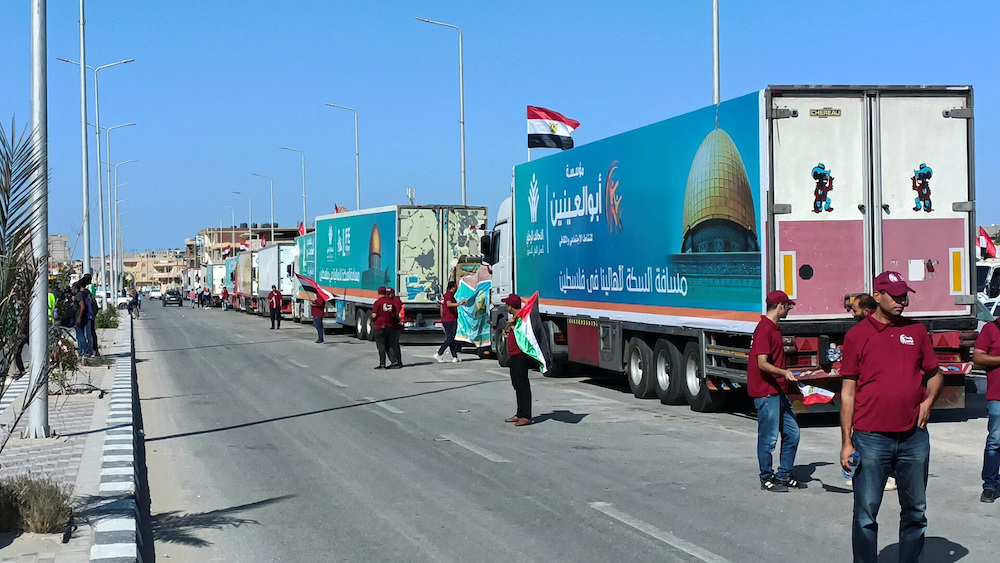
Volunteers wait next to a convoy of trucks carrying humanitarian aid to Palestinians, as they wait for an agreement on the Rafah border crossing to enter Gaza on Oct. 15, 2023. (Reuters)
Israeli Prime Minister Benjamin Netanyahu’s office on Monday denied reports of any temporary Gaza cease-fire to allow foreign nationals to flee the enclave to neighboring Egypt.
However, the army pledged to refrain from striking routes within Gaza designated for evacuating people from the enclave’s north to the south during a limited time window, from 8 a.m. to noon.
Media reports had said Israel, Egypt and the US had agreed the Rafah crossing between Gaza and Egypt would be opened for several hours Monday in a one-off move to allow foreign nationals to flee and aid goods to enter.
But Netanyahu’s office said in a statement that “there is currently no cease-fire and humanitarian aid in Gaza in return for removing foreigners.”
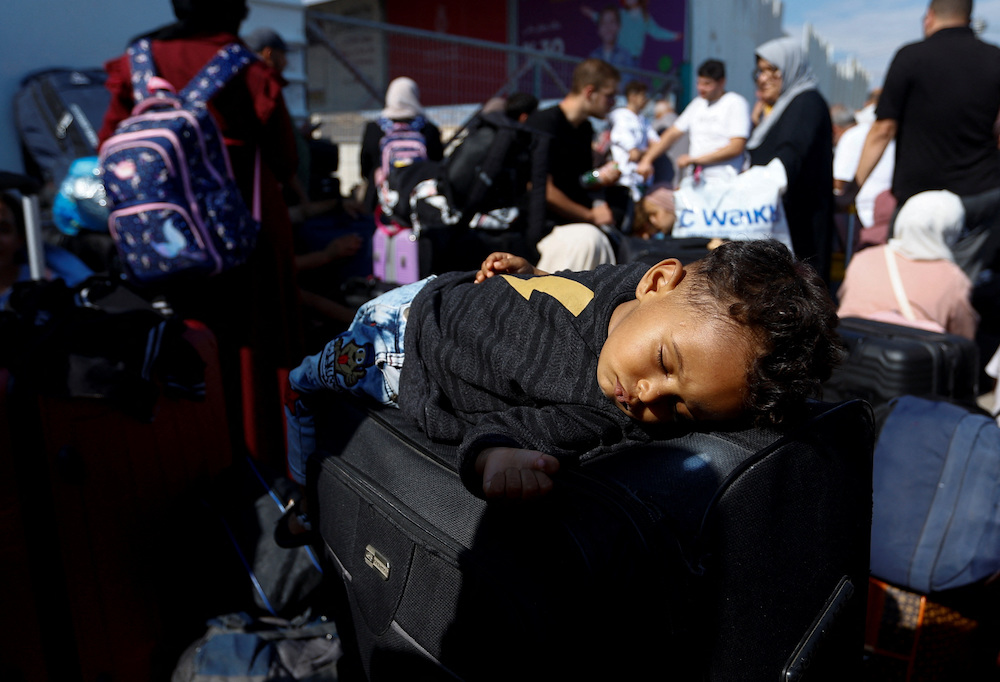
A child sleeps as Palestinians with dual citizenship gather outside Rafah border crossing with Egypt. (Reuters)
Aid convoys have waited on the Egyptian side but, according to witnesses, had not left the town of El-Arish, about 40 kilometers east of Rafah on Monday.
The Israeli military said earlier Monday it would refrain from striking two roads in the Gaza Strip marked for residents to move south and out of the way of a possible ground offensive.
“The IDF (Israeli Defense Forces) will refrain from targeting the designated axis from 8:00 am (0500 GMT) until 12:00 (0900 GMT),” military spokesman Avichay Adraee said on X, formerly Twitter.
“For your safety take advantage of this short period of time to move south from the north of the strip and Gaza City.”
Military spokesman Jonathan Conricus pledged in a separate statement that the two designated roads “would be safe to use” for that duration.
US President Joe Biden has urged Israel to follow the laws of war in its response to the Hamas attacks, and on Sunday said in a post on social media that “the overwhelming majority of Palestinians had nothing to do with Hamas’ appalling attacks and are suffering as a result of them.”
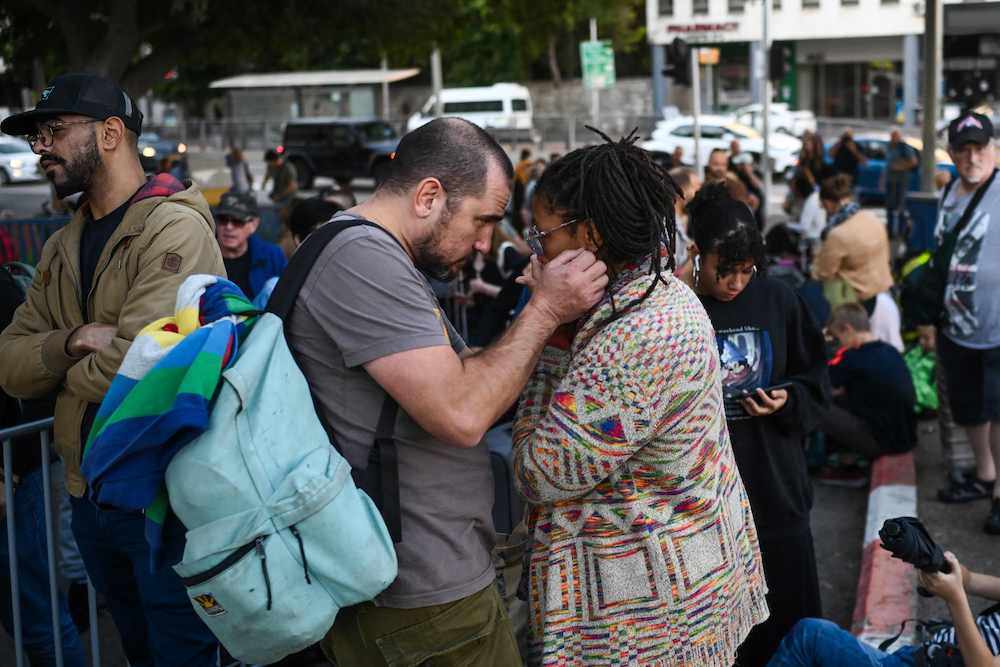
US citizens wait at the port of Haifa to be evacuated to Cyprus on Oct. 16, 2023. (AFP)
In a CBS 60 Minutes interview aired on Sunday, Biden also said Israel needed to eliminate Hamas, but warned that it would be a mistake for Israel to occupy Gaza.
NBC News, citing a Palestinian official, reported the Rafah border crossing would open at 9 a.m. on Monday. Citing a security source, ABC News reported the crossing would open for a few hours on Monday, without providing details.
Israel has urged exhausted Gazans to evacuate south, which hundreds of thousands have already done in the besieged enclave that is home to more than 2 million people. Hamas, which runs Gaza, has told people to ignore Israel’s message.
“Hamas has always said that there is no surrender, there is only freedom and justice,” the militant group said in a statement on Sunday.
Palestinians in Gaza said Israel’s bombing campaign overnight was the heaviest since it launched its retaliatory attacks last week. Bombardment was especially heavy in Gaza City, with airstrikes hitting the areas around two of the city’s main hospitals, they said.
Reserves of fuel at all hospitals across the Gaza Strip are expected to last only around 24 more hours, putting thousands of patients at risk, the United Nations humanitarian office (OCHA) said on Monday.
Blinken said leaders in Arab states he visited across the region in recent days were determined to stop the war from spreading. Blinken is also seeking to secure the release of 155 hostages, including Americans, Israel says were taken by Hamas back into Gaza.
Iran, which backs both Hamas and Hezbollah, warned Israel of escalation if it kept attacking Palestinians, adding that it could not simply say an observer.
An Israeli blockade has prevented fuel, food and water from entering Gaza, although Netanyahu had agreed with Biden to resume the water supply to parts of southern Gaza, a minister said on Sunday.