


LONDON/DUBAI: Social media users have complained that posts and accounts have been suspended or banned due to their pro-Palestinian content in the wake of Israel’s intense bombardment of the Gaza Strip.
Mondoweiss, a news and analysis account dedicated to Palestine with platforms on X and TikTok, reported that its TikTok account had been temporarily taken down.
Some Instagram users have also complained of restrictions on their accounts and inability to livestream.
One London-based user, who asked not to be named in fear of harassment, told Arab News that she had posted several Instagram stories regarding Palestine that only received up to five views within a couple of hours.
After posting a picture of a skirt, however, she reached 91 views in 40 minutes.
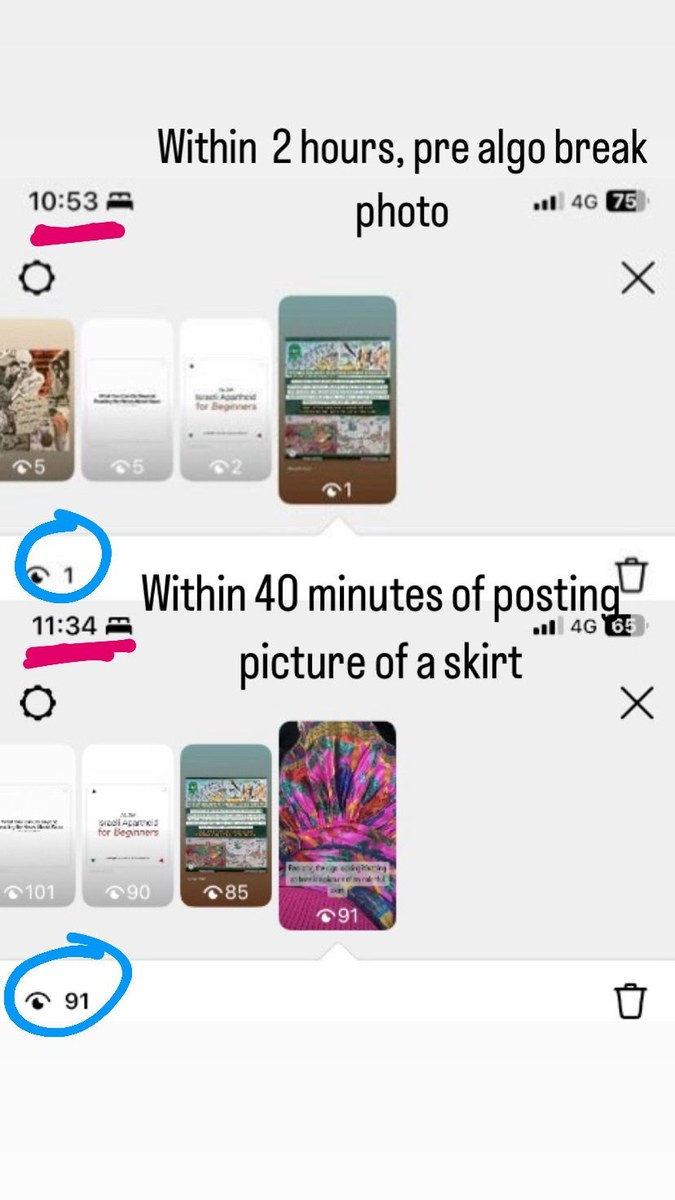
After posting a picture of a skirt, however, she reached 91 views in 40 minutes. (Instagram)
Several other users with pro-Palestinian accounts took to the site to raise awareness of the issue.
Another user, who asked to have her account handle blocked out, shared a story saying: “OK, so literally not one soul has seen my stories for the past hour.
“So let me try this: #FreeIsrael.”
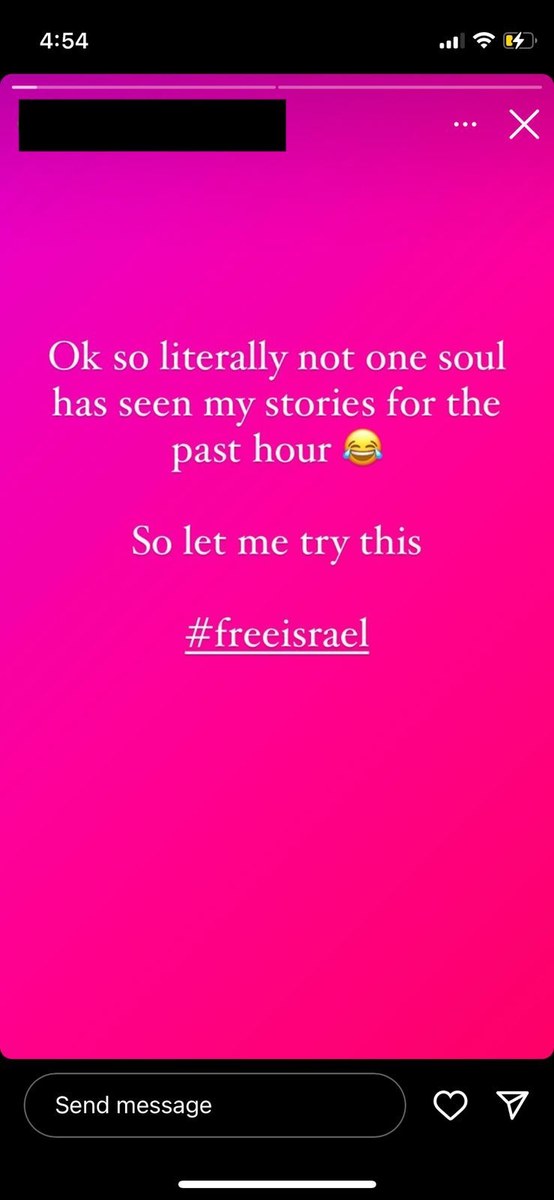
Several other users with pro-Palestinian accounts took to the site to raise awareness of the issue. (Instagram)

Soon after, she posted another story with the Palestinian flag, stating that 40 people saw the post within five minutes. “I guess you post with #FreeIsrael if you want a voice on this platform,” she wrote.
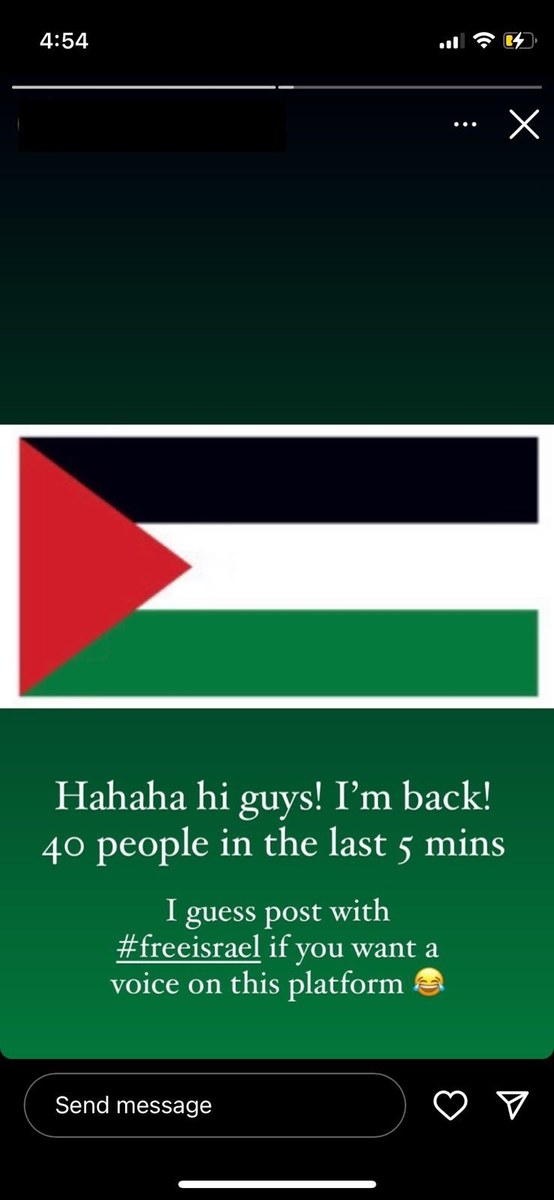
After posting a picture of a skirt, however, she reached 91 views in 40 minutes. (Instagram)
The targeting of pro-Palestinian accounts came after the Israeli siege was imposed on the Gaza Strip. Israeli Energy Minister Israel Katz said that “no electric switch will be turned on, no water hydrant will be opened, and no fuel truck will enter” until hostages taken by Hamas in its action were freed.
Nadim Nashif, the executive director and co-founder of 7amleh: The Arab Center for the Advancement of Social Media, a Palestinian digital rights group, told Arab News that “7amleh has repeatedly documented how Palestinian content gets overly moderated and overly scrutinized by major online platforms.”
He added: “In the most recent context, for example, we noticed a double standard in how Meta hid the search results on an all-encompassing Arabic hashtag … associated with the recent escalation, but did not take similar action on the parallel hashtag in Hebrew because that was mainly used by state actors who get treated preferentially.”
Meta refutes any claims of censorship on the basis of taking sides or silencing Palestinian voices.
A Meta spokesperson told Arab News: “The suggestion that we’re trying to suppress a particular community or point of view is categorically untrue.
“Our policies are designed to give everyone a voice while keeping people safe on our apps, and we apply these policies regardless of who is posting, or their personal beliefs.”
The social networking giant recently released a post in which it listed the actions it was taking on accounts.
One of the points noted that “given the higher volumes of content being reported to us, we know content that doesn’t violate our policies may be removed in error.”
This is not the first time that Meta and its subsidiaries — which include Facebook, Instagram and WhatsApp — have been accused of censorship and shadow banning, a term that refers to blocking a user from a social media site or online forum without their knowledge, typically by making posts and comments no longer visible to other users.
Nashif added: “When we believe certain media platforms are not safeguarding the digital rights of Palestinians, we work to build pressure on those platforms, through our communities, to ensure those social media platforms acknowledge their role and responsibilities to human rights and to ensure their platforms are free from discrimination.”
Arab News reported on the censorship of accounts containing pro-Palestinian sentiments during the Sheikh Jarrah protests in 2021.
Meta then worked with groups such as 7amleh to address the issues.
Nashif said: “Meta engaged with 7amleh and other civil society organizations to mitigate its human rights impact following an assessment of its performance during Sheikh Jarrah (protests).
“However, we continue to face an uphill battle as so much of the Palestinian narrative and factual reporting out of Palestine get disproportionately targeted because of the company’s policies.”
Yumna Patel, the Palestine news director of Mondoweiss, said: “The censorship of Palestinian voices — those who support Palestine, and alternative news media who report on the crimes of the Israeli occupation — by social media networks and giants like Meta and TikTok is well documented.
“We often see these violations become more frequent during times like this, when there is an uptick in violence and international attention on Palestine.
“We saw it with the censorship of Palestinian accounts on Instagram during the Sheikh Jarrah protests in 2021, the Israeli army’s deadly raids on Jenin in the West Bank in 2023, and now once again as Israel declares war on Gaza.”
Adnan Barq, a Palestinian public figure on Instagram, shared guidelines he was sent by Instagram, stating his content and profile could not be shown to non-followers.
Barq shared with the caption: “Blocked from going live. Stop your racism @instagram and grow the hell up.”
To counter the shadow-bans, users circulated a memo noting how to get around Meta’s guidelines such as “breaking the rhythm of posting about Palestine with any other content, preferably anything from your gallery and not reposting from the platform itself.”
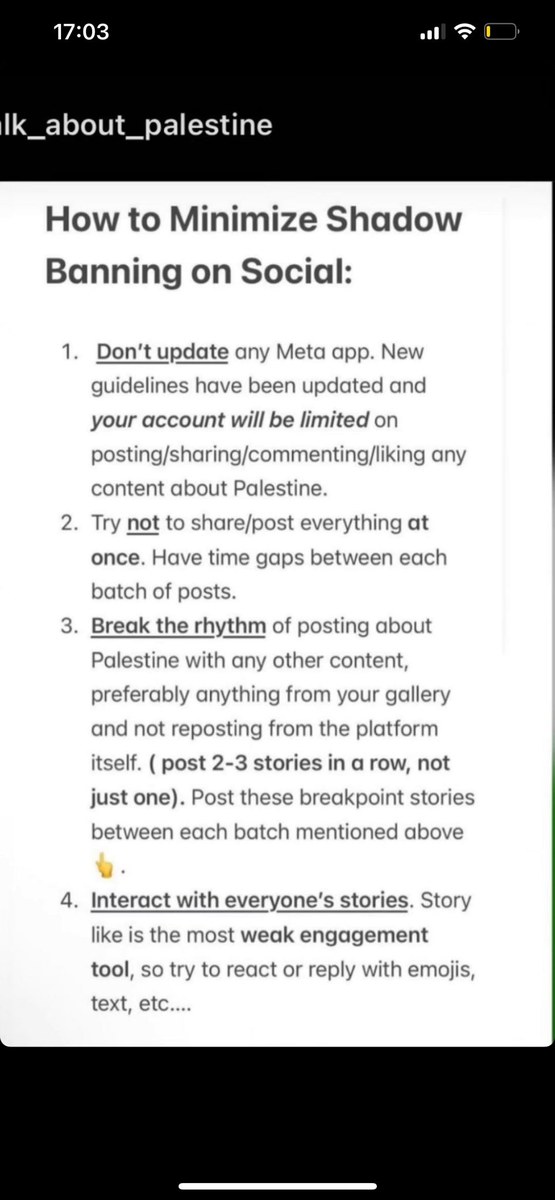
Users circulated a memo noting how to get around Meta’s guidelines. (Screenshot)
The European Commission also opened an investigation into X in the summer after warnings about misinformation linked to Hamas and Israel.
X was given 24 hours by the EU at the time to address the issue or face penalties under the Digital Services Act.
TikTok’s CEO Shou Zi Chew was given 24 hours by the European Commission on Thursday to show how his company was protecting teenagers from violent content and misinformation regarding issues surrounding incidents involving Israel and Hamas.
As Israel prepares for an on the ground invasion of Gaza while its residents were given 24 hours to evacuate, many social media users have been posting what they deem to be their last words citing lack of power to charge their outlets and the brutal bombardment they remain under.


