LONDON: Carrying the Palestinian flag is a symbol of solidarity with the Palestinian people’s legitimate struggle for basic human rights and their right to live in the recognized state of Palestine and should not be considered a criminal offense, a leading British discrimination lawyer has said.
“By waving the Palestinian flag, all you are doing is ultimately highlighting your sympathies, secondly your concerns and thoughts, and thirdly your support for the Palestinians and the people that are suffering,” which does not constitute an offense, Yasin Patel told Arab News.
His comments came in response to UK Home Secretary Suella Braverman’s letter to senior police chiefs earlier this week saying that waving a Palestinian flag or singing a chant advocating freedom for the occupied territory may be a criminal offense.
“It is not just explicit pro-Hamas symbols and chants that are cause for concern. I would encourage police to consider whether chants such as ‘From the river to the sea, Palestine will be free’ should be understood as an expression of a violent desire to see Israel erased from the world, and whether its use in certain contexts may amount to a racially aggravated section 5 public order offense,” she said in the letter released on Tuesday.
Her words, which follow relentless strikes by Israel on the Gaza Strip over the past eight days in response to a surprise attack by the Hamas group, deeply impact the right to freedom of expression, which “are fundamental rights that we have and the reason why we have those is (to) allow you those rights so that you can have democracy,” Patel said.
He said if people wanted to express their freedom of expression using the flag during marches that support the Palestinian cause they were entitled to do so, as this is a basic fundamental right according to UK law and enshrined within the European Charter.
“In terms of a public order (offense), one has to incite something, break the law or do something that’s unlawful in order to upset someone,” he said. “What’s been alleged here is that by waving the flag, you would upset Israeli citizens or those with sympathies for Israel and/or alternatively supporting Hamas.
“Hamas is a proscribed terrorist organization, but the Palestinian flag is not Hamas and Hamas is not the Palestinian flag,” he added.
Patel continued: “Braverman wants headlines, and no doubt she’s putting her two pennies’ worth in terms of trying to make sure that she’s lining herself up for the next PM role, but, ultimately, in terms of the law, it’s very simple; just because you wave a Palestinian flag that’s not a terrorist act, that’s not unlawful, that’s not illegal.
“If she does feel that’s the case, she can happily arrest those people who are carrying Palestinian flags, and I have no doubt, not only myself but thousands of other lawyers, would happily represent the people who (would stand) before the courts questioning what offense they’ve committed.
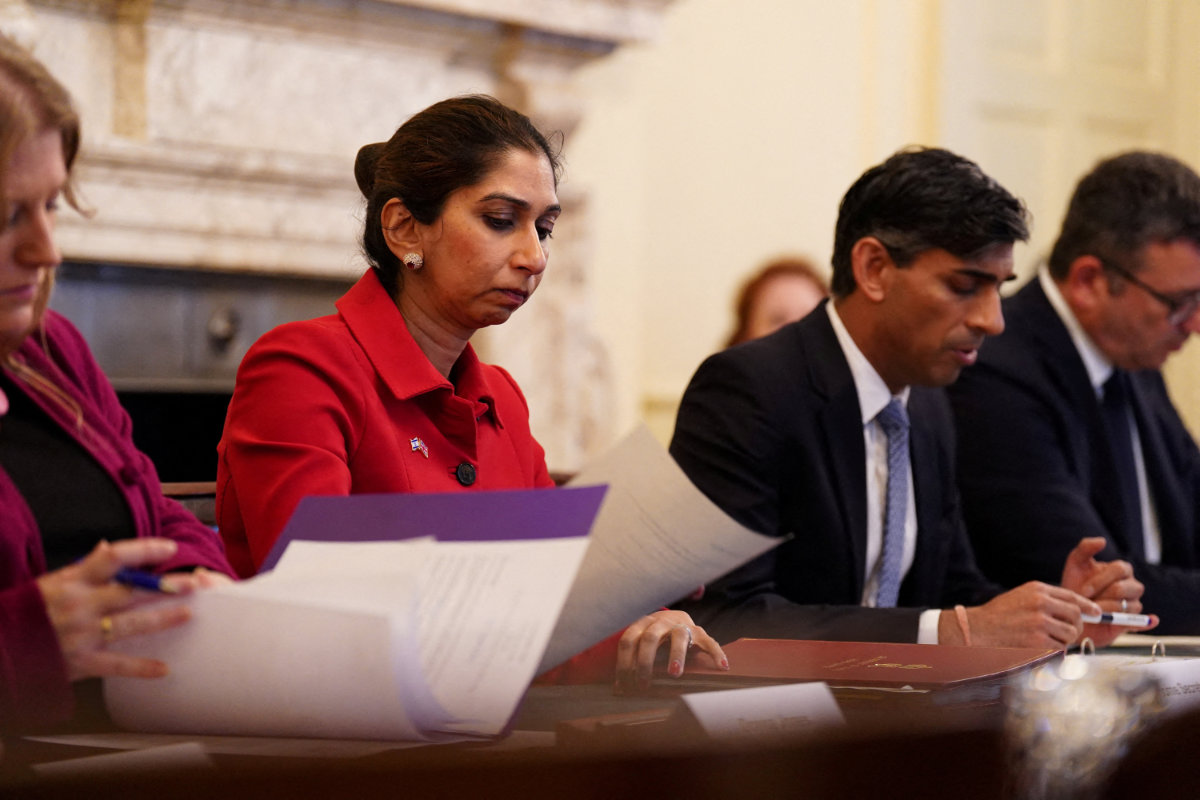
Home Secretary Suella Braverman (2-L) with Prime Minister Rishi Sunak as he hosts a policing roundtable at 10 Downing Street in London on October 12, 2023. (Pool via REUTERS)
“We had the Israeli flag upon Downing Street a couple of days ago. No one’s saying they can’t do that (but) I’m a bit surprised that the government only shows support to one side but not all the innocent babies, children, citizens who are dying and about to die in the hands of the Israeli military now.”
Beleigh Jbara, a former human rights lawyer, called Braverman’s two-page letter a “disgrace,” and said that it would be difficult for British society to agree to, while questioning whether it was “acceptable or not acceptable by law and regulations and police powers.”
Jbara said that if the British government and parliament were saying Hamas was a terrorist group, then this was about what the UK has to do to prevent its society from supporting such a group.
“We’re talking about protecting the UK society from such events coming from outside and getting into our society, like what happened throughout Al-Qaeda and Daesh,” where young generations had gone to the Middle East to fight, he said.
UK-based Friends of Al-Aqsa, an NGO concerned with defending the human rights of Palestinians, condemned Braverman’s suggestion that flying Palestinian flags or chanting “Free Palestine” would be a criminal act and said her “veiled threat and denial of political expression is unacceptable.”
Its chair, Ismail Patel, said: “It is draconian for the British government to deny our right to express the plight of the Palestinians. Legitimate political expression should not be a privilege, nor the reserve of those allied with the government; it is a fundamental right for all citizens in a democratic society.”
He added: “I was at the forefront of organizing and demonstrating against the British government’s war against Afghanistan and Iraq (and) we were never obstructed from voicing our opinions like this. So why is this government giving cover to Israeli policies by denying British citizens their right to political expression?
“The right to champion the plight of the occupied, discriminated-against and marginalized is integral to democracy,” and the UK government’s “steps will prevent British citizens from helping to end human rights violations, which will disenfranchise people from political activism,” he said.
FOA was one of six groups to organize a rally on Saturday, along with the Palestine Solidarity Campaign, where tens of thousands of pro-Palestinian protesters took to the streets of London in defiance of Braverman’s letter.
Ben Jamal, the director of PSC, said that the letter was “deeply concerning” and “threatens civil liberties and normalizes the dehumanization of Palestinians that is widespread in current political discourse.”
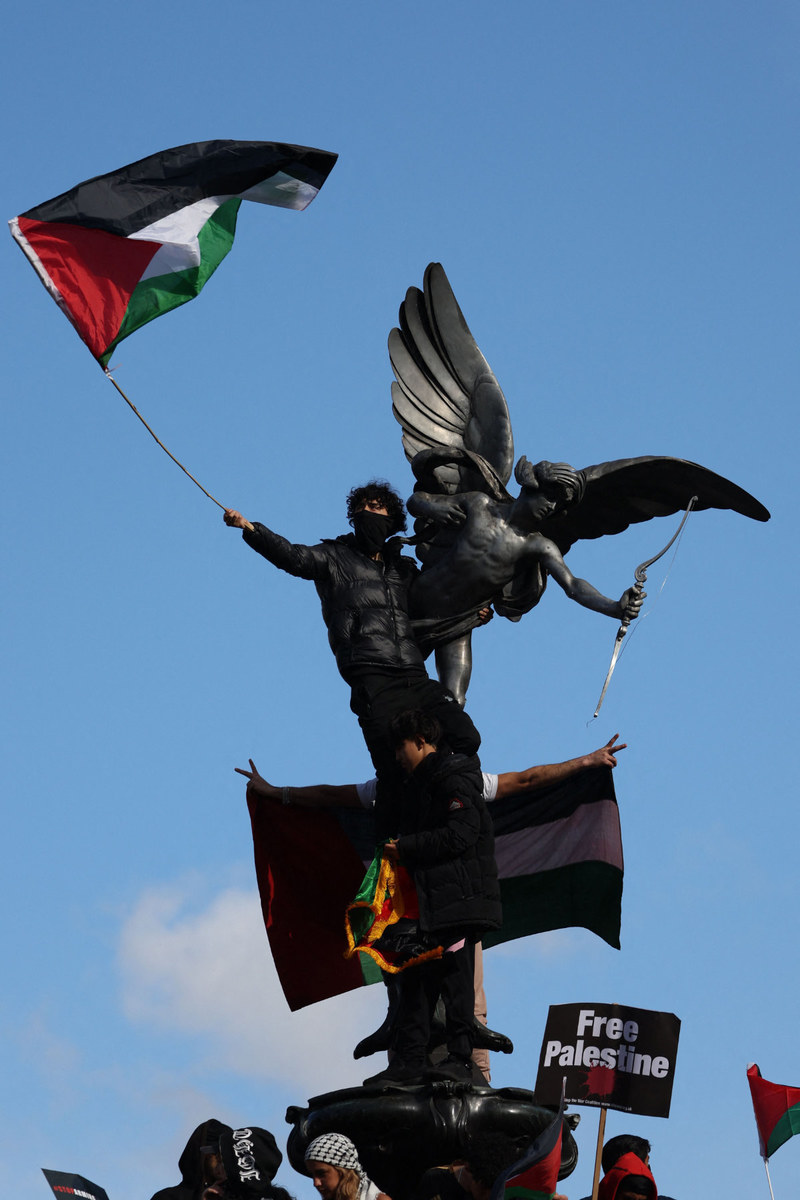
A protester holding a Palestinian flag climbs the Eros statue at Piccadilly Circus during a 'March For Palestine', part of a pro-Palestinian national demonstration, in London on October 14, 2023. (AFP)
He added that police officers enacting Braverman’s orders would be denying “the right of Palestinians to fly the flag of their country; a flag which is the symbol both of their nationhood and struggle for liberation from Israel’s apartheid system of oppression.”
Jamal said that the Palestinian flag “is a precious national symbol that represents its people’s aspirations for freedom and self-determination, to live in peace and equality.”
Meanwhile, Rajab Shamalakh, former president of the Palestinian Community in the UK, said Braverman’s statement “was clearly siding with Israel despite the fact of her knowing that the Israeli army has inflicted lots of misery on the Palestinian people by attacking civilians, bombing homes without any warning, and they’ve killed over 600 Palestinian children” so far.
“When someone protests, by default, they’re going to have to carry the flag of (those) whom they are sympathetic with because the picture that we are seeing is a major catastrophe, so of course we have to carry the Palestinian flag to show those people who are under siege, being bombed, being killed, and they feel they need some kind of support,” he said.
Shamalakh, who is originally from Gaza, added that the Palestinian flag has been recognized by the UN and “there are more countries who recognize Palestine with its flag than those who recognize Israel.”
Shamalakh, who has lost at least 13 family members — 12 from one household — since the war began, said Braverman “cannot deprive people of practicing democracy in a manner that is allowed and there is no law that has been physically passed to prevent people or to make it illegal, adding that there have been many similar demonstrations in the past “so why is it different this time?“