Arab League slams Israel siege of Gaza, demands aid for Gazans

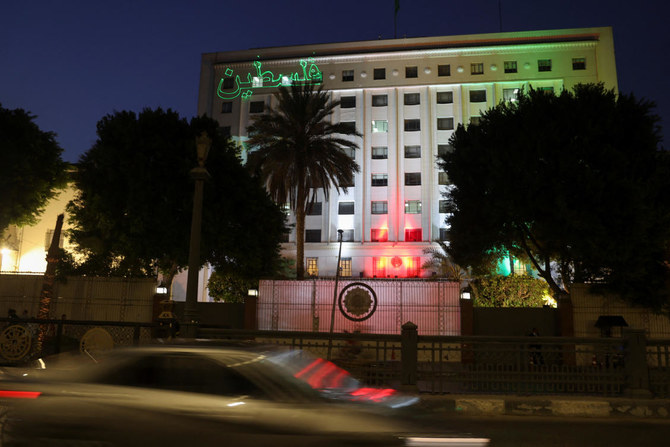
An Arabic sign reading "Palestine" is projected on the Arab League headquarters, in support of Palestinians on the day the league's foreign ministers met to discuss the Israeli-Palestinian conflict, in Cairo on Oct.11, 2023. (Reuters)
Short Url
Updated 11 October 2023
Follow

Arab League slams Israel siege of Gaza, demands aid for Gazans

  • The Arab foreign ministers urged Israel to reconsider its “unjust decision to cut electricity supply and water to Gaza”

CAIRO: Arab foreign ministers on Wednesday denounced Israel’s siege of Gaza following the shock attack by Palestinian militants on Israel, demanding that aid be “immediately” allowed to enter the blockaded enclave.
Israel has imposed a “complete siege” on the Gaza Strip, cutting off the water supply, food, electricity and other essential supplies, after Saturday’s massive assault by Hamas militants that has killed hundreds on both sides.
On Wednesday, as Israel kept up its bombardment of targets in the crowded and impoverished coastal enclave for a fifth day, the only power plant in Gaza shut down.
The Palestinian enclave’s electricity authority made the announcement saying the plant had run out of fuel.
Meeting at Arab League headquarters in Cairo, Arab foreign ministers discussed the ongoing war between Israel and Hamas and demanded Israel lift its siege of Gaza.
They also called for the “immediate” dispatch of food, fuel and humanitarian aid to the impoverished and densely populated coastal enclave.
The Arab foreign ministers also urged Israel to reconsider its “unjust decision to cut electricity supply and water to Gaza.”
Five days of relentless bombardment of Gaza by Israel in retaliation for the brutal assault on Israeli communities across the border have left the tiny territory in tatters.
Air strikes have struck residential buildings, mosques, factories and shops, said Salama Marouf of the Gaza government’s media office.
Medical supplies, including oxygen, were running low at Gaza’s overwhelmed Al-Shifa hospital, said emergency room physician Mohammed Ghonim.
Israel has reported a “staggering” 1,200 deaths since Saturday’s onslaught by the militants while Gaza officials speak of more than 1,000 people killed in Israel air and artillery strikes.
Gaza is one of the most densely populated places on the planet, with 2.3 million people living on a 362-square-kilometer strip of land.
It has been under Israeli blockade since 2007 when Hamas took control of the territory from the secular Fatah movement of Palestinian president Mahmud Abbas.
The only entrance to Gaza not controlled by Israel is Rafah on the Egyptian border.
Rafah has been bombarded by Israel three times this week.


Egypt vows to prevent escalation between Lebanon and Israel amid tensions over Hezbollah

Updated 19 December 2025
Follow

Egypt vows to prevent escalation between Lebanon and Israel amid tensions over Hezbollah

  • “Egypt will spare no effort in continuing its tireless endeavors to keep Lebanon away from any escalation,” Madbouly told reporters
  • Madbouly’s visit also focused on strengthening bilateral ties and addressing pressing regional development

BEIRUT: Egypt is doing all it can to prevent further escalation between Lebanon and Israel amid tension between the two neighbors over the disarmament process of the militant Hezbollah group, the country’s prime minister said Friday during a visit to the Lebanese capital.
Egypt, which signed a peace treaty with Israel in 1979, has been working for months to deescalate the regional tensions and Prime Minister Mustafa Madbouly’s visit to Beirut comes after similar trips to the small Arab nation by Egypt’s foreign minister and intelligence chief.
“Egypt will spare no effort in continuing its tireless endeavors to keep Lebanon away from any escalation,” Madbouly told reporters during a joint briefing with his Lebanese counterpart Nawaf Salam.
Madbouly’s visit also focused on strengthening bilateral ties and addressing pressing regional developments.
Madbouly’s meetings in Beirut came as the committee monitoring the enforcement of a US-brokered ceasefire that halted the latest war between Israel and Hezbollah a year ago held another meeting Friday.
Friday’s gathering along the Lebanon-Israel border was the second meeting of the mechanism after Israel and Lebanon appointed civilian members to a previously military-only committee. The group also includes the United States, France and the UN peacekeeping force deployed along the border.
A statement issued by the US Embassy in Beirut said that military participants offered operational updates and remained focused on deepening the cooperation by finding ways to increase coordination through the mechanism. It added that all participants agreed that a strengthened Lebanese army, the guarantors of security in the border area known as the south Litani Sector, “is critical to success.”
The embassy added that civilian participants meanwhile focused on setting conditions for residents to return safely to their homes, advancing reconstruction, and addressing economic priorities. It added that they underscored that durable political and economic progress is essential to reinforcing security gains and sustaining lasting peace.
The embassy said meeting participants reaffirmed that progress on security and political tracks remain mutually reinforcing and essential “to ensuring long-term stability and prosperity for both parties.”
The Lebanese government has said that the army should have the whole border area south of the Litani River cleared from Hezbollah’s armed presence by the end of the year.
The latest Israel-Hezbollah war began on Oct. 8, 2023, a day after Hamas-led militants attacked southern Israel, after Hezbollah fired rockets into Israel in solidarity with Hamas. Israel launched a widespread bombardment of Lebanon in September 2024 that severely weakened Hezbollah, followed by a ground invasion.
Israel has carried out almost daily airstrikes since then, mainly targeting Hezbollah members, but also killing 127 civilians, according to the office of the UN High Commissioner for Human Rights.
Also Friday, the Israeli military said that a Hezbollah operative who was captured from Lebanon last year played a major role in the group’s secretive maritime force. The military added that Imad Amhaz was trained in Iran and Lebanon to carry out maritime operations.
A Hezbollah official said the group will not comment on the video released by the Israeli military of Amhaz, describing him as “a Lebanese citizen who was kidnapped.” The official spoke on condition of anonymity because he was not authorized to speak to the media.