What We Are Reading Today: The Synthetic University

Short Url
Updated 09 October 2023
Follow

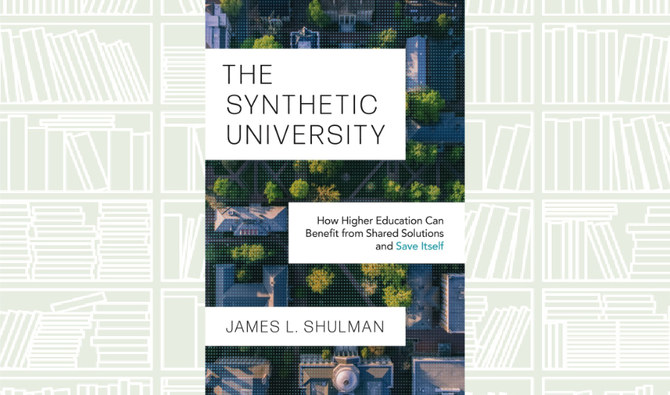
What We Are Reading Today: The Synthetic University

Author: James L. Shulman

US colleges and universities have long been the envy of the world. Institutional autonomy has fostered creativity among faculty, students, and staff. But this autonomy means that colleges tend to create their own solutions for every need. As a result, higher education suffers from costly redundancies that drive tuitions ever upward, putting higher education, essential to the fabric of the country, at risk.

Instead of wishful thinking about collaboration or miraculous subsidies, “The Synthetic University” describes intermediary organizations that can provide innovative, cost-effective solutions.


What We Are Reading Today: A Capital’s Capital

Updated 16 February 2026
Follow

What We Are Reading Today: A Capital’s Capital

Authors: Gilles  Postel-Vinay and Jean-Laurent Rosenthal

Successful economies sustain capital accumulation across generations, and capital accumulation leads to large increases in private wealth. In this book, Gilles Postel-Vinay and Jean-Laurent Rosenthal map the fluctuations in wealth and its distribution in Paris between 1807 and 1977. 

Drawing on a unique dataset of the bequests of almost 800,000 Parisians, they show that real wealth per decedent varied immensely during this period while inequality began high and declined only slowly. 

Parisians’ portfolios document startling changes in the geography and types of wealth over time.

Postel-Vinay and Rosenthal’s account reveals the impact of economic factors (large shocks, technological changes, differential returns to wealth), political factors (changes in taxation), and demographic and social factors (age and gender) on wealth and inequality.

Before World War I, private wealth was highly predictive of other indicators of welfare, including different forms of human capital, age at death, and access to local public goods.