

Pakistan condemns Indian chief minister’s ‘irresponsible’ remarks on ‘taking back’ Sindh province

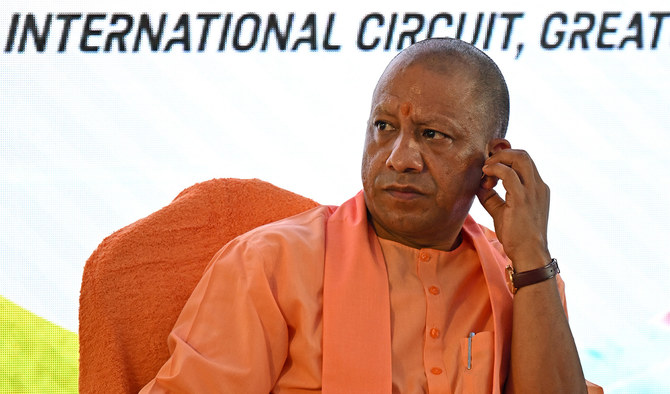
The chief minister of India's Uttar Pradesh state Yogi Adityanath attends an 'Invest India' conference before the start of the Indian MotoGP Grand Prix at the Buddh International Circuit in Greater Noida on the outskirts of New Delhi, on September 24, 2023. (AFP/File)
Short Url
Updated 09 October 2023
Follow

Pakistan condemns Indian chief minister’s ‘irresponsible’ remarks on ‘taking back’ Sindh province

  • Uttar Pradesh Chief Minister Yogi Adityanath said on Sunday that there is no reason why India cannot ‘take back Sindhu’
  • Pakistan’s foreign office spokesperson advises India to avoid nurturing ‘hegemonic and expansionist ambitions’

ISLAMABAD: Pakistan’s foreign office spokesperson on Monday criticized the recent statement by the chief minister of India’s Uttar Pradesh state regarding Sindh, saying that the “highly irresponsible” remarks reflect the leader’s expansionist mindset. 

Addressing a convention in Lucknow, Uttar Pradesh Chief Minister Yogi Adityanath said on Sunday that if Ram Janmabhoomi— a site in Ayodhya believed by Hindus to be the birthplace of Rama— can be taken back after 500 years, then there is no reason why India cannot take back Sindhu, the region around the Indus River in southern Pakistan. 

“We condemn the highly irresponsible remarks made by the Chief Minister of Uttar Pradesh, a key member of India’s ruling dispensation and a follower of the bigoted Hindutva ideology, at the National Sindhi Convention in Lucknow,” Foreign Office Spokesperson Mumtaz Zahra Baloch said in a statement. 

The site in the northern town of Ayodhya was bitterly contested for decades with both Hindus and Muslims laying claim to it. India’s majority Hindus say the site was holy to them long before Muslim Mughals razed a temple at the spot and built the Babri mosque there in 1528.

A Hindu mob destroyed the mosque in 1992, triggering riots that killed about 2,000 people across India, most of them Muslims.

Baloch condemned Adityanath for using Ram Janmabhoomi’s reclamation as a template for reclaiming Pakistan’s Sindh province. 

“Clearly, the Chief Minister’s provocative remarks are inspired by the gratuitous assertion of ‘Akhand Bharat’ (undivided India),” she said. 

“These remarks manifest a revisionist and expansionist mindset that seeks to subjugate the identity and culture of not only India’s neighboring countries but also its own religious minorities.”

Baloch urged Indian leaders to resolve disputes with neighboring countries to build a peaceful South Asia instead of nurturing “hegemonic and expansionist ambitions.”


Pakistan says CPEC has helped bridge cultural and language barriers with China

Updated 10 sec ago
Follow

Pakistan says CPEC has helped bridge cultural and language barriers with China

  • Ataullah Tarar suggests Pakistan-China digital platform to counter ‘disinformation’ around CPEC
  • People-to-people ties have remained limited between the two states despite strong official relations

ISLAMABAD: Federal Minister for Information and Broadcasting Ataullah Tarar said on Wednesday the China-Pakistan Economic Corridor (CPEC) has brought about a “cultural change,” helping break barriers of language and bringing the two countries closer together.

Pakistan and China have longstanding strategic relations, though much of their interactions have traditionally occurred at the government-to-government level through diplomatic, strategic and economic engagements. People-to-people ties between them have mostly remained limited, though the Pakistani minister said there was a gradual shift in the trend in the wake of the multibillion-dollar economic, infrastructure development and regional connectivity initiative.

Launched in 2015, CPEC includes investments in energy, transport, and industrial zones, and has since become a cornerstone of bilateral ties and Pakistan’s long-term development strategy.

“CPEC in Pakistan has broken a lot of barriers. It has broken the barrier of language, and it has broken the barriers of division. It has brought harmony,” Tarar said while addressing a ceremony organized by the Pakistan-China Institute, a local think tank.

“This corridor brought about a cultural change where we had investments coming in, where we had infrastructure being built, where we had industry being built, where we had airports and seaports being developed.”

He said it was “heartening” to see cultural change in Pakistan, such as a Chinese citizen speaking fluent Urdu or a Pakistani citizen speaking Mandarin.

Tarar said the cultural shift had become part of Pakistan’s ethos as the two countries move forward, describing Chinese President Xi Jinping’s 2015 visit as a turning point in reviving the economy.

He also maintained CPEC was targeted by a disinformation campaign, suggesting a digital media platform between Pakistan and China to counter the problem.

“I would suggest that maybe the Pakistan-China Institute can come up with a digital media platform to call out fake news and to label fake news circulating around CPEC,” he said, adding the government would fully support the endeavor.

“I think that will go a long way in not only strengthening the media cooperation but also in getting rid of misinformation and stating the correct facts in a very timely manner,” he added.

Tarar said the initiative will help promote a positive narrative around CPEC 2.0, referring to the next phase of the initiative that aims to focus on industrial development in Pakistan.