

Filipino Muslim affairs agency sets out to develop halal agro-industry in Philippines

1 / 2
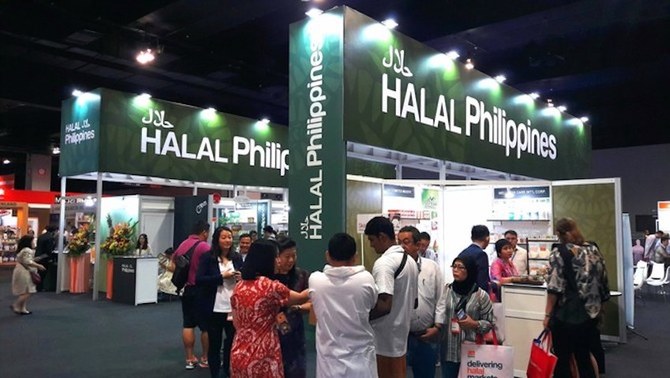
Filipino companies display halal-certified food products at the Malaysia International Halal Showcase in Kuala Lumpur, Malaysia on April 3, 2019. (MIHAS)
2 / 2
Short Url
Updated 09 October 2023
Follow

Filipino Muslim affairs agency sets out to develop halal agro-industry in Philippines

  • Philippine officials have been working to promote, develop domestic halal industry
  • NCMF wants to help strengthen Filipino Muslim communities, support national goals

MANILA: Muslim authorities in the Philippines are working to develop agro-industrial hubs dedicated to halal products throughout the country, the National Commission on Muslim Filipinos said on Monday.

Muslims make up over 6 percent of the Philippines’ nearly 110 million, predominantly Catholic population. Most live on the island of Mindanao and the Sulu archipelago in the country’s south, as well as the central-western province of Palawan.

NCMF, the body governing Muslim affairs in the Philippines, has set eyes on developing halal agro-industrial hubs to also support Manila’s efforts to expand Filipino presence in the global halal market.

“The implementation of halal agro-industrial hubs in the 17 regions across the country will produce halal food and non-food products for local consumption and for exportation,” NCMF spokesman Yusoph Mando told Arab News on Monday.

“This will create hundreds of thousands of jobs and means of livelihood for the jobless Filipinos, Muslims and Christians alike,” he said, adding that the halal agro-industrial hubs can be established in a number of areas across the country, including in its largest and most populous island of Luzon.

“The halal industry is growing in the Philippines and (the country is) considered to be a potential key player in the halal industry globally because of its rich natural resources, strategic location, and growing population.”

The Philippines dispatched a special trade mission to member states of the Gulf Cooperation Council in February, aimed at promoting halal-certified food from the Southeast Asian nation.

It was later followed by the Philippine Economic Zone Authority announcing in May that it would promote the domestic halal industry to tap into the rapidly growing regional and global markets, estimated to be worth more than $7 trillion.

The halal industry potential was also a focus for President Ferdinand Marcos Jr. during his state visit to Malaysia in July, during which he sought to forge synergies to tap into the global market opportunities.

NCMF is keen on supporting the Philippine halal industry as it is part of the agency’s mission to address the needs of Filipino Muslim communities as well as national development goals.

“NCMF is (aiming) to improve the Muslim Filipino communities’ capacities through catch-up development programs, activities, and projects, a dream that will need the support of Philippine legislators and public offices,” Mando said.


SpaceX acquires xAI in record-setting deal as Musk looks to unify AI and space ambitions

Updated 03 February 2026
Follow

SpaceX acquires xAI in record-setting deal as Musk looks to unify AI and space ambitions

  • The deal is the biggest M&A transaction of all time
  • Deal values xAI at $250 billion, SpaceX at $1 trillion

Elon Musk said on Monday ​that SpaceX has acquired his artificial-intelligence startup xAI in a record-setting deal that unifies Musk’s AI and space ambitions by combining the rocket-and-satellite company with the maker of the Grok chatbot. The deal, first reported by Reuters last week, represents one of the most ambitious tie-ups in the technology sector yet, combining a space-and-defense contractor with a fast-growing AI developer whose costs are largely driven by chips, data centers and energy. It could also bolster SpaceX’s data-center ambitions as Musk competes with rivals like Alphabet’s Google, Meta, Amazon-backed Anthropic ‌and OpenAI in the ‌AI sector.
The transaction values SpaceX at $1 trillion, and ‌xAI ⁠at $250 ​billion, according ‌to a person familiar with the matter.
“This marks not just the next chapter, but the next book in SpaceX and xAI’s mission: scaling to make a sentient sun to understand the Universe and extend the light of consciousness to the stars!” Musk said. The purchase of xAI sets a new record for the world’s largest M&A deal, a distinction held for more than 25 years when Vodafone bought Germany’s Mannesmann in a hostile takeover valued at $203 billion ⁠in 2000, according to data compiled by LSEG. The combined company of SpaceX and xAI is expected to price shares ‌at about $527 each, another person familiar with the matter said. ‍SpaceX was already the world’s most ‍valuable privately held company, last valued at $800 billion in a recent insider share sale. ‍XAI was last valued at $230 billion in November, according to the Wall Street Journal. The merger comes as the space company plans a blockbuster public offering this year that could value it at over $1.5 trillion, two people familiar with the matter said.
SpaceX, xAI and Musk did not immediately respond ​to requests for comment.
The deal further consolidates Musk’s far-flung business empire and fortunes into a tighter, mutually reinforcing ecosystem – what some investors and analysts informally ⁠call the “Muskonomy” – which already includes Tesla, brain-chip maker Neuralink and tunnel firm the Boring Company. The world’s richest man has a history of merging his ventures together. Musk folded social media platform X into xAI through a share swap last year, giving the AI startup access to the platform’s data and distribution. In 2016, he used Tesla’s stock to buy his solar-energy company SolarCity.
The agreement could draw scrutiny from regulators and investors over governance, valuation and conflicts of interest given Musk’s overlapping leadership roles across multiple firms, as well as the potential movement of engineers, proprietary technology and contracts between entities.
SpaceX also holds billions of dollars in federal contracts with NASA, the Department of Defense and intelligence agencies, which all have some authority ‌to review M&A transactions for national security and other risks.
