

PCB ‘extremely disappointed’ over World Cup visa delays for Pakistani fans, journalists

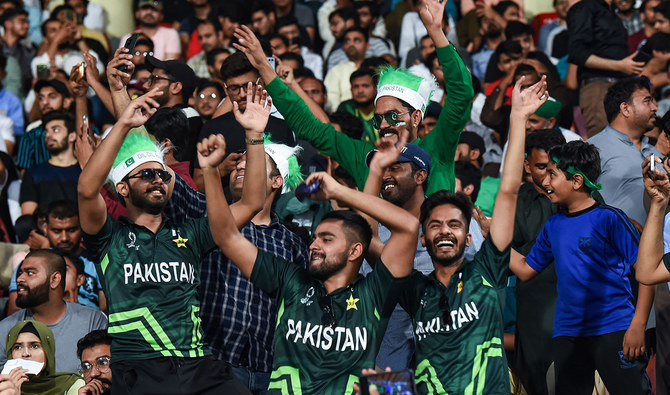
Pakistan's fans cheer during the Asia Cup 2023 one-day international (ODI) cricket match between Pakistan and Bangladesh at the Gaddafi Stadium in Lahore on September 6, 2023. (AFP/File)
Short Url
Updated 09 October 2023
Follow

PCB ‘extremely disappointed’ over World Cup visa delays for Pakistani fans, journalists

  • There was no Pakistani fan or media presence for opening game against Netherlands last week
  • PCB asks government to evaluate Pakistani cricketers’ security in India during the World Cup

ISLAMABAD: The Pakistan Cricket Board (PCB) said on Monday it was “extremely disappointed” that Pakistani fans and journalists were facing visa delays for the World Cup tournament in India, urging Islamabad to take up the matter with the Indian government. 

When Pakistan captain Babar Azam’s team arrived in Hyderabad last month, they were pleasantly surprised to receive a warm welcome at the airport. However, they have lamented a lack of support from the stands as their fans remain stranded in Pakistan.

Around 60 Pakistani journalists are expected to make the trip for the World Cup. Pakistan had plenty of local support for their World Cup opener against Netherlands in Hyderabad on Friday but no member of their media contingent or fan was present. Cricket has been a victim of a soured political relationship between the neighbors and bitter rivals, who play each other only in multi-team events like the World Cup.

“PCB is extremely disappointed to see that journalists from Pakistan and fans are still facing uncertainty about obtaining an Indian visa to cover Pakistan games in ICC World Cup 2023,” the board said in a statement. 

The board said it has again reminded the International Cricket Council (ICC) and the Board of Control for Cricket in India (BCCI) about their respective obligations and of the conditions stipulated in the Host agreement to guarantee visas for fans and journalists of participating teams.

The board said PCB Management Committee Chairman Zaka Ashraf met Pakistan Foreign Secretary Syrus Sajjad Qazi to raise his concerns over the issue. The PCB official urged Pakistan’s government to discuss the issue with India’s home ministry via the Pakistan High Commission in New Delhi, the statement added. 

Ashraf also took note of Indian media reports about security threats and requested the government to evaluate players’ security in the country. 

“He emphasized that the well-being and safety of the Pakistan squad was of paramount importance,” the PCB statement added. 

Visas for the Pakistan team itself were granted barely 48 hours before they left for what is their first tour of India since the T20 World Cup in 2016.

Earlier this week, the ICC told Indian media it was working with the BCCI to ensure visas for Pakistani fans and journalists were issued. 

“This [visa] is an obligation of our host [BCCI] and they are working hard on it with our full support. Every effort is being made to get this sorted,” an ICC spokesperson told India’s PTI news agency.

Pakistan began their campaign on the field with an easy victory over the Netherlands on Friday. They next take on Sri Lanka in a match between two former champions on Tuesday. On Oct. 14, Pakistan take on arch-rivals India in arguably the most anticipated match of the tournament. 


Pakistan says defense pact with Saudi Arabia elevated brotherly ties to ‘new heights’

Updated 25 February 2026
Follow

Pakistan says defense pact with Saudi Arabia elevated brotherly ties to ‘new heights’

  • Pakistan, Saudi Arabia signed strategic defense pact last year pledging aggression against one will be treated as attack on both
  • Deputy PM Ishaq Dar says enduring bonds with Islamic and Arab nations form vital pillar of Pakistan’s foreign policy 

ISLAMABAD: Deputy Prime Minister Ishaq Dar said on Wednesday that Pakistan’s defense pact with Saudi Arabia elevated its brotherly ties with the Kingdom to “new heights,” stressing that close ties with Arab and Islamic nations form a key pillar of Islamabad’s foreign policy. 

Pakistan and Saudi Arabia signed a Strategic Mutual Defense Agreement on Sept. 17 last year, pledging that aggression against one country would be treated as an attack on both, enhancing joint deterrence and formalizing decades of military and security cooperation.

Both nations agreed in October 2025 to launch an economic cooperation framework to strengthen trade and investment ties. 

“In the Middle East, our landmark Strategic Mutual Defense Agreement with Saudi Arabia has elevated our brotherly ties to new heights,” Dar said while speaking at the Pakistan Governance Forum 2026 event in Islamabad. 

The Pakistani deputy prime minister was speaking on the topic “Navigating International Relations Amidst Changing Geo-Politics.”

Dar noted that Pakistan has reinforced partnerships with other Middle Eastern nations such as the UAE, Qatar, Jordan, Oman, Egypt and Bahrain. He said these partnerships have yielded “concrete agreements” in investment, agriculture, infrastructure, and energy sectors. 

“Our enduring bonds with Islamic and Arab nations form a vital pillar of our foreign policy, and we will continue to expand our partnerships across Asia, Latin America, and Africa,” he said. 

Dar pointed out that the presidents of Kazakhstan, Uzbekistan and Kyrgyzstan have undertaken visits to Pakistan in recent months, reflecting Central Asian nations’ desire to boost cooperation with Islamabad.

On South Asia, the Pakistani deputy PM said Pakistan has successfully transformed its fraternal ties with Bangladesh into “a substantive partnership.”

“Similarly, the trilateral mechanism involving China, Pakistan, and Bangladesh has been launched with a view to expanding and deepening regional cooperation and synergy,” the Pakistani minister said. 

He said Islamabad has strengthened its “all-weather” partnership with China via the second phase of the multi-billion-dollar China-Pakistan Economic Corridor agreement and “unwavering support” from both sides for each other’s core interests. 

Dar said Pakistan had also reinvigorated its partnership with the US, advancing cooperation in trade, technology, investment, and regional stability. 

“This calibrated approach has enhanced our ability to navigate complexity with skill and confidence, ensuring that our national interests are served without compromising our core foreign policy principles,” he said.