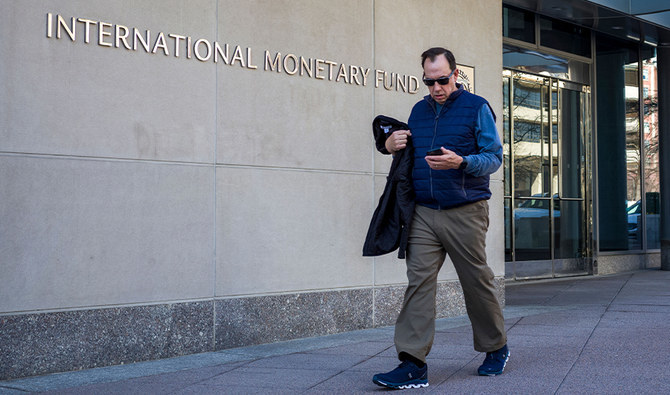
KARACHI: Pakistan remains hopeful of clearing the International Monetary Fund’s (IMF) inaugural economic review for its short-term loan program next month, a success that would unlock approximately $700 million in disbursements, following the implementation of stringent financial reforms, according to financial experts in the country.
In July of this year, the IMF Executive Board approved a vital nine-month Stand-By Arrangement (SBA) for Pakistan, allocating $3 billion to bolster the country’s economic stabilization efforts. Having received an initial sum of $1.2 billion the same month, Pakistan is now gearing up for a review scheduled for November.
The country’s interim administration has implemented a raft of tough financial measures in recent months to secure the IMF backing, including hikes in electricity and fuel prices as well as interest rates, which led to intense inflationary pressure in the economy.
The government also plans to increase gas tariffs, fulfilling a critical stipulation set by the IMF.
“Despite challenges and a few missed targets related to external funding, primary deficit and gas price adjustments, we think there is high probability that Pakistan will get the next IMF tranche,” Muhammad Sohail, CEO of Topline Securities, said.
According to a research report by Topline Securities released a day earlier, the IMF’s upcoming review for Pakistan includes a comprehensive set of performance markers, comprising two continuous criteria, four indicative targets, and 10 structural benchmarks. Out of these benchmarks, three are continuous, while the remaining seven are scheduled for completion post-September 2023.
During his post-monetary policy analysts briefing on September 14, the governor of the country’s central bank emphasized that all quantitative performance goals pertaining to the State Bank of Pakistan (SBP) — including Net Domestic Assets (NDA), swaps, and net international reserves — had been successfully met.
Supported by the SBA, Pakistan’s new IMF program serves as a foundational policy framework for addressing both domestic and external imbalances. It also paves the way for financial backing from multilateral and bilateral partners.
Key focal points of the program involve the execution of the FY24 budget to enact required fiscal adjustments for debt sustainability, reestablishing a market-driven exchange rate, enhancing the functionality of the foreign exchange market, and implementing a rigorously tight monetary policy aimed at curbing inflation.
With elections on the horizon for early next year, experts believe that essential reforms are likely to be rolled out during the tenure of the caretaker government, as an elected administration may hesitate to impose stringent financial measures.
“The most likely situation will be that the unpopular reforms, which the elected government may be reluctant to enforce, are likely to be implemented by the current government,” Dr. Vaqar Ahmed, Joint Executive Director at the Sustainable Development Policy Institute (SDPI), told Arab News.
Ahmed expressed confidence that Pakistan would successfully pass the IMF review, with the expectation that all required reforms would be completed by the end of February next year. He noted that challenging measures, such as hikes in electricity and fuel prices, had already been implemented.
The national polls in Pakistan were constitutionally scheduled to take place in November, though they were delayed by the election commission to redraw national and provincial constituencies and are now slated for January.
The government that emerges from these elections will negotiate a new loan program with the IMF.
“In another situation,” Dr. Ahmed said, “there is no clarity, in case the election is delayed, whether the SBA could be extended, or new program would materialize.”
According to a briefing by the governor of the State Bank of Pakistan, the country’s total external financing requirement for FY24 stands at $24.6 billion. Of this amount, $2.8 billion has already been disbursed, and the central bank has secured commitments for rollovers amounting to $8 billion.


Pakistan optimistic about success of IMF review following painful economic measures
https://arab.news/4s3kg
Pakistan optimistic about success of IMF review following painful economic measures

- The country has increased electricity and fuel prices to comply with the IMF conditions ahead of next month’s review
- Pakistan will get $700 million disbursement after the successful completion of the IMF evaluation under July agreement

Pakistan, seven Muslim nations back Palestinian technocratic body, stress Gaza-West Bank unity
- The National Committee for the Administration of the Gaza Strip was announced on January 14
- Muslim nations call for consolidation of the ceasefire and unimpeded humanitarian aid into Gaza
ISLAMABAD: Pakistan and seven other Muslim-majority countries on Thursday welcomed the formation of a temporary Palestinian technocratic body to administer Gaza, stressing that it must manage daily civilian affairs while preserving the institutional and territorial link between the Gaza Strip and the West Bank amid the ongoing peace efforts.
In a joint statement, the foreign ministers of Pakistan, Egypt, Jordan, Saudi Arabia, Qatar, Türkiye, Indonesia and the United Arab Emirates said the newly announced National Committee for the Administration of the Gaza Strip would play a central role during the second phase of a broader peace plan aimed at ending the war and paving the way for Palestinian self-governance.
“The Ministers emphasize the importance of the National Committee commencing its duties in managing the day-to-day affairs of the people of Gaza, while preserving the institutional and territorial link between the West Bank and the Gaza Strip, ensuring the unity of Gaza, and rejecting any attempts to divide it,” the statement said.
The committee, announced on Jan. 14, is a temporary transitional body established under United Nations Security Council Resolution 2803 and is to operate in coordination with the Palestinian Authority, the ministers said.
The statement said the move forms part of the second phase of US President Donald Trump’s Comprehensive Peace Plan for Gaza, which the ministers said they supported, praising Trump’s efforts to end the war, ensure the withdrawal of Israeli forces and prevent the annexation of the occupied West Bank.
The top leaders of all eight Muslim countries attended a meeting with Trump in New York last September, shortly before he unveiled the Gaza peace plan.
The ministers also called for the consolidation of the ceasefire, unimpeded humanitarian aid into Gaza, early recovery and reconstruction and the eventual return of the Palestinian Authority to administer the territory, leading to a just and sustainable peace based on UN resolutions and a two-state solution on pre-1967 lines with East Jerusalem as the Palestinian capital.


