

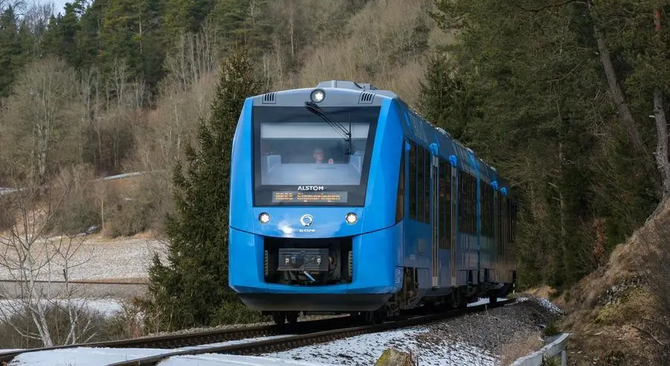
Saudi Arabia starts testing its ambitious hydrogen train project 

In September 2022, Saudi Arabia Railways inked a memorandum of understanding with the French rail transportation giant Alstom to develop hydrogen train solutions tailored for the Kingdom. Photo/Supplied
Short Url
Updated 08 October 2023
Follow

Saudi Arabia starts testing its ambitious hydrogen train project 

RIYADH: Saudi Arabia has achieved a new milestone in sustainable transportation as its national railway company has entered into an agreement with its French partner to commence testing for its ambitious hydrogen train project. 

In September 2022, Saudi Arabia Railways inked a memorandum of understanding with the French rail transportation giant Alstom to develop hydrogen train solutions tailored for the Kingdom. 

As per the Saudi Press Agency, both entities will embark on operational experiments and studies to assess the trains’ compatibility with the environment, setting the stage for their future deployment. 

Saudi Arabia Railways has underscored that these trains represent a pioneering initiative in the Middle East and North Africa, highlighting the Kingdom’s commitment to adopting sustainable transportation technologies. 

Minister of Transport and Logistics Services Saleh bin Nasser Al-Jasser told the SPA that this step is an outcome of the National Strategy for Transport and Logistics Services. He emphasized SAR’s continuous transformation into a more sustainable transportation system driven by the latest technologies. 

FASTFACTS

In September 2022, Saudi Arabia Railways inked a memorandum of understanding with the French rail transportation giant Alstom to develop hydrogen train solutions tailored for the Kingdom. 

Both entities will embark on operational experiments and studies to assess the trains’ compatibility with the environment, setting the stage for their deployment. 

Alstom has previously undertaken the implementation of Riyadh Metro Lines 3, 4, 5, and 6, a major project featuring six lines spanning 176 km and comprising 85 stations.

Al-Jasser further said that the Saudi railway company is committed to achieving the Saudi Green Initiative, as envisioned in Saudi Vision 2030. This initiative encompasses reducing carbon emissions, increasing reliance on clean energy, and protecting the environment. 

According to SAR CEO, Bashar bin Khaled Al-Malik, the hydrogen train stands as one of the most pivotal innovations in modern sustainable transport. 

The ability to generate the energy required for train operation without emitting carbon holds a set of advantages, making it an attractive option for sustainable energy. Moreover, its environmental, economic, and generational benefits make it a promising option for the future. 

Notably, Alstom has previously undertaken the implementation of Riyadh Metro Lines 3, 4, 5, and 6, a major project featuring six lines spanning 176 km and comprising 85 stations. It ranks among the world’s largest urban transit undertakings. 

Having established its presence in the Kingdom as far back as 1951 with the installation of the first gas turbine, Alstom has been instrumental in advancing the region’s transport infrastructure. The company continues to be a prominent provider of sustainable mobility solutions in Saudi Arabia, thanks to its substantial investments in rail transport systems. 


Closing Bell: Saudi stocks slip as Tadawul falls 1% amid broad market weakness

Updated 30 December 2025
Follow

Closing Bell: Saudi stocks slip as Tadawul falls 1% amid broad market weakness

RIYADH: Saudi stocks fell sharply on Tuesday, with the Tadawul All Share Index closing down 108.14 points, or 1.03 percent, at 10,381.51.

The broader decline was reflected across major indices. The MSCI Tadawul 30 Index slipped 0.78 percent to 1,378.00, while Nomu, the parallel market index, fell 1 percent to 23,040.79.

Market breadth was strongly negative on the main board, with 237 stocks falling compared to just 24 gainers. Trading activity remained robust, with 164.7 million shares changing hands and a total traded value of SR3.19 billion ($850.6 million).

Among the gainers, SEDCO Capital REIT Fund led, rising 2.73 percent to SR6.77, followed by Chubb Arabia Cooperative Insurance Co., which gained 2.69 percent to SR20.20.

National Medical Care Co. added 1.72 percent to close at SR141.60, while Alyamamah Steel Industries Co. and Thimar Advertising, Public Relations and Marketing Co. advanced 1.57 percent and 1.13 percent, respectively.

Losses were led by Al Masar Al Shamil Education Co., which tumbled 8.36 percent to SR24.65. Raoom Trading Co.fell 6.75 percent to SR64.20, while Alkhaleej Training and Education Co. dropped 6.60 percent to SR18.12 and Naqi Water Co. declined 5.51 percent to SR54.00. Gulf General Cooperative Insurance Co. closed 5.44 percent lower at SR3.65.

On the announcement front, Chubb Arabia Cooperative Insurance Co. signed a multiyear insurance agreement with Saudi Electricity Co. to provide various coverages, expected to positively impact its financial results over the 2025–2026 period. The deal will run for three years and two months and is within the company’s normal course of business.

Meanwhile, Bupa Arabia for Cooperative Insurance Co. announced a one-year health insurance contract with Saudi National Bank, valued at SR330.2 million, covering the bank’s employees and their families from January 2026. Despite the sizable contract, Bupa Arabia shares fell 0.8 percent to close at SR137, weighed down by the broader market weakness.

In contrast, United Cooperative Assurance Co. revealed an extension of its engineering insurance agreement with Saudi Binladin Group for the Grand Mosque expansion in Makkah. The contract value exceeds 20 percent of the company’s gross written premiums based on its latest audited financials and is expected to support results through 2026. However, the stock came under selling pressure, ending the session down 4.51 percent at SR3.39.