

Russia to seek return to UN rights body despite Ukraine war

1 / 4
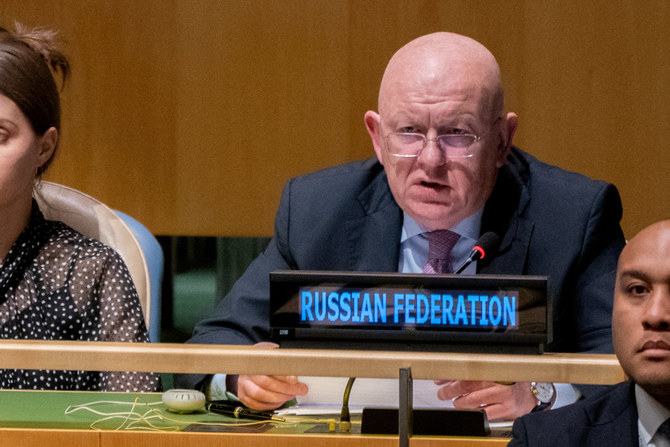
Russian Ambassador to the UN Vassily Nebenzia address members of the general assembly prior to a vote on a resolution condemning Russia's invasion of Ukraine on October 12, 2022. (REUTERS/File Photo
2 / 4
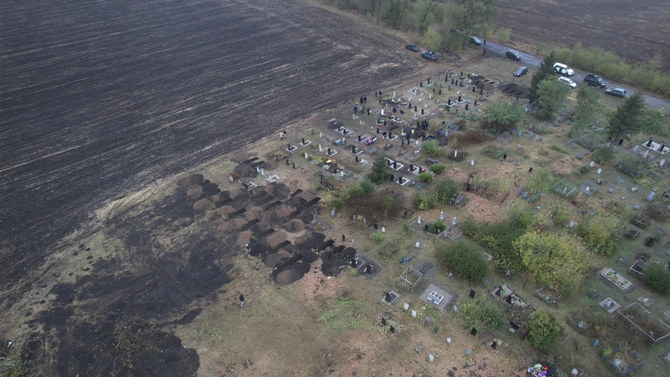
New graves for victims of a rocket strike are seen at a cemetery in the village of Hroza, near Kharkiv, Ukraine, on Oct. 7, 2023. (AP)
3 / 4
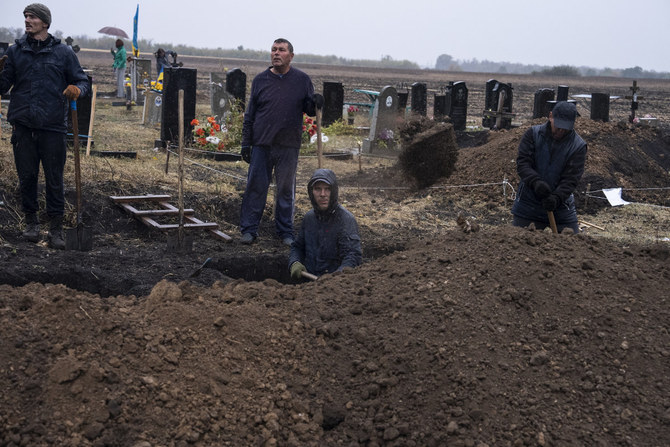
Relatives and friends mourn by the coffins of a couple, who were among over 50 Ukrainians killed by a Russian rocket strike in the village of Hroza, near Kharkiv, on Oct. 7, 2023. (AP)eede
4 / 4
Ukrainians dig graves for victims of a rocket strike in the village of Hroza, near Kharkiv, on Oct. 7, 2023. (AP)
Short Url
Updated 08 October 2023
Follow

Russia to seek return to UN rights body despite Ukraine war

  • UNGA will vote on Tuesday to elect 15 new members to the Geneva-based UN body, for terms running from 2024 to 2026
  • To be elected to the rights council, a country needs 97 votes of the UN’s 193 member countries

UNITED NATIONS: Russia, which was ousted from the UN Human Rights Council after its forces invaded Ukraine, will attempt a return to the body on Tuesday — an uncertain move that will provide a gauge of its international support.

The UN General Assembly will vote that day to elect 15 new members to the Geneva-based UN body, for terms running from 2024 to 2026.
The council’s 47 members are allocated by region, and each large regional group usually pre-selects its own candidates, which the General Assembly then generally approves.
But this year two groups have more candidates than available seats: Latin America (candidates from Brazil, Cuba, the Dominican Republic and Peru will contest three seats), and Eastern Europe (Albania, Bulgaria and Russia will vie for two seats).
Moscow’s candidacy has drawn skepticism, and the vote will come just days after a Russian missile attack on the Ukrainian village of Groza killed more than 50 people in a scene of carnage.
“We hope UN members will firmly reject (Russia’s) preposterous candidacy,” a State Department spokesperson told AFP on condition of anonymity.
“Members of Russia’s forces have committed violations of international humanitarian law, including war crimes and crimes against humanity in Ukraine,” the spokesperson added.
Mariana Katzarova, a top UN expert, recently said repression inside Russia had intensified since its February 2022 invasion of Ukraine, reaching levels “unprecedented in recent history.”
To be elected to the rights council, a country needs 97 votes of the UN’s 193 member countries.
In April 2022, 93 countries voted to suspend Russia from the council, while 24 opposed that move.
That majority vote against Russia was less lopsided than other resolutions defending the territorial integrity of Ukraine, with around 140 countries approving.
But the situation with the rights council is more complex, as some countries also seen as rights offenders fear they may face the same fate.

The vote Tuesday will be by secret ballot — perhaps shining a clearer light on a fragmented world in which several developing countries have grown weary of the West’s persistent focus on Ukraine.
“I think Western diplomats in New York are rather worried Russia could sneak back into the Human Rights Council” in what would be “a public relations disaster for the UN on a massive scale,” said Richard Gowan of the International Crisis Group.
“Russia has always argued that many UN members sympathize with it in private but won’t support it in public for fear of antagonizing Western powers,” he added. “Moscow will hope that this supposed silent majority supports it in this secret vote.”
Vassily Nebenzia, the Russian ambassador to the UN, pushed back, saying: “There are no beacons of democracy or rogue states, as is sometimes being portrayed. No member state can claim to be immune from human rights violations.”
Louis Charbonneau of the NGO Human Rights Watch (HRW) conceded that no member of the council “has an unblemished rights record,” but added that “every UN member nation should recognize that the council has membership standards for which Russia and China show despicable disregard.”
His group has called on member countries to also refrain from voting for Beijing, citing its violations of the rights of China’s Uyghur minority.
China, however, risks little in the vote: It is one of four countries in the Asian regional group vying for four open seats.
HRW is also calling for countries to oppose Cuba’s candidacy, while another NGO, the International Service for Human Rights, opposes not just the Russian and Chinese candidacies but also that of Burundi.
Other candidates on Tuesday are Ivory Coast, Malawi, Ghana, Kuwait, Indonesia, Japan, the Netherlands and France.


Cuba says attacking speedboat had nearly 13,000 rounds of ammunition

Updated 9 sec ago
Follow

Cuba says attacking speedboat had nearly 13,000 rounds of ammunition

  • Firefight took place at a range of 20 meters, Cuba says
  • Incoming crew originally ‌set out on two vessels but ditched one
HAVANA: A commando of Cuban exiles who intended to infiltrate Cuba on a speedboat was armed with nearly 13,000 rounds of ammunition, 13 rifles and 11 pistols, Cuban officials said on Friday, providing new details about Wednesday’s deadly exchange of gunfire at sea. The government in Havana has said 10 Cuban nationals coming from the United States entered Cuban waters and opened fire on a border guard vessel, leading Cuban forces to return fire killing four and wounding six others, who were taken into custody.
In an attempt to dispel doubts about its account to date, senior Cuban Interior Ministry officers displayed the captured armaments from the studio on a special television program, including bins full of at least some of the 12,846 recovered rounds. They also showed pictures of the vessels, each peppered with bullet holes from ‌the firefight they ‌said took place at a range of 20 meters (66 feet).
The confrontation took place ‌at ⁠a fraught moment ⁠in US-Cuban relations, with US President Donald Trump pressuring the island by imposing a virtual oil blockade after capturing and ousting Venezuelan President Nicolas Maduro, a crucial Cuban ally, on January 3.
Cuba has identified the assailants as Cuban exiles, some of whom had been previously placed on a list of accused terrorists, who came from the United States with the intent to sow chaos and attack military units on the Communist-ruled island.
“The intent of this group is to infiltrate, to promote public disorder. To incite the people to unite. To carry out something violent. Attack military units ⁠in order to incite social unrest and to unite the people in order to ‌steal the revolution. That has been duly proven,” said Col. Victor Alvarez ‌of the Interior Ministry.
Cuba says response ‘proportional’
US politicians have expressed skepticism over Cuba’s version of events. Secretary of State Marco ‌Rubio on Wednesday said his government would independently investigate, adding that it was not a US operation and ‌that no US government personnel were involved.
Cuban officers said the infiltrators set out from Marathon in the Florida Keys on two vessels but ditched one at some point due to technical difficulties. They united on one speedboat, which a US official said was reported stolen in Florida. Cuba said it recovered a drone, radios, knives, a portable power plant, bolt cutters and ‌other materiel. They also found emblems of the November 30th Movement and People’s Self-Defense, anti-communist groups that oppose the Cuban government.
Cuba says a patrol of five ⁠border guard members on ⁠a 9-meter boat spotted the incoming vessel shortly after 7 a.m., with some members of the incoming crew in the water, about one nautical mile off a cay on the Caribbean island’s northern coast, about 100 miles (160 km) from Marathon.
The infiltrators opened fire at a distance of 185 meters, striking the captain of the Cuban vessel in the abdomen, Cuba said. Bleeding heavily, the wounded captain remained at the helm and steered toward the enemy vessel, leading to a firefight at a distance of about 20 meters, the officers said.
Cuba called its response “proportional.”
“It is a defensive model that practically never uses firearms, and the use of firearms is proportional to the type of action being carried out against our force,” said Interior Ministry Col. Ybey Carballo.
The captured Cuban nationals were receiving medical care and face charges including armed aggression, illegal entry into national territory, crimes associated with terrorist acts, and arms trafficking, prosecutor Edward Robert Campbell told the program. He said they face prison terms of up to 10 to 15 years for the lesser offenses and 20 to 30 years — or even the death penalty — for the more serious charges.