

Asian Games put Saudi team on track ahead of Paris Olympics

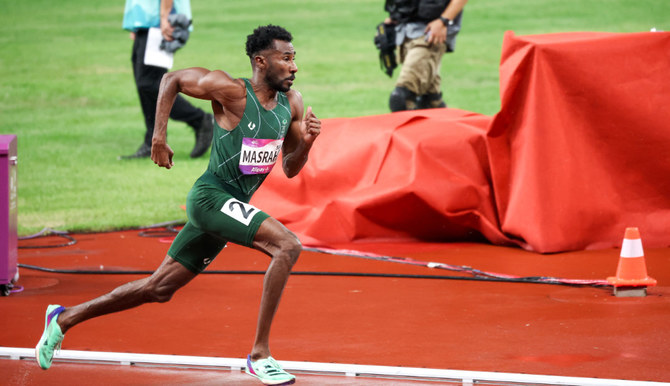
Saudi athlete and gold medalist Yousef Ahmed Masrahi participates in the men's 400 m event during the 19th Asian Games in Hangzhou, China, on Sept. 30. (AN photo)
Short Url
Updated 08 October 2023
Follow

Asian Games put Saudi team on track ahead of Paris Olympics

  • Saudi Arabia has gained most of its medals in athletics so far
  • Saudi team’s performance at the 19th Asian Games is already their best since 2014

HANGZHOU: The performance of young Saudi athletes at this year’s Asian Games so far has shown the world the support they receive from their country and sparked expectations of even better performances in upcoming international events. 

Saudi participants in the 19th Asian Games in China have so far won 10 medals, including four golds — the country’s best performance in the Games since 2014. 

Most of the medals were won in track and field, traditionally the Kingdom’s strongest area in the Asian Games. 

Saudi Arabia’s medal tally at this year’s Games is already nearly double its total at the last edition of the event in Indonesia in 2018. 

On Sept. 30, Yousef Ahmed Masrahi won Saudi Arabia’s first gold in the men’s 400m event with a time of 45.55 seconds, just 0.02 seconds ahead of Japan’s Sato Kentaro, who won the Asian Championship a few months ago.  

The 35-year-old Masrahi had the fastest reaction time in the finals, proving age is just a number for him. 

Martial artist Abdulmalik Al-Murdhi won Saudi Arabia’s first-ever medal in ju-jitsu on Wednesday, picking up bronze in the under-62kg category.  

The 21-year-old runner Essa Kzwani won the Kingdom’s second gold in the men’s 800m on Tuesday. While the other finalists struggled to better their timing from the heats, Kzwani finished in 1:48.05, nearly a second faster than his time in heat one. 

Niranjan Rajbanshi, treasurer of the Asian wing of the International Sports Press Association, was particularly struck by Kzwani’s performance. 

“I remember there used to be very little Saudi Arabian participation in track events, but now they’re competing for gold medals. In fact, to see a 21-year-old Saudi win the medal against all odds is a good message for Asian athletics too. Other nations should learn from this,” he told Arab News. 

Another two Saudi golds came from the equestrian team, along with silvers in the men’s 200m and men’s shot, and three further bronzes, in pole vaulting, the men’s jiu-jitsu under-85kg category, and the men’s karate over-84kg category. 

Abdullah Akbar Mohammed, who picked up silver in the men’s 200m final, said the pressure took a toll on him as he missed out on gold by a whisker, finishing 0.03 seconds behind Japan’s Koki Ueyama (20.60 seconds).  

“Honestly, I aimed for the gold, but the pressure of the race caused the loss,” he told reporters. “But I’m grateful for winning a silver medal. Thank God for the win. Hopefully, next time I’ll do better.” 

“Next time” could be the Paris 2024 Summer Olympics. Rajbanshi, for one, believes Saudi athletes have reason to be optimistic. 

“There are talents, and with the support that Saudi Arabia’s government is giving, this is a good message for the Asian contingent as a whole,” he said. “We saw experienced Masrahi making a comeback, and a few days later the youngster Kzwani winning gold, too. We can expect good things to follow at the Olympics next year.”


‘Papaya’s not going anywhere’: How McLaren banished the wilderness years on and off the track

Updated 16 December 2025
Follow

‘Papaya’s not going anywhere’: How McLaren banished the wilderness years on and off the track

  • On-track success of 2 constructors’ championships and Lando Norris’s title win matched by a rebrand attracting a new generation of fans to the British F1 team

ABU DHABI: It’s been just over a week since Lando Norris claimed his first Formula One championship title, but for McLaren’s growing army of supporters the party continues.

When the British driver crossed the finish line at Abu Dhabi’s Yas Marina Circuit in third place to confirm his title victory, you could be forgiven for thinking the post-race celebrations had a familiar look to others in recent years at the season-closing Grand Prix in the UAE’s capital.

This time however, the celebrating fans were sporting the orange of McLaren’s distinctive “papaya” livery, rather than the orange of Max Verstappen’s native Netherlands.

The resurgence of the British team in recent years has been nothing short of remarkable. On the track, their overwhelming supremacy has been secured by a superior car and two gifted drivers in Norris and Australia’s Oscar Piastri. Off it, they deployed one of motor sport’s most successful rebranding campaigns, as a result of which McLaren’s main color now rivals Ferrari’s red as the most iconic in F1.

“You know, it was the fans’ choice to bring papaya back,” Matt Dennington, co-chief commercial officer at McLaren, told Arab News.

“Back in, I think it was 2016, we went out to our fans and it was an overwhelming ‘yes’ that they wanted to see our heritage come back into the team. It’s a key brand asset for us.”

Speaking during a “Live Your Fandom” event at Yas Island in Abu Dhabi, co-hosted with Velo, a team sponsor since 2019, he said: “For us, the fans are the lifeblood of our sport. We don’t go racing without them, and to be able to celebrate our fans and our partners together has been awesome.”

Norris’s success in Abu Dhabi was a crowning moment for the team, but the development on the track has been clear and dramatic for several years.

In 2017, the team finished a lowly ninth out of 10 in the constructors’ championship. Improvements to the car, particularly after switching to a Mercedes engine, helped the team move up to become a fixture in the “mid-field” F1 grid. Then, in 2024, came the giant leap forward as McLaren won the team title and then retained it this year.

In tandem with those successes, the commercial work that has taken place off the track has helped McLaren, in large part thanks to return of its papaya colors, develop one of the strongest brand identities in all of sports.

“Obviously, the on-track performance has been a great boost for that,” Dennington said. “You know, the other areas that have helped progress our fandom, and the sport, is the work that Liberty Media have done in the schedule.”

Liberty, an American mass media company, acquired Formula One Group from CVC Partners in 2017 for $4.4 billion. The popularity of the sport has skyrocketed since then thanks to huge engagement across media channels — including a certain Netflix show.

“More races, more races in the US, ‘Drive to Survive’ (on Netflix, and) we had the F1 movie,” Dennington said. “So there’s some great media platforms really driving the audience growth and the diversity of the audience.

“As a team, we’ve been pushing ourselves to be more sophisticated in the way in which we engage and communicate with our teams, but also looking at the partners we work with to give our fans the access to the McLaren brand and access to racing culture.”

The team’s portfolio now boasts more than 50 sponsors, among them Google, Mastercard and British American Tobacco. Dennington highlighted a number of campaigns that caught the public’s imagination.

“Some good examples of that is the work that we’ve done with Reiss and Abercrombie & Fitch — we bought our first women’s line of fashion through those organizations; the work we’re doing with Lego in capturing those sort of youth consumers into the brand; and also the work we’ve done with Tumi over the last few years in the luggage category.

“So we’re trying to extend the brand, we’re trying to create more access.”

In August, McLaren and Velo launched the “Live Your Fandom” campaign, offering nine superfans from the UK, Romania, the Czech Republic, Mexico and other places a “golden ticket” F1 experience in the form of a full day at the McLaren Technology Centre in Woking, England.

The chosen fans enjoyed a behind-the-scenes tour, shared their memories of the team directly with McLaren Racing CEO Zak Brown, and took part in a surprise Q&A session with Norris.

One high-profile result of their special day was the graphical contributions they made to the team’s 2025 Abu Dhabi livery design, unveiled just days before Norris claimed the title, which featured art they helped create inspired by their most defining McLaren moments.

The livery features a series of bespoke images, including the “Papaya Family” representing the community spirit among McLaren F1 fans around the world; a “Forever Forward” friendship bracelet; and “Home Wins,” symbolizing the team’s victories this season in its home country at the British Grand Prix at Silverstone, and at the Bahrain Grand Prix, which is considered the team’s second home.

Other images celebrated the back-to-back constructors’ championship victories; 200 race wins; 50 top-two race finishes; and the fastest pitstop of the 2025 season (1.91 seconds).

Louise McEwen, McLaren Racing’s chief marketing officer, said: “Our fans are at the heart of everything we do, and this special livery is another way of showing our appreciation.

“Through the ‘Live Your Fandom’ campaign with Velo we’ve been able to celebrate their passion and creativity in a way that truly brings the Papaya Family together.”

Such efforts by McLaren to bring more fans even closer to the action will continue, Dennington said.

“Less than 1 percent of all fans in Formula One over their lifetime get to go to a race,” he added. “So I think it’s up to us as a sport, as teams, to be able to create more opportunities for them (and) to connect with our fans.”

As for the image and identity of the team moving forward, he had a reassuring message for fans: “Papaya’s not going anywhere and you’ll continue to see that into the future.”