Khan’s party tells Pakistan regulator enforced disappearances being used as ‘pre-poll rigging’ tactic

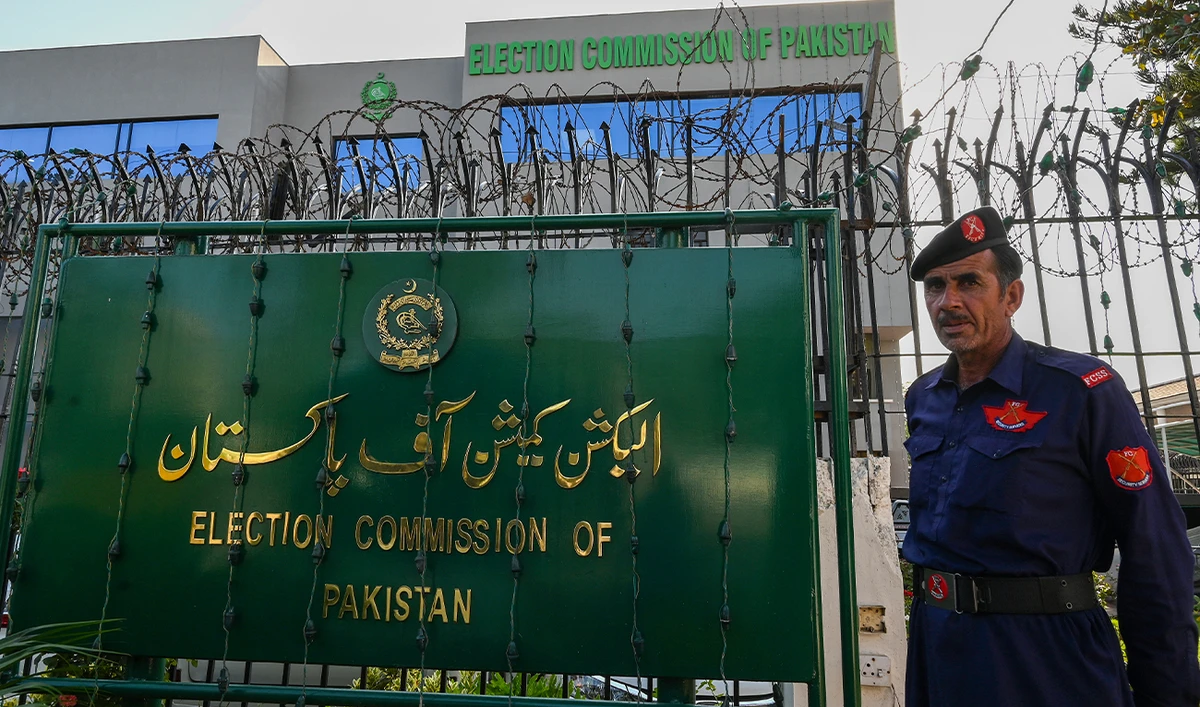
A security personnel stands guard at the headquarters of Election Commission of Pakistan in Islamabad, Pakistan on September 21, 2023. (AFP/File)
Short Url
Updated 03 October 2023
Follow

Khan’s party tells Pakistan regulator enforced disappearances being used as ‘pre-poll rigging’ tactic

  • Khan has openly accused the military and intelligence agencies of trying to destroy his political party
  • Army and government deny crackdown, say only Khan supporters involved in violence being punished

ISLAMABAD: The Pakistan Tehreek-e-Insaf (PTI) of former Prime Minister Imran Khan wrote a letter to the Election Commission of Pakistan (ECP) on Tuesday and called for action against enforced disappearances that it said were being used as an “orchestrated pre-poll rigging campaign” against the party.

Khan, who is serving a three-year jail sentence in a corruption case, has openly accused the powerful military and intelligence agencies of trying to destroy his political party, and said ongoing legal cases against him were a ploy to keep him out of the next general election likely in January. The conviction in the corruption case has effectively barred him from running for public office. 

A bruising year-long standoff between Khan, Pakistan’s most popular leader according to polls, and the army came to a head when military buildings and property were ransacked in May by Khan supporters after he was briefly arrested in a separate land graft case. After the violent protests, thousands of Khan supporters were arrested, the PTI says, and scores of its members, including the ex-premier’s closest aides, abandoned the PTI over what is widely believed to be pressure from the state.

The military and the previous government of PM Shehbaz Sharif, which was ruling during the May protests, have denied a crackdown against the PTI and said only those who were involved in the violence would be punished. The caretaker administration of PM Anwaar-ul-Haq Kakar has said the PTI would get a “level playing field” in the next elections.

“I wanted to bring to your attention perhaps the most serious of all the violations of the law and the Constitution happening right now as part of an orchestrated pre-poll election rigging campaign against PTI, the issue of enforced disappearances,” the PTI’s letter to the chief election commission said.

“The impunity with which individuals linked to PTI are being illegally arrested and disappeared, is perhaps the most blatant and open form of pre-poll rigging happening in the country. Even more than that, it is an exceptionally serious violation of Pakistan’s system of law and justice of the sort that has not been seen before, certainly not in recent history.”

The letter listed six PTI senior members as “victims” of a campaign of enforced disappearances, namely Sadaqat Ali Abbasi, former PTI MNA, missing since September 1, Usman Dar, a former adviser to Khan, missing since September 10, Abdul Kareem Khan, a PTI ticket holder from Lahore, missing since September 19, Awais Younus, PTI Lahore Secretary Information, missing since September 19, Farrukh Habib, a former minister of state, missing since September 27 and Sheikh Rasheed, a key Khan aide, missing since September 17.

The PTI said the disappearances were in violation of several articles of the Constitution of Pakistan, including Article 9 (security of a person), Article 10 (safeguards against arrest and detention under which anyone detained in custody must be produced before a magistrate within 24 hours), Article 10A (right to fair trial) and Article 14 (inviolability of dignity of a person and which protects the privacy of homes and bans any form of torture in custody), as well as the constitutionally guaranteed right of life.

The statement reminded the administration of PM Kakar that the caretaker’s primary responsibility was to hold free and fair elections and “be impartial to every person and political party.”

The PTI said the disappearances also contravened Pakistan’s commitments on several international covenants and treaties including the International Covenant on Civil and Political Rights (ICCPR), the Convention against Torture and Other Cruel, Inhuman or Degrading Treatment or Punishment (CAT), as well as the International Convention for the Protection of All Persons from Enforced Disappearance (CED), which is obligatory upon Pakistan under customary international law principles.

The letter named many pro-Khan journalists who had been arrested and later released, and members of former PM Khan’s staff and young volunteers who had disappeared for various lengths of time.

“Unless these people are released, and the law enforcement agencies, and any other agencies involved
are reprimanded to immediately desist from such practices, I am afraid that no question exists of the
upcoming elections being even remotely free or fair,” the statement, which was signed by the party’s secretary general, said.

“We hope that you will treat this matter with the urgency and seriousness it deserves, note what is happening, and discharge your duty in passing immediate and clear instructions to the government to produce these people, and to immediately desist from such activities in the future.”


Pakistan, 21 other countries condemn Israeli West Bank measures, warn of ‘de facto annexation’

Updated 5 sec ago
Follow

Pakistan, 21 other countries condemn Israeli West Bank measures, warn of ‘de facto annexation’

  • Joint statement says settlement expansion violates international law, cites UN resolutions, ICJ advisory opinion
  • Signatories include European and Latin American nations such as France and Brazil , alongside Muslim countries

ISLAMABAD: Pakistan and 21 other countries, including France, Brazil, Spain and Denmark, on Tuesday condemned sweeping Israeli measures to expand control over the occupied West Bank, warning the steps risk advancing “unacceptable de facto annexation” and undermining prospects for a two-state solution.

In a joint statement issued by the foreign ministers of countries from the Middle East, Europe and Latin America, as well as the secretaries general of the League of Arab States and the Organization of Islamic Cooperation, the signatories urged Israel to immediately reverse recent decisions reclassifying Palestinian land and accelerating settlement activity.

The statement marks a broadening of international criticism beyond Muslim-majority states that have long denounced Israeli settlement expansion, bringing together countries like Norway, Sweden, Portugal, Finland, Iceland, Ireland and Luxembourg alongside Arab and other Muslim-majority nations.

“Israel’s illegal settlements, and decisions designed to further them, are a flagrant violation of international law, including previous United Nations Security Council Resolutions and the 2024 Advisory Opinion of the International Court of Justice,” the ministers said.

They added the measures were “part of a clear trajectory that aims to change the reality on the ground and to advance unacceptable de facto annexation,” warning that they undermine ongoing efforts for regional peace and stability, including a proposed 20-Point Plan for Gaza, and threaten prospects for broader regional integration.

The ministers called on Israel “to reverse them immediately, to respect its international obligations, and to refrain from actions that would result in permanent changes to the legal and administrative status of the occupied Palestinian Territory.”

The latest statement follows mounting concern over Israel’s land and settlement policies in the West Bank.

Last week, Pakistan and seven other Muslim nations condemned Israel’s decision to approve land registration procedures in parts of the West Bank for the first time since 1967, a move widely seen as easing the path for settlement expansion and potential annexation.

Members of the Israeli cabinet have backed measures to tighten administrative control over areas of the West Bank, including Area C, which makes up around 60 percent of the territory and remains under full Israeli security and administrative control under the Oslo accords.

More than 500,000 Israeli settlers live in settlements and outposts in the West Bank, excluding Israeli-annexed East Jerusalem, alongside around three million Palestinians.

Settlements are considered illegal under international law, a position Israel disputes.

In the latest statement, the foreign ministers reiterated their rejection of “all measures aimed at altering the demographic composition, character and status of the Palestinian Territory occupied since 1967, including East Jerusalem,” and said they oppose “any form of annexation.”

“In view of the alarming escalation in the West Bank, we also call on Israel to put an end to settler violence against Palestinians, including by holding those responsible accountable,” they added.

The ministers pledged to take “concrete steps, in accordance with international law,” to counter the expansion of illegal settlements and policies or threats of forcible displacement and annexation.

Highlighting sensitivities around Jerusalem during Ramadan, they stressed the importance of preserving the historic and legal status quo at the city’s holy sites, recognizing the special role of the Hashemite custodianship of Jordan.

Reaffirming support for a negotiated settlement, the signatories said they remain committed to achieving “a just, comprehensive and lasting peace” on the basis of a two-state solution, in line with the Arab Peace Initiative and relevant UN resolutions, based on the June 4, 1967 lines.

“As reflected in the New York Declaration, the end of the Israeli-Palestinian conflict is imperative for regional peace, stability and integration,” the statement said, adding that only the realization of an independent, sovereign and democratic Palestinian state would allow coexistence among the region’s peoples and states.