

Pakistan declares ‘all-out war’ on militants after deadly attack on religious procession in Balochistan

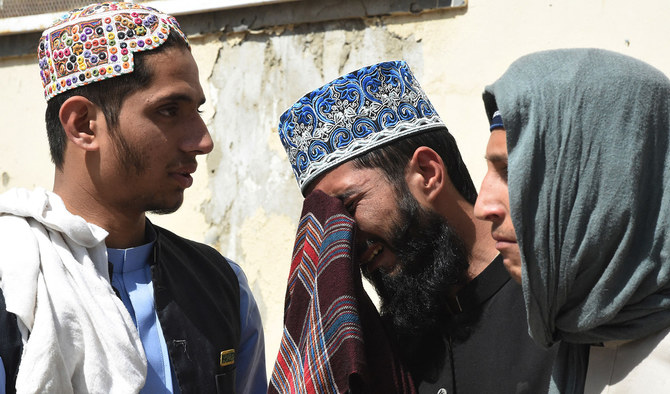
Relatives mourn the death of a blast victim at a hospital in Quetta on September 29, 2023, after a suicide bomber targeted a procession marking the birthday of Prophet Muhammad (PBUH) in Mastung district. (AFP)
Short Url
Updated 01 October 2023
Follow

Pakistan declares ‘all-out war’ on militants after deadly attack on religious procession in Balochistan

  • Provincial information minister says the government will pursue the masterminds behind recent militant attacks
  • Jan Achakzai assures of security measures that will help ‘systematically stamp out terrorism’ for the country

ISLAMABAD: A top interim administration official of Balochistan said on Sunday the government had decided to declare an “all-out war” against militant groups targeting the country, adding it would not just take on radical operatives but also pursue the masterminds behind the attacks in different parts of Pakistan.
Jan Achakzai, the provincial information minister, made the announcement at a news conference in Quetta after a suicide bomber targeted a gathering to celebrate the birth anniversary of the Prophet Muhammad (PBUH) in Mastung district on Friday, killing about 60 people and injuring many more.


Residents assisting in the transfer of injured individuals to an ambulance following an explosion in Mastung town, in Pakistan's Balochistan province, on September 29, 2023. (Photo courtesy: Al Khidmat Foundation)

Asked about a possible operation against extremist factions in the wake of the tragic incident, he told the media that the government would defend every corner of the country and carry out intelligence-based operations wherever required.
Achakzai maintained militant violence could be seen across Pakistan, saying there was a pattern to it which was not visible in other regional states.
“This implies that there is a mastermind behind all this who is methodically trying to destabilize us,” he said. “Enough is enough. There will be no appeasement and we will not offer any concessions. We will not consider anything at all. We declare all-out war on these terrorists.”
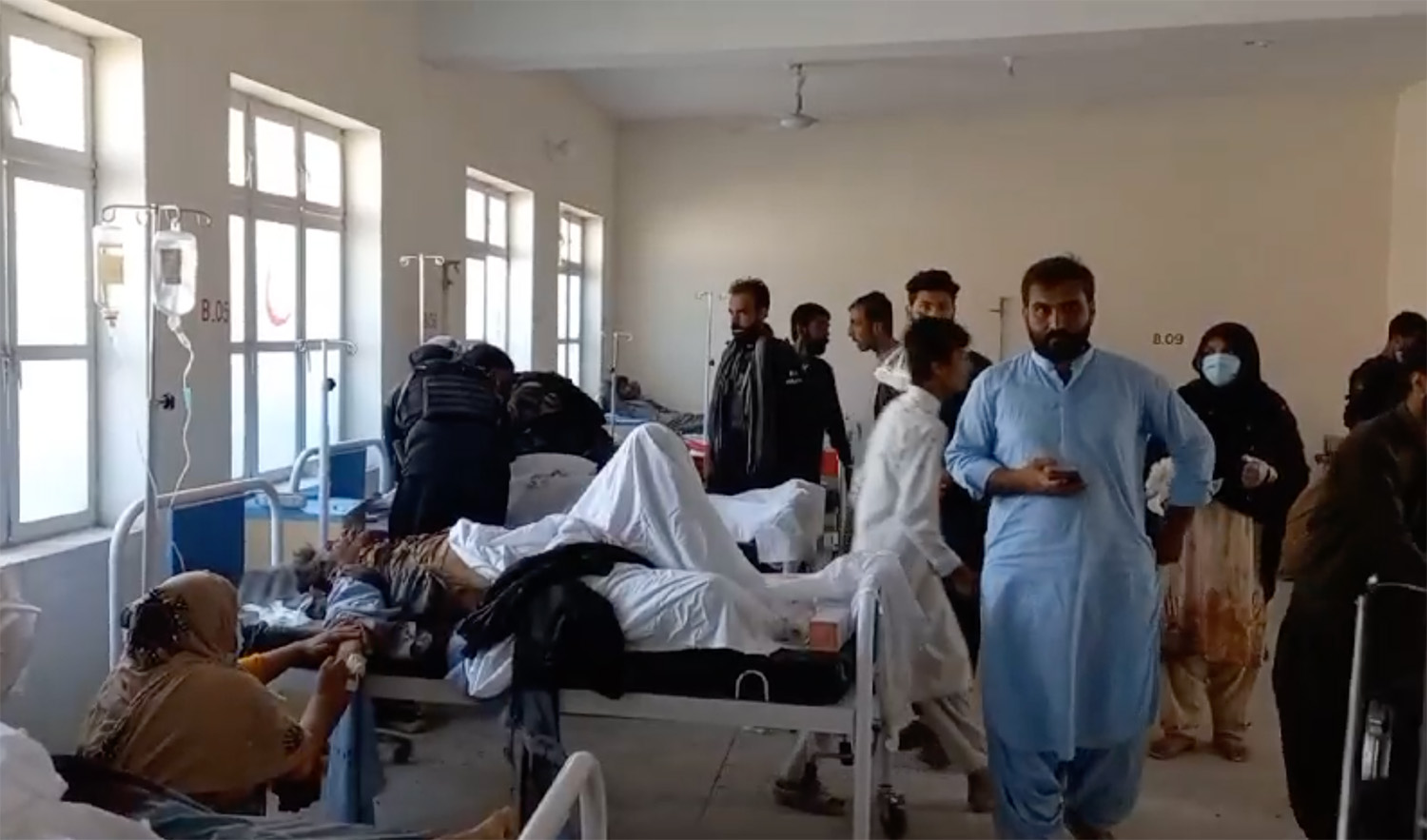


People being treated in a hospital after getting wounded in an explosion during a procession in Mastung town of Pakistan's Balochistan province on September 29, 2023. (Photo courtesy: Edhi Foundation)

Pakistan’s caretaker information minister Sarfaraz Bugti named India’s premier spy agency, Research and Analysis Wing (RAW), after the Mastung attack, though he did not share evidence to substantiate his claim.
Chief of Army Staff General Asim Munir also made a similar assertion, calling the people behind the attack on the religious procession as “proxies” of the enemies of the state and its people.
Achakzai told the news conference the attack in Mastung could not have taken place without the facilitators and militant sanctuaries abroad, pointing out that these armed groups were not surviving without their “links.”
“We will take security measures to systematically stamp out terrorism,” he continued.
The minister maintained there was complete clarity on the issue within the government, as he tried to highlight the state’s resolve to deal with the security challenge.
“We will pursue the masterminds and those managing these proxies,” he added.
Achakzai also indicated the government would offer financial compensation to the families that had lost their loved ones in the Mastung attack.


Punjab expands Pakistan-India Wagah border arena with museum, partition-themed park

Updated 4 sec ago
Follow

Punjab expands Pakistan-India Wagah border arena with museum, partition-themed park

  • The border crossing, near eastern city of Lahore, is the primary land route between Pakistan and India and one of the most recognizable symbols of their often-tense relations
  • The site is best known for its daily flag-lowering ceremony, a choreographed military ritual performed by border forces from both countries that draws thousands of spectators

ISLAMABAD: Maryam Nawaz, chief minister of Pakistan’s Punjab province, on Thursday inaugurated the newly constructed arena at Wagah border cross between Pakistan and India, which includes a museum and a partition themed park.

The Wagah border crossing, located near the eastern city of Lahore, is the primary land route between Pakistan and India and one of the most recognizable symbols of the often-tense relationship between the two neighbors. It serves as a key point for prisoner exchanges and limited movement of travelers, while remaining tightly regulated due to security considerations.

The site is best known for its daily flag-lowering ceremony, a choreographed military ritual performed by border forces from both countries that draws thousands of spectators. Over the years, the ceremony has evolved into a popular tourist attraction, blending displays of nationalism with public spectacle and making it one of Pakistan’s most visited landmarks, which connects with India’s Attari.

Flanked by military officials, CM Nawaz visited the crossing and inaugurated the new arena, with its seating capacity increased from 7,500 to 25,000 spectators, the state-run Radio Pakistan broadcaster reported. The chief minister also visited the martyrs’ monument and offered her respects.

“In addition to the arena’s expansion, several new constructions have been added at the Joint Check Post Wagah. These new developments include a theme park depicting the partition of the Subcontinent, featuring models of a railway station, military equipment and a Martyrs’ Memorial,” the broadcaster reported.

“A Pakistan Museum has also been established within the arena, showcasing the country’s history and culture from the Freedom Movement to the present day.”

In August 1947, Britain divided the Indian Sub-continent, its former colony, into two countries — Hindu-majority India and Muslim-majority Pakistan.

Excitement over independence was quickly overshadowed by some of the worst bloodletting that left up to 1 million people dead as gangs of Hindus and Muslims slaughtered each other.

Creating two independent nations also tore apart millions of Hindu and Muslim families in one of the world’s largest peacetime migrations, which displaced at least 15 million people.

The fate of Kashmir, then a princely state, was left undecided. The Himalayan territory continues to remain a flashpoint in relations between the neighbors, who have fought multiple wars over it.