PRISTINA: Kosovo on Saturday demanded that Serbia withdraw its troops from their common border, saying it was ready to protect its territorial integrity.
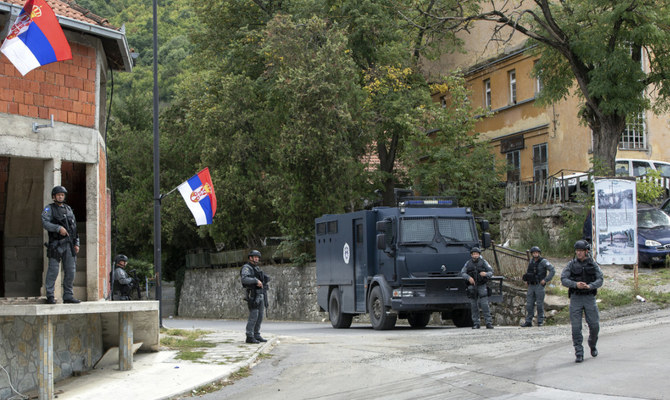
Tensions between the two countries have been high since last Sunday when Kosovo police fought around 30 heavily armed Serbs who stormed the Kosovo village of Banjska and barricaded themselves in a Serbian Orthodox monastery. Three attackers and one police officer were killed.
The gunbattle prompted new international concern over stability in Kosovo, which has an ethnic Albanian majority and declared independence from Serbia in 2008 after a guerrilla uprising and a 1999 NATO intervention.
“We call on President Vucic and the institutions of Serbia to immediately withdraw all troops from the border with Kosovo,” the Kosovo government said in a statement.
“The deployment of Serbian troops along the border with Kosovo is the next step by Serbia to threaten the territorial integrity of our country.”
Serbian President Aleksandar Vucic told the Financial Times he did not intend to order his forces to cross the border into Kosovo because an escalation of the conflict would harm Belgrade’s aspirations to the join the European Union.
On Friday the United States said it was monitoring a troubling Serbian military deployment along the Kosovo border that is destabilizing the area.
“Kosovo, in coordination with international partners, is more determined than ever to protect its territorial integrity,” the Pristina government said.
“This deployment also includes the deployment of anti-aircraft systems and heavy artillery.”
“The Government of the Republic of Kosovo has been in constant contact with the USA and the EU countries regarding this serious threat from Serbia.”
NATO, which still has 4,500 troops in Kosovo, said on Friday it had “authorized additional forces to address the current situation.”


![]()

Kosovo demands Serbia withdraw troops from border
Short Url
https://arab.news/6c6tx
Kosovo demands Serbia withdraw troops from border
- Tensions between the two countries have been high since last Sunday when Kosovo police fought around 30 heavily armed Serbs who stormed the Kosovo village of Banjska


Latest updates


© 2026 SAUDI RESEARCH & PUBLISHING COMPANY, All Rights Reserved And subject to Terms of Use Agreement.