

52 killed in bombing in southwest Pakistan near gathering to mark Prophet’s birthday

1 / 2
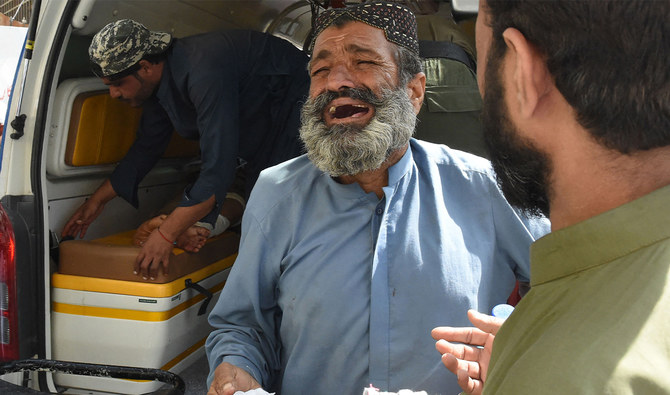
A relative mourns the death of a blast victim at a hospital in Quetta on September 29, 2023, after a suicide bomber targeted a procession marking the birthday of Islam's Prophet Mohammed in Mastung district. (AFP)
2 / 2
Residents assisting in the transfer of injured individuals to an ambulance following an explosion in Mastung town, in Pakistan's Balochistan province, on September 29, 2023. (Photo courtesy: Al Khidmat Foundation)
Short Url
Updated 30 September 2023
Follow

52 killed in bombing in southwest Pakistan near gathering to mark Prophet’s birthday

  • Hospital officials say 100 people injured, death toll could increase as many in critical care
  • Five killed as bomb rips through mosque in northwestern Pakistan during Friday prayers

QUETTA/PESHAWAR: At least 52 people, including a senior police official, were killed on Friday when a suicide bomber hit close to a gathering to mark the Prophet’s birthday in southwest Pakistan, a district commissioner and hospital officials said.

The attack, in which 100 people were injured, took place in Mastung city in the impoverished Balochistan province.

“Locals were gathering for an Eid Milad ul Nabi procession when a suicide bomber attacked a police van near the rally,” Assistant Commissioner Mastung Atta ul Munim told Arab News, adding that a deputy superintendent of police was among the dead.

Dr. Saeed Baloch at the Nawab Ghos Buksh Raisani Hospital said 52 had been killed and 100 were injured.

“Thirty-two dead bodies have arrived at our hospital [NGBR] and 20 were shifted to District Headquarters Hospital Mastung,” the doctor said. “The number of critical injuries is high and the death toll might increase.”


Residents assisting in the transfer of injured individuals to an ambulance following an explosion in Mastung town, in Pakistan's Balochistan province, on September 29, 2023. (Photo courtesy: Al Khidmat Foundation)

Bilal Ahmed, a local resident of city said, the rally to mark the Prophet’s birth anniversary was about to begin when he heard a powerful blast and saw people running and screaming.

“People were gathering outside the Madani Mosque at Mastung’s Golra Road when the blast hit the procession’s participants,” he told Arab News.

Rab Nawaz, another person who was injured in the attack, informed he was about 10 feet away from the spot where the suicide bomber blew his explosive vest.

“My brother was killed and I got injured,” he said.

Quetta’s Senior Superintendent Police (SSP) Tariq Jawad said the central Eid Milad ul Nabi procession had ended peacefully in the provincial capital of Balochistan, though the law enforcement agency had beefed up security in the city after the Mastung attack.

No group has as yet claimed responsibility for the attack but the Tehreek-e-Taliban Pakistan (TTP) denied it was involved.

The Daesh group is known for attacks in Pakistan and beyond on religious gatherings and on minorities.

Balochistan is also home to a decades-long insurgency by ethnic Baloch guerrillas fighting the government over accusations of exploiting the province’s rich gas and mineral resources.x
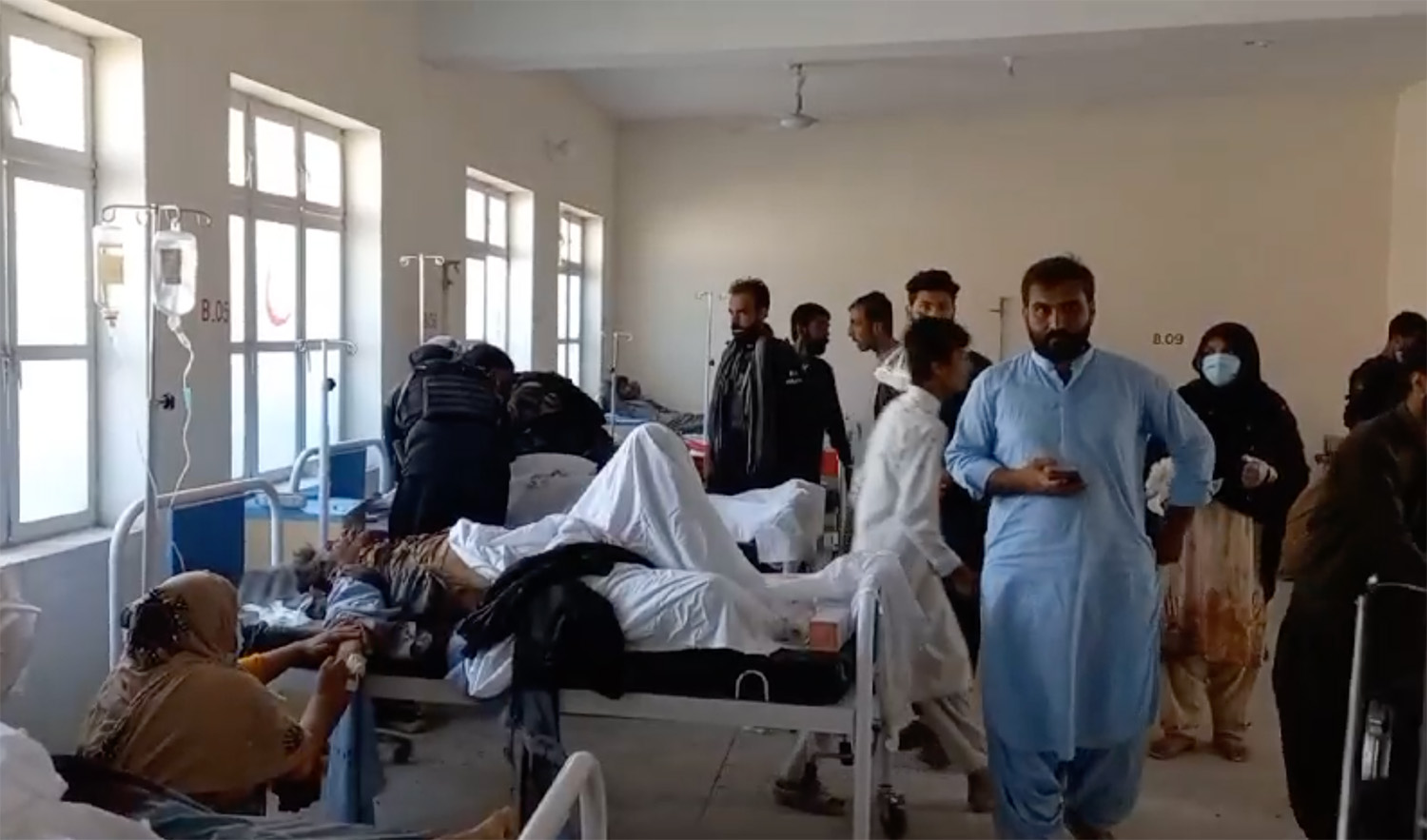


People being treated in a hospital after getting wounded in an explosion during a procession in Mastung town of Pakistan's Balochistan province on September 29, 2023. (Photo courtesy: Edhi Foundation)

HANGU ATTACK
Separately, at least five people were killed and at least 15 injured as two suicide explosions ripped through a mosque located in a police station in Hangu in the northwestern Khyber Pakhtunkhwa province.

“The death toll has risen to five,” a spokesperson for Rescue 1122 Hangu told Arab News.

The roof of the mosque had collapsed, police said, and many people were trapped inside.

Deputy Commissioner Hangu, Fazal Akbar, said two suicide blasts had occurred at the mosque at the Doaba Police Station during Friday prayers, as a mosque leader was delivering his sermon before a group of around 30 people.


Pakistan’s president defends ongoing strikes in Afghanistan, urges Kabul to dismantle militants

Updated 02 March 2026
Follow

Pakistan’s president defends ongoing strikes in Afghanistan, urges Kabul to dismantle militants

  • Afghanistan on Thursday launched attacks in retaliation for Pakistani airstrikes the previous Sunday
  • Pakistan’s military says it is only targeting Afghan military installations to avoid civilian casualties

ISLAMABAD: Pakistan’s president on Monday defended his country’s ongoing military strikes in neighboring Afghanistan, saying Islamabad tried all forms of diplomacy before targeting militants operating from Afghan territory, and called on the Taliban government in Kabul to disarm groups responsible for attacks in Pakistan.

Pakistan earlier said it is in “open war” with Afghanistan, alarming the international community. The border area remains a stronghold for militant organizations including Al-Qaeda and the Daesh (Islamic State) group.

“(The Afghan Taliban) must choose to dismantle the terror groups that survive on conflict and its war economy,” Asif Ali Zardari said during a speech to lawmakers, adding that “no state accepts serial attacks on its soil.”

Afghanistan on Thursday launched attacks in retaliation for Pakistani airstrikes the previous Sunday. Since then, Pakistan has carried out operations along the border, with Information Minister Attaullah Tarar claiming the killing of 435 Afghan forces and the capture of 31 Afghan positions.

Kabul has denied such claims.

In Afghanistan, the deputy government spokesman Hamdullah Fitrat said Pakistan’s military fired mortar shells at a refugee camp in eastern Kunar province, killing three children and injuring three others.

Afghanistan’s defense ministry said Afghan forces carried out strikes targeting a Pakistani military facility near Paktia province, causing “substantial losses and heavy casualties.”

Pakistan’s military did not respond to questions. It has said Pakistan is only targeting Afghan military installations to avoid civilian casualties.

Pakistan has witnessed a surge of violence in recent months and blames it on the outlawed Pakistani Taliban, known as Tehreek-e-Taliban Pakistan or TTP. It operates both inside Pakistan and from Afghan territory.
Islamabad accuses Afghanistan’s Taliban government of providing safe havens for the TTP, which Kabul denies.

The latest cross-border fighting ended a ceasefire brokered by Qatar and Turkiye in October. The two sides failed to reach a permanent agreement during talks in Istanbul.

Zardari reiterated Pakistan’s call for talks, saying, “We have never walked away from dialogue.”

The Pakistani leader again accused Afghanistan of acting as a proxy for India by sheltering militant groups.

“Stop being used by another country as a battlefield for their ambitions,” he said.

Zardari cited a recent report from the United Nations Security Council’s monitoring team that described the presence of militant groups in Afghanistan as an extra-regional threat.