

Pakistani vocational school helps Afghan women refugees build businesses

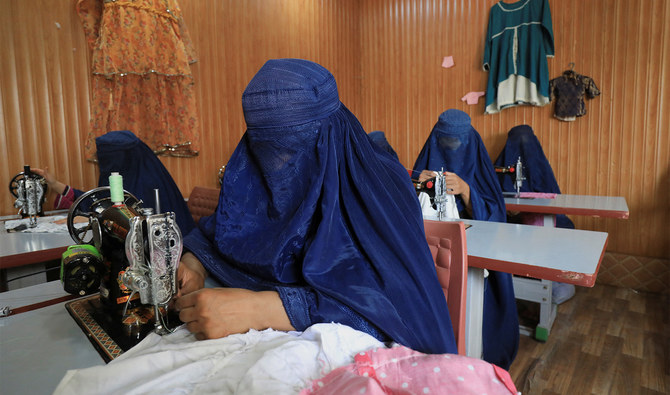
Women attend tailoring classes at the Skills Academy for Needy Aspirants (SANA) in Peshawar, Pakistan on July 12, 2023. (REUTERS)
Short Url
Updated 28 September 2023
Follow

Pakistani vocational school helps Afghan women refugees build businesses

  • Skills center was set up last year by Peshawar resident Mahra Basheer to help people fleeing neighboring Afghanistan 
  • Basheer opened the workshop to teach tailoring as well as digital skills and beauty treatments to Afghan women 

PESHAWAR, Pakistan: In a small workshop in the bustling northwestern Pakistani city of Peshawar, a dozen Afghan women sit watching a teacher show them how to make clothes on a sewing machine.

The skills center was set up last year by Peshawar resident Mahra Basheer, 37, after seeing the steady influx of people from neighboring Afghanistan where they face an economic crisis and growing restrictions on women since the Taliban took over in 2021.

Trying to create options for women to become financially independent, she opened the workshop to teach tailoring as well as digital skills and beauty treatments. Basheer quickly found hundreds of women enrolling and has a long wait list.

“If we get assistance, I think we will be able to train between 250 and 500 students at one time, empowering women who can play an important role in the community,” Basheer said.
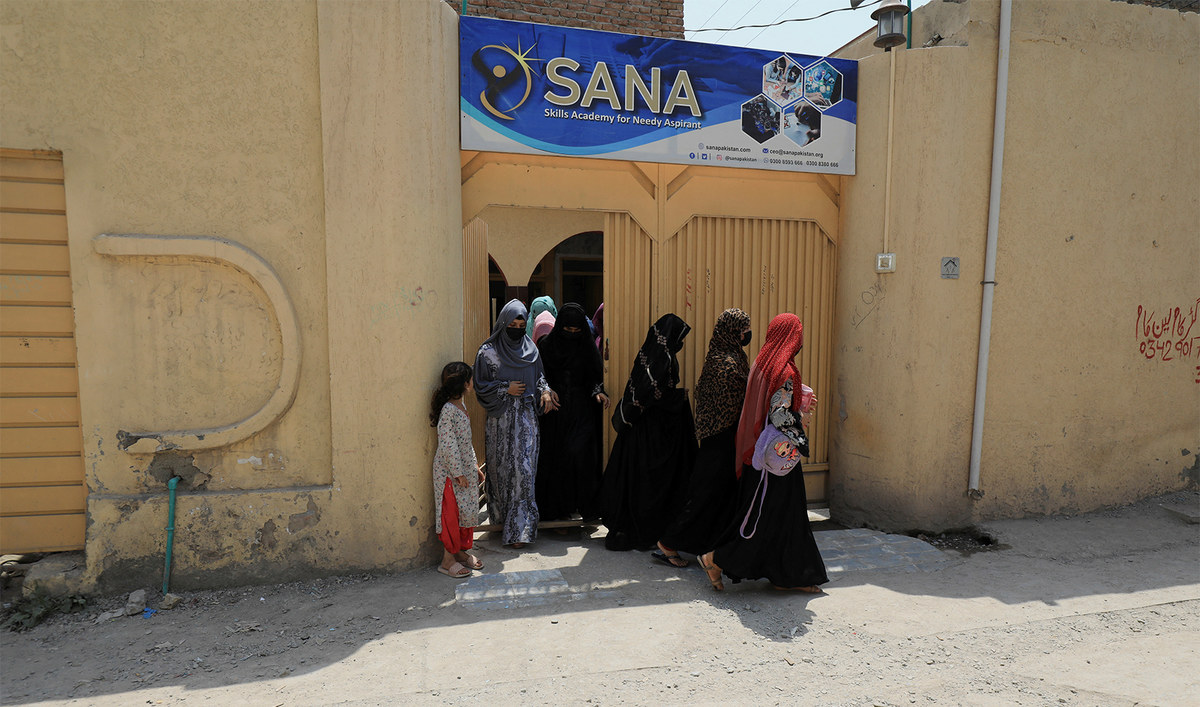


Afghan women leave after they attended classes at the Skills Academy for Needy Aspirants (SANA) in Peshawar, Pakistan on August 9, 2023. (REUTERS)

Officials say hundreds of thousands of Afghans have traveled to Pakistan since foreign forces left and the Taliban took over in 2021. Even before then, Pakistan hosted some 1.5 million registered refugees, one of the largest such populations in the world, according to the United Nations refugee agency.

More than a million others are estimated to live there unregistered. Grappling with an economic crisis of its own, Pakistan’s government is increasingly anxious about the number of Afghans arriving, officials say. Lawyers and officials have said scores of Afghans have been arrested in recent months on allegations they don’t have the correct legal documents to live in Pakistan.
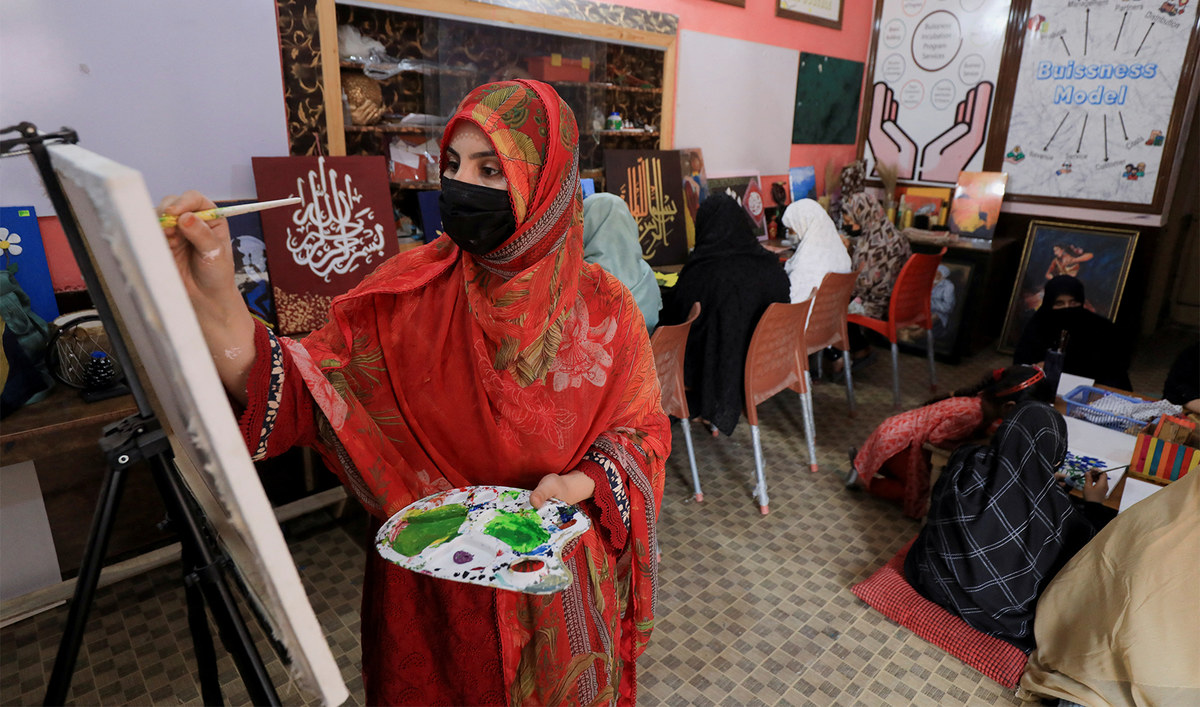


An Afghan girl attends a painting and art class at the Skills Academy for Needy Aspirants (SANA) in Peshawar, Pakistan on July 12, 2023. (REUTERS)

Basheer said that her main focus was expanding operations for Afghan women and she has also included some Pakistani women in the program to boost their opportunities in the conservative area. Once graduating from the three-month course, the women are focused on earning a modest but meaningful income, often starting their own businesses.


An Afghan woman attends a tailoring class at the Skills Academy for Needy Aspirants (SANA) in Peshawar, Pakistan on July 13, 2023. (REUTERS)

Nineteen-year-old Afghan citizen Fatima who had undertaken training at the center, said she now wanted to open a beauty parlour in Peshawar – currently banned in her home country just a few hours away.

“Right now my plan is to start a salon at home. Then to work very professionally so that I can eventually open a very big salon for myself,” she said.


Pak-Qatar becomes Pakistan’s first dedicated family takaful operator to list on PSX

Updated 8 sec ago
Follow

Pak-Qatar becomes Pakistan’s first dedicated family takaful operator to list on PSX

  • Pak-Qatar Family Takaful Limited’s initial public offering raises $3.2 million, says company
  • Company says remains committed to strengthening Pakistan’s Islamic financial eco-system

KARACHI: The Pak-Qatar Family Takaful Limited (PQFTL) became the first dedicated family Takaful operator to be listed on the Pakistan Stock Exchange (PSX), the company announced on Thursday, saying the development would strengthen the ecosystem for Islamic financial products and services in the stock market. 

PQFTL is the country’s first and largest dedicated shariah-compliant family risk-protection provider, holding 44 percent of the total family takaful market and more than 90 percent of the fully dedicated segment, with a nationwide presence of 73 branches and 1,971 field representatives.

The company announced in a statement last month it would offer 50 million shares, starting at a floor price of Rs14 per share ($0.05), with a ceiling of Rs21 per share ($0.07). Of the total issue, 37.5 million shares will be allocated to institutional investors, while 12.5 million shares will be offered to the general public.

In its latest statement, the PQTFL said the book building and public subscription portions of its Initial Public Offering (IPO) were oversubscribed by 3.2 times and 3.8 times, respectively, reflecting strong investor confidence in the company and Pakistan’s Islamic financial ecosystem.

“The IPO raised Rs901 million [$3.2 million], achieving a 29 percent premium, reflecting strong investor interest and positive market perception,” the statement said. 

“This historic milestone and response from investors underscore PQFTL’s exceptional financial resilience, strategic foresight, and unwavering commitment to Shariah-compliant excellence,” it added. 

The company said over 8,200 investors participated in the IPO, making it one of the highest investor turnouts in Pakistan’s insurance and Takaful sector. 

“The offering attracted a diverse mix of institutional investors, insurance companies, family offices, corporate investors, and a significant number of individual investors,” it said. 

Muhammad Kamran Saleem, a member of the board of directors of the PQFTL, said the company’s listing on the stock exchange was a “historic achievement.”

“The overwhelming response from investors demonstrates deep trust in our business fundamentals, Shariah governance standards and strategic vision,” he said. 

“We are grateful to Allah Almighty for this historic achievement and we remain committed to strengthening the Islamic financial eco-system and long-term sustainable value creation to all our stakeholders.”

PQFTL said the IPO proceeds will help it in meeting regulatory capital requirements, expand digital distribution channels, enhance product innovation and drive customer-centric growth initiatives.