

Royal Commission for Riyadh City seminar in Paris highlights Saudi World Expo themes

1 / 2
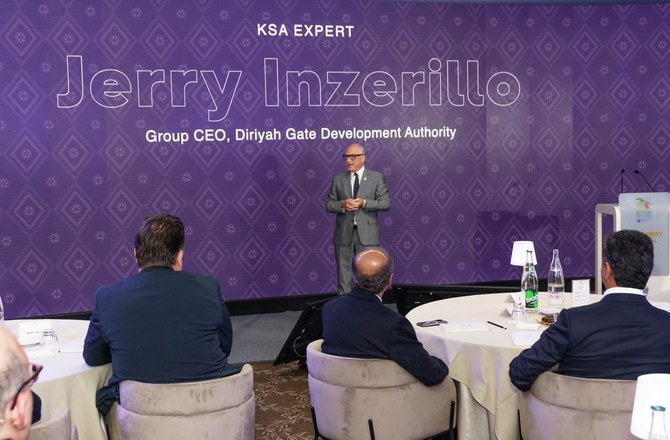
The Royal Commission for Riyadh City, the Saudi government agency leading the Kingdom’s bid to host World Expo 2030, recently held a seminar in Paris on the country’s expo themes. (Supplied)
2 / 2
The Royal Commission for Riyadh City, the Saudi government agency leading the Kingdom’s bid to host World Expo 2030, recently held a seminar in Paris on the country’s expo themes. (Supplied)
Short Url
Updated 26 September 2023
Follow

Royal Commission for Riyadh City seminar in Paris highlights Saudi World Expo themes

  • Titled “Prosperity for All,” the meeting was attended by delegates from the member countries of the Bureau International des Expositions
  • Saudi delegation included Minister of Tourism Ahmed Al-Khateeb and DGDA CEO Jerry Inzerillo

RIYADH: The Royal Commission for Riyadh City, the Saudi government agency leading the Kingdom’s bid to host World Expo 2030, recently held a seminar in Paris on the country’s expo themes.

Titled “Prosperity for All,” the meeting was attended by delegates from the member countries of the Bureau International des Expositions, an inter-governmental organization that regulates World Expo.

During the seminar, Saudi Minister of Tourism Ahmed Al-Khateeb, Diriyah Gate Development Authority CEO Jerry Inzerillo, and senior adviser Daniel Sobel, addressed the BIE delegates and highlighted the Kingdom’s expo vision.

Al-Khateeb said the Riyadh Expo 2030 theme, “The Era of Change: Together for a Foresighted Tomorrow,” aligned with the country’s commitment to, “fostering international collaboration and addressing global disparities toward a more inclusive and sustainable world.”

The minister added: “Saudi Arabia is committed as a host and as an equal partner to working with all of you to create a world where prosperity is more than a vision but a collective reality.”

Inzerillo said: “The Kingdom is undergoing unprecedented development in various fields and in openness in various sectors, including investment, culture, and tourism, which will contribute to delivering an exceptional edition of the Riyadh Expo 2030.”

He noted the significant developmental initiatives and major projects which he felt would contribute to making Saudi Arabia the ideal destination for hosting the event.

“We do not want to win the Expo for the sake of wining the Expo, we want to use it to show a rich genuine welcoming culture,” Inzerillo added.

The Paris seminar formed part of a series of gatherings organized by the Royal Commission for Riyadh City to establish connections with participating countries and gather ideas and opinions from delegates regarding the suitability of the themes for their respective nations.

Sobel said: “The sub-theme ‘Prosperity for All’ points to the importance of inclusive education in providing equal opportunities for all segments of society.

“One of the things which is exciting about Saudi Arabia more than any other country that I found is the thirst for excellence in education, which will contribute to achieving ‘Prosperity for All,’” he added.


Experimental farm in Al-Lith looks into future of Saudi Arabian agriculture

Updated 02 February 2026
Follow

Experimental farm in Al-Lith looks into future of Saudi Arabian agriculture

  • Research initiative reflects strategic transformation

JEDDAH: An experimental farm in Saudi Arabia’s Al-Lith Governorate is one of the research initiatives reflecting the strategic transformation taking place in the Kingdom’s agricultural sector.

The farm uses highly efficient, sustainable production models that combine scientific research with commercial application, contributing to strengthening the country’s food security system and the sustainability of water resources.

Located in the Ghumaiqa Center on an area of about 10 hectares, the cutting-edge farm is a testing platform for modern agricultural technologies that tackle the challenge of water scarcity.

The farm includes developed open fields and modern greenhouses, supported by smart irrigation encompassing drip and sprinkler irrigation alongside surface and subsurface technologies.

All the systems operate via smart controls that enable the monitoring of water consumption and ensure improved efficiency, thereby achieving a balance between agricultural production and water conservation.

The farm also uses treated and diluted low-salinity seawater.

It aims to diversify agricultural water sources, reduce reliance on freshwater, and open new horizons for agriculture in coastal and semi-arid environments.

A view of the experimental farm in Al-Lith. (SPA)

The project represents a promising investment opportunity in the field of smart agriculture, enabling the development of commercially scalable production models, particularly for high-value vegetables and fruits, while reducing operational costs associated with water and energy, enhancing the economic feasibility of future agricultural projects.

In addition, the project contributes to transferring and localizing agricultural expertise, supporting local food supply chains, and creating an attractive environment for agricultural investment.

This aligns with Sustainable Development Goals and enhances the efficiency of the private sector in adopting innovative agricultural solutions.

Yahya bin Abdulrahman Al-Mahabi, the director of the Ministry of Environment, Water and Agriculture office in Al-Lith Governorate, told the Saudi Press Agency that the project represented the future of agriculture in the Kingdom.

He explained that the vision was based on investing in technology, enhancing the return on water per unit, and integrating scientific research with investment opportunities.

Al-Mahabi spoke of the experimental farm as a modern, scalable and replicable model applicable in several regions of the Kingdom, particularly in coastal environments.

Al-Mahabi highlighted the Ministry of Environment, Water and Agriculture’s commitment to supporting distinctive projects that contributed to achieving food security while developing rural areas and enhancing agricultural production efficiency, in line with the objectives of the Kingdom’s Vision 2030.