Lebanon risks being ‘ostracized’ if presidential vacuum lingers -French envoy

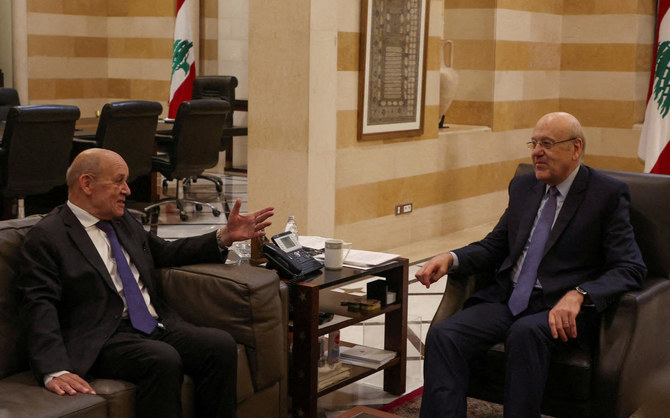
Lebanon’s caretaker Prime Minister Najib Mikati meets with former French Foreign Minister Jean-Yves Le Drian in Beirut in June 2023. (Reuters)
Short Url
Updated 26 September 2023
Follow

Lebanon risks being ‘ostracized’ if presidential vacuum lingers -French envoy

  • Le Drian told Lebanese daily L’Orient-Le Jour that he was planning to host a series of “consultations” among political actors
  • “I hope that the actors are aware that a way out must be found; otherwise, they will be ostracized by the international community,” Le Drian said

BEIRUT: Lebanon risks being “ostracized” by the international community if its nearly year-long presidential vacuum drags on further, France’s special envoy Jean-Yves Le Drian told a local Lebanese newspaper in an interview published on Tuesday.
Lebanon has been without a president since the term of former head of state Michel Aoun ended last October. The current parliament, one of the country’s most deeply divided, has failed 12 times to elect a successor, with the last session in June.
Le Drian told Lebanese daily L’Orient-Le Jour that he was planning to host a series of “consultations” among political actors and that he hoped Speaker of Parliament Nabih would then begin convening parliament “for consecutive and open sessions.”
“I hope that the actors are aware that a way out must be found; otherwise, they will be ostracized by the international community. No one will want to see them anymore, and it will be unnecessary to seek support here or there,” Le Drian said.
The failure to elect a president has deepened sectarian tensions in Lebanon, already mired in one of the world’s worst economic crises and facing unprecedented political paralysis, with its cabinet only partially empowered.
Lebanon has failed to enact reforms required to gain access to $3 billion in funding from the International Monetary Fund. The IMF has blamed “vested interests” for the lack of progress.
Donor countries have stepped in to help fund various public services but have grown increasingly frustrated with Lebanon’s requests for more funding.
Le Drian on Tuesday said five key countries — the United States, France, Qatar, Saudi Arabia and Egypt — who had been coordinating on policies to help Lebanon out of its political impasse were beginning to reconsider assistance.
“The five are wondering how long they will continue to help Lebanon,” he said.
The five had already discussed possible measures against politicians and groups who were obstructing the election of a president.


Arab, Muslim countries slam US ambassador’s remarks on Israel’s right to Middle East land

Updated 47 min 36 sec ago
Follow

Arab, Muslim countries slam US ambassador’s remarks on Israel’s right to Middle East land

  • The backlash widened sharply on Sunday as more than a dozen Arab and Islamic governments issued a joint statement denouncing the US diplomat’s comments as “dangerous and inflammatory”

JERUSALEM: Arab and Islamic countries issued a joint condemnation on Sunday of remarks by US ambassador to Israel Mike Huckabee, who suggested Israel had a biblical right to a vast swath of the Middle East.
Huckabee, a former Baptist minister and a fervent Israel supporter, was speaking on the podcast of far-right commentator and Israel critic Tucker Carlson.
In an episode released Friday, Carlson pushed Huckabee on the meaning of a biblical verse sometimes interpreted as saying that Israel is entitled to the land between the river Nile in Egypt and the Euphrates in Syria and Iraq.
In response, Huckabee said: “It would be fine if they took it all.”
When pressed, however, he continued that Israel was “not asking to take all of that,” adding: “It was somewhat of a hyperbolic statement.”
The backlash widened sharply on Sunday as more than a dozen Arab and Islamic governments — alongside three major regional organizations — issued a joint statement denouncing the US diplomat’s comments as “dangerous and inflammatory.”
The statement, released by the United Arab Emirates’ foreign ministry, was signed by the UAE, Egypt, Jordan, Indonesia, Pakistan, Turkiye, Saudi Arabia, Qatar, Kuwait, Oman, Bahrain, Lebanon, Syria and the State of Palestine, as well as the Organization of Islamic Cooperation, the Arab League and the Gulf Cooperation Council.
They said the comments contravene the UN Charter and efforts to de-escalate the Gaza war and advance a political horizon for a comprehensive settlement.
Iran joined the chorus with its foreign ministry accusing Huckabee on X of revealing “American active complicity” in what it called Israel’s “expansionist wars of aggression” against Palestinians.
Earlier, several Arab states had issued unilateral condemnations.
Saudi Arabia described the ambassador’s words as “reckless” and “irresponsible,” while Jordan said it was “an assault on the sovereignty of the countries of the region.”
Kuwait decried what it called a “flagrant violation of the principles of international law,” while Oman said the comments “threatened the prospects for peace” and stability in the region.
Egypt’s foreign ministry reaffirmed “that Israel has no sovereignty over the occupied Palestinian territory or any other Arab lands.”
The Palestinian Authority said on X that Huckabee’s words “contradict US President Donald Trump’s rejection of (Israel) annexing the West Bank.”
On Saturday, Huckabee published two posts on X further clarifying his position on other topics touched upon in the interview, but did not address his remark about the biblical verse.
The speaker of the Israeli parliament, Amir Ohana, praised Huckabee on X for his general pro-Israel stance in the interview, and accused Carlson of “falsehoods and manipulations.”
Carlson has recently found himself facing accusations of antisemitism, particularly following a lengthy, uncritical interview with self-described white nationalist Nick Fuentes — a figure who has praised Hitler, denied the Holocaust and branded American Jews as disloyal.