’Break down walls’: Tunisia dance show celebrates diversity

1 / 6
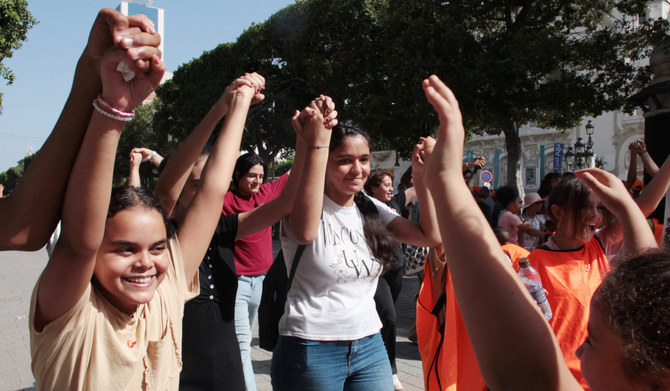
Dancers perform during a show aimed at raising awareness of children with disabilities, in Tunis on September 20, 2023. (AFP)
2 / 6
Tunisian actress and dancer Sondos Belhassen performs during a dance show aimed at raising awareness of children with disabilities, in Tunis on September 20, 2023. (AFP)
3 / 6
Iyed, a blind 13-year-old, poses for a picture with his mother Hakima during a dance show aimed at raising awareness of children with disabilities, in Tunis on September 20, 2023. (AFP)
4 / 6
Rayen performs during a dance show aimed at raising awareness of children with disabilities, in Tunis on September 20, 2023. (AFP)
5 / 6
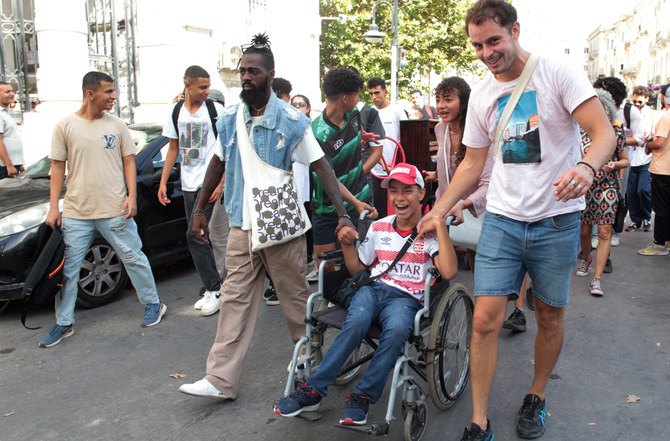
People attend a music parade, aimed at raising awareness of children with disabilities, in Tunis on September 21, 2023. (AFP)
6 / 6
People attend a music parade, aimed at raising awareness of children with disabilities, in Tunis on September 21, 2023. (AFP)
Short Url
Updated 26 September 2023
Follow

’Break down walls’: Tunisia dance show celebrates diversity

  • As the ensemble performs together, the audience is captivated by 16-year-old Rayen descending from his wheelchair onto the stage to perform his mesmerising dance number

TUNIS: A performer on a wheelchair, another who is blind and a third with Down syndrome share the stage for a pioneering new dance show seeking to push the boundaries in Tunisia.
Choreographer Andrew Graham says “the show is not about disability at all” but rather a celebration of diversity and inclusion that also involves migrants and LGBTQ artists.
“The idea is to break down all the walls,” said Graham, 35, whose production “Lines” premiered this weekend and runs until October 8 at the Dream City Festival in Tunis.


Tunisian actress and dancer Sondos Belhassen performs during a dance show aimed at raising awareness of children with disabilities, in Tunis on September 20, 2023. (AFP)

The performance brings together 15 dancers from different segments of society in the north African country.
It offers an opportunity for “sharing and mutual aid,” said Gabonese dancer Cedric Mbourou, 29.
The performance comes at a difficult time for Tunisia, which recently saw a wave of racial violence mainly targeting migrants from sub-Saharan Africa.
Mbourou himself was forced to go into hiding after an anti-migrant speech by President Kais Saied set off a wave of attacks.
“We see people just dancing for an hour non-stop,” said Graham, a Franco-British dance artist and teacher based in Marseille with his company L’Autre Maison.
“And very quickly the onlooker becomes interested in the dance and not necessarily who they are but in what they actually do.”

Graham hopes that this “very ambitious” show can “travel around the world, in Europe, the Middle East and Africa.”
As the ensemble performs together, the audience is captivated by 16-year-old Rayen descending from his wheelchair onto the stage to perform his mesmerising dance number.
Graham conceived of “Lines” after directing workshops in Tunis in 2021 for L’Art Rue, the organizer of Dream City, and activities aimed at making art accessible to underprivileged children.
The choreographer said he also drew inspiration from the stories of his grandfather, a Sicilian from Tunisia, and from “this extremely mixed country that has blended many cultures.”
The show features rhythmic “hadra” chants from the Muslim Sufi tradition and electronic music beats.
On stage, the singer and dancer Iyed — who at just 13 years old studies at the prestigious music conservatory in Tunis, and who is visually impaired — is gently hoisted into the air by the other performers.
His mother Hakima Bessoud, 49, is proud to join her son as they live out a passion that she said was a “childhood dream.”
She left a tourism sector job in 2018 to accompany her son to the conservatory and said that, since rehearsals started for “Lines,” her life has been “turned upside down.”
“Before, I had the routine of a homemaker: children, the house,” she said. “Now, I have a lot of energy, and I rush to do everything to attend rehearsals.”

Bessoud, who says she hails from a conservative background, said she welcomed being around the show’s openly gay dancer and actor Ahmed Tayaa.
“I have no problem with differences,” she said. “We must accept everyone, even Iyed is different.”
Tayaa, meanwhile, said he was amazed to see his sister Nourhene, 21, who has Down syndrome, perform.
He marvelled at having “discovered the artist that is Nourhene.”
“We all have a disability,” he said. “The people who see the show will discover their disability on the inside.”
“Lines,” he said, is “a paradise for people with all kinds of differences.”
One of the show’s professional dancers, Sondos Belhassen, 55, hailed the experience as “unique for a dancer,” saying they had experienced “something wonderful.”
“I wonder what weight it will leave in their universe, what memories they’ll keep?“
She said the performance had forced her to “readjust everything.”
“We are forced to experiment,” she said about working with performers whose physique is not “typical of a dancer.”
“We have a free body that can do anything, even the unexpected.”


Cambodia takes back looted historic artifacts handled by British art dealer

Updated 1 min 30 sec ago
Follow

Cambodia takes back looted historic artifacts handled by British art dealer

  • The objects were returned under a 2020 agreement between the Ministry of Culture and Fine Arts and the family of the late Douglas Latchford, a British art collector and dealer who allegedly had the items smuggled out of Cambodia

PHNOM PENH, Cambodia: Cambodian officials on Friday received more than six dozen historic artifacts described as part of the country’s cultural heritage that had been looted during decades of war and instability.
At a ceremony attended by Deputy Prime Minister Hun Many, the 74 items were unveiled at the National Museum in Phnom Penh after their repatriation from the United Kingdom.
The objects were returned under a 2020 agreement between the Ministry of Culture and Fine Arts and the family of the late Douglas Latchford, a British art collector and dealer who allegedly had the items smuggled out of Cambodia.
“This substantial restitution represents one of the most important returns of Khmer cultural heritage in recent years, following major repatriations in 2021 and 2023 from the same collection,” the Culture Ministry said in a statement. “It marks a significant step forward in Cambodia’s continued efforts to recover, preserve, and restore its ancestral legacy for future generations.”
The artifacts were described as dating from the pre-Angkorian period through the height of the Angkor Empire, including “monumental sandstone sculptures, refined bronze works, and significant ritual objects.” The Angkor Empire, which extended from the ninth to the 15th century, is best known for the Angkor Wat archaeological site, the nation’s biggest tourist attraction.
Latchford was a prominent antiquities dealer who allegedly orchestrated an operation to sell looted Cambodian sculptures on the international market.
From 1970 to the 1980s, during Cambodia’s civil wars and the communist Khmer Rouge ‘s brutal reign, organized looting networks sent artifacts to Latchford, who then sold them to Western collectors, dealers, and institutions. These pieces were often physically damaged, having been pried off temple walls or other structures by the looters.
Latchford was indicted in a New York federal court in 2019 on charges including wire fraud and conspiracy. He died in 2020, aged 88, before he could be extradited to face charges.
Cambodia, like neighboring Thailand, has benefited from a trend in recent decades involving the repatriation of art and archaeological treasures. These include ancient Asian artworks as well as pieces lost or stolen during turmoil in places such as Syria, Iraq and Nazi-occupied Europe. New York’s Metropolitan Museum of Art is one of the prominent institutions that has been returning illegally smuggled art, including to Cambodia.
“The ancient artifacts created and preserved by our ancestors are now being returned to Cambodia, bringing warmth and joy, following the country’s return to peace,” said Hun Many, who is the younger brother of Prime Minister Hun Manet.