

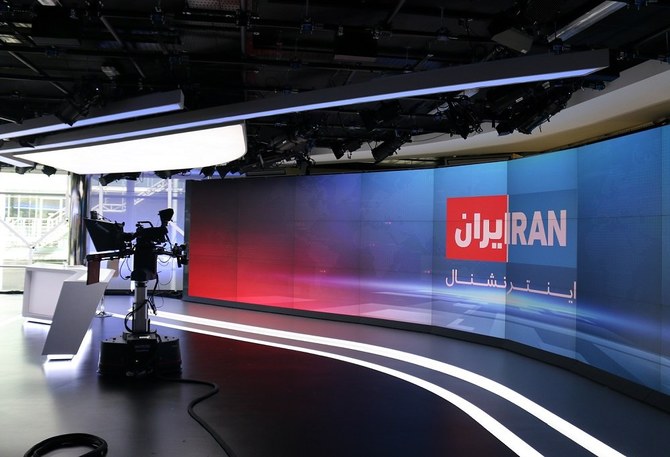
Iran International TV returns to air from high-security studio

The channel’s return to air comes at a time of heightened tensions between Iran and the West. (II/File)
Short Url
Updated 25 September 2023
Follow

Iran International TV returns to air from high-security studio

  • London-based broadcaster suspended operations in February over threats to staff
  • UK authorities claimed Iranian government behind threats, Tehran denied involvement

LONDON: Iran International returned to air on Monday from a new high-security studio in London.

The Farsi-language news broadcaster closed in February following alleged threats from the Iranian government.

But the TV channel’s head of news, Aliasghar Ramezanpoor, told The Sunday Times: “We are saying, ‘you are back — you are finding your voice again.’ As a journalist, I feel it is my moral obligation. People are putting their trust in us.”

British authorities claimed broadcast staff, particular those born in Iran, had been the target of “multiple threats,” adding that due to the studio’s former location in Chiswick Business Park police could not guarantee workers’ safety.

The station’s offices have been relocated to a new, high-security site in north London with steel barriers and armed patrols.

Following the decision to shut down the station in mid-February based on recommendations from Scotland Yard, the channel and parts of its staff were relocated to Washington as a temporary solution.

Ramezanpoor, who has reportedly received three credible death threats since last year, said that the suspension of the London operation had been a major blow to the broadcaster and expressed hope that the channel and its journalists would be able to reconnect with viewers.

Iran International, which is owned by private investors, including a British Saudi businessman, claimed to have 30 million viewers in Iran and among the Iranian diaspora.

The broadcaster, which provided round-the-clock updates during the protests that erupted in the country following the death of Mahsa Amini in police custody last year, said it relied heavily on amateur footage sent in by citizens in Iran.

Saeid Habil, a senior television and radio journalist at Iran International, said that the channel’s coverage of the events prompted the government to try and shut down its operations.

The Iranian government has denied any involvement in threats against Iran International staff. However, Iran’s intelligence minister, Esmail Khatib, recently described the station as a “terrorist network” and said the regime would take “offensive security measures … whenever and wherever we deem appropriate.”

The channel’s return to air comes at a time of heightened tensions between Iran and the West.

Tehran has been accused of providing drones to Russia for use in the war in Ukraine, and it is also facing international pressure over its nuclear program.

And an Iranian government official was recently accused by Iran International of attacking one its journalists covering President Ebrahim Raisi’s stay in New York.


Foreign press group welcomes Israel court deadline on Gaza access

Updated 22 December 2025
Follow

Foreign press group welcomes Israel court deadline on Gaza access

  • Supreme Court set deadline for responding to petition filed by the Foreign Press Association to Jan. 4
  • Since the start of the Gaza war in October 2023, Israeli authorities have prevented foreign journalists from independently entering the Strip

JERUSALEM: The Foreign Press Association in Jerusalem on Sunday welcomed the Israeli Supreme Court’s decision to set January 4 as the deadline for Israel to respond to its petition seeking media access to Gaza.
Since the start of the Gaza war in October 2023, sparked by Palestinian militant group Hamas’s attack on Israel, Israeli authorities have prevented foreign journalists from independently entering the devastated territory.
Israel has instead allowed, on a case-by-case basis, a handful of reporters to accompany its troops into the blockaded Palestinian territory.
The Foreign Press Association (FPA), which represents hundreds of foreign journalists in Israel and the Palestinian territories, filed a petition to the supreme court last year, seeking immediate access for international journalists to the Gaza Strip.
On October 23, the court held a first hearing on the case, and decided to give Israeli authorities one month to develop a plan for granting access.
Since then the court has given several extensions to the Israeli authorities to come up with their plan, but on Saturday it set January 4 as a final deadline.
“If the respondents (Israeli authorities) do not inform us of their position by that date, a decision on the request for a conditional order will be made on the basis of the material in the case file,” the court said.
The FPA welcomed the court’s latest directive.
“After two years of the state’s delay tactics, we are pleased that the court’s patience has finally run out,” the association said in a statement.
“We renew our call for the state of Israel to immediately grant journalists free and unfettered access to the Gaza Strip.
“And should the government continue to obstruct press freedoms, we hope that the supreme court will recognize and uphold those freedoms,” it added.
An AFP journalist sits on the board of the FPA.