Pakistan investigates local distributors of Roche cancer drug after 12 diabetes patients go blind

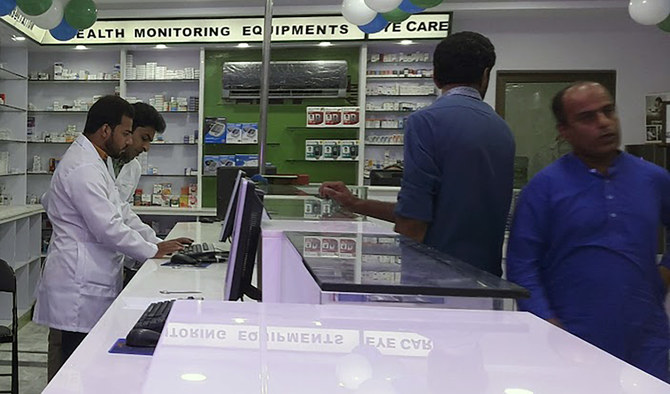
The undated file photo shows pharmacists dealing with customers at a pharmacy in Lahore, Pakistan. (Photo courtesy: social media)
Short Url
Updated 25 September 2023
Follow

Pakistan investigates local distributors of Roche cancer drug after 12 diabetes patients go blind

  • Drug Regulatory Authority says investigation launched in Punjab into local use of cancer drug Avastin, which is licensed for use in Pakistan
  • Avastin, when used in lower doses, is similar to eye drug Lucentis, used as low-cost option to treat certain blindness-causing conditions

LAHORE: Pakistan said on Monday it was investigating two local distributors of Swiss pharmaceutical company Roche’s Avastin cancer drug after 12 diabetic patients injected with the drug went blind.
The Drug Regulatory Authority of Pakistan (DRAP) said the health authorities in Punjab, the most populous province, had launched the investigation into local use of the drug Avastin, which is licensed for use in Pakistan.
“Incidents of loss of vision in diabetic patients have been reported following treatment with Altered/Dispensed/Diluted Avastin injection,” the regulator said in a statement.
Javed Akram, the province’s Minister for Specialized Health, said police were questioning two men they believe to be the drug’s distributors in the state.
“A high-level committee has been constituted to probe the issue. A case has been registered against the distributor and his aide,” Akram said.
Following the incidents, the DRAP instructed the importer to recall the suspected batches of Avastin 100mg injection, which it said had been created illegally.
“The sale/distribution of registered Avastin Injection has been put on halt till verification of its quality through sampling and laboratory testing to safeguard public health,” it said in a statement on its website.
On its website, Roche said Avastin was approved in more than 130 countries, including the United States, to treat several types of cancer. Roche’s Pakistan spokesman did not answer several calls.
Avastin was used as an eye treatment off-label, meaning outside of the approved use. Cancer drug Avastin, when used at much lower doses, is similar to eye drug Lucentis, and is used in many countries as a low-cost option to treat certain blindness-causing conditions.
Alam Sher, Punjab’s deputy drug controller who filed the police complaint against the distributors, told Reuters that some companies buy Avastin and repackage it in smaller doses to make it more affordable for patients.
A sharp drop in the value of the local currency against the US dollar has inflated the price of drugs in Pakistan, many of which are either imported or based on imported ingredients. 
Record high inflation has also diminished the purchasing power of many people.


Karachi shopping plaza blaze leaves rescuers struggling to recover and identify the dead

Updated 5 sec ago
Follow

Karachi shopping plaza blaze leaves rescuers struggling to recover and identify the dead

  • Extreme heat, structural collapse have turned Gul Plaza rescue into prolonged recovery and forensic operation
  • Burned and fragmented remains mean DNA testing may take weeks, prolonging uncertainty for grieving families

KARACHI/ISLAMABAD: The fire that last weekend tore through Gul Plaza, a crowded shopping complex in Karachi’s busy Saddar business district, did not only kill people. It destroyed the ability to account for them.

Days after the blaze erupted late Saturday, rescue officials say extreme heat, structural collapse and lingering smoke have transformed what initially began as a rescue mission into a slow and traumatic recovery operation, one in which even determining how many people died has become a challenge.

Close to 60 deaths have been officially confirmed so far, while authorities say dozens of people remain missing, with little hope of finding survivors. Recovery teams say the conditions inside the building, home to over 1,200 shops, were so extreme that many victims were burned beyond recognition, complicating identification and prolonging the anguish of families waiting outside the site.

Globally, fires in enclosed commercial buildings often present some of the most complex rescue scenarios, particularly when flames burn unchecked for hours, as they did in this case when it took nearly three days to control the inferno. High temperatures can cause floors to collapse, weaken load-bearing columns and trap heat and toxic gases long after the fire is extinguished. But in Karachi, officials and rescuers say these universal challenges are compounded by dense construction, limited access points and weak enforcement of fire safety standards.

One senior official described the situation as a “massive humanitarian crisis,” warning that the condition of the remains and the manner in which debris would need to be removed could significantly delay, or in some cases prevent, families from ever recovering their loved ones.

“The reality of the recovery process is harrowing. Bodies are being extracted from the rubble using excavators, which has further mutilated the already charred remains,” the official, who declined to be named, told Arab News.

“In some instances, remains counted as a single body weigh only about 3 kg and have included mismatched limbs, such as three legs. It is clear that untrained rescue officials have created a chaotic situation that will complicate the entire identification process.”

Karachi authorities rejected the allegation that rescue teams lacked training, saying heavy machinery was unavoidable given the scale of collapse.

Responding to the criticism, a spokesman for the Karachi Metropolitan Corporation said:

“This is very unfair and incorrect that staff is not trained, staff is trained and able to separate remains from debris. Without heavy machinery, you can’t remove this material.”

According to the spokesman, 89 people were initially reported missing while mobile phone data suggested around 40 people were still inside the building whose two floors had yet to be fully cleared due to safety concerns.

On Wednesday evening, DIG South Syed Asad Raza told Arab News another 30 bodies had been pulled out of one shop, bringing the death toll close to 60. Officials had previously confirmed 28 deaths.

Rescue officials say the intensity of the fire itself explains both the high death toll and the difficulty of recovery.

“This was a third-degree fire which was so intense that it reached the rooftop,” Raja Rustam, senior director of municipal services at the Karachi Metropolitan Corporation, told Arab News.

Rustam said the blaze burned hot enough to melt steel reinforcement bars inside the building.

“In such conditions, how could anyone have survived inside,” he said, gesturing toward the ruins, where families of missing persons have been sitting day and night since the fire was brought under control.

PROLONGED UNCERTAINTY

Medical and rescue workers say the same heat that made survival unlikely has made identification exceptionally difficult.

“Fire melts the human body,” said Muhammad Ameen, in-charge of the Edhi Rescue Service, one of Pakistan’s largest volunteer emergency organizations.

“When debris such as cement blocks or mortar collapses onto it, bodies break apart. As a result, during recovery, a hand may belong to one person and a foot to another.”

He said survival inside the building would have required nothing short of divine intervention.

“If it is a miracle of God, someone’s life can be saved, but the fire has destroyed the walls,” he said.

Even after flames were extinguished, Ameen said, temperatures and structural instability inside the plaza remained so dangerous that rescue workers could only enter for short periods.

“It is the most challenging fire,” he said.

Indeed, Karachi has repeatedly witnessed deadly blazes in markets and commercial buildings, often linked to poor wiring, illegal construction and lax enforcement of safety regulations.

Now the focus is firmly on recovery rather than rescue, officials said. 

Abdus Sattar Hakro, an additional deputy commissioner of Karachi, said the death toll continued to rise as debris was cleared.

“We have identified 28 deceased persons and 86 missing persons,” he said, adding that the operation involved excavators, bucket loaders, fire brigade vehicles, spotlights and lighting towers to allow round-the-clock work.

Mohammad Ashraf, operations chief of the Urban Search and Rescue team, said search crews had cleared the second and third floors of the building, but the ground and first floors remained largely inaccessible.

“There is a situation on the first and ground floor which has some debris that is making the place inaccessible,” Ashraf said.

He added that panic among traders attempting to retrieve cash and belongings had further complicated the operation.

“People are restlessly trying to get their belongings and cash back,” he said.

Outside the cordoned-off site, families of the missing and shopkeepers continued to gather behind barricades, at times chanting slogans and confronting officials. On one occasion, protesters briefly breached security barriers and argued with municipal staff.

Meanwhile, forensic identification is now the final and most painful phase of the tragedy. Officials warn that because many remains are badly burned and fragmented, confirming identities may take weeks, prolonging the uncertainty for families already devastated by loss.

Karachi police surgeon Dr. Summaiya Syed said 48 DNA samples had been collected from families of the missing and were being processed at Sindh’s forensic laboratory.

“Human remains received will be sorted today [Wednesday],” she told Arab News, “and we will continue to process dead bodies as they are received.”