Pope blames weapons industry for Russia-Ukraine war and ‘martyrdom’ of Ukrainian people

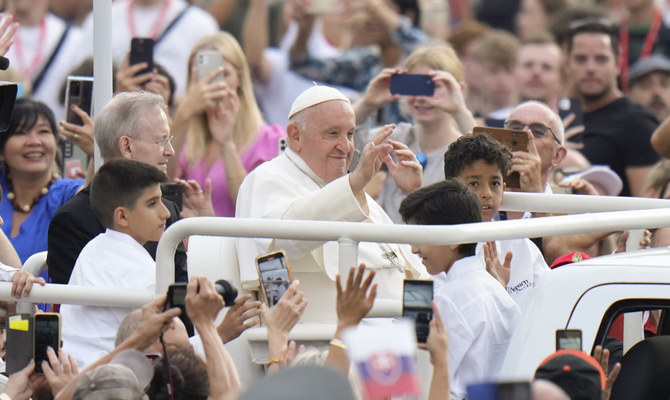
Pope Francis arrives for his weekly general audience in St. Peter's Square, at the Vatican, Sept. 20, 2023. (AP)
Short Url
Updated 25 September 2023
Follow

Pope blames weapons industry for Russia-Ukraine war and ‘martyrdom’ of Ukrainian people

  • Francis has long denounced the weapons industry as “merchants of death,” but he has also asserted the right of countries to defend themselves

ABOARD THE PAPAL PLANE: Pope Francis on Saturday labeled the weapons industry as being a key driver of the “martyrdom” of Ukraine’s people in Russia’s war, saying even the withholding of weapons now is going to continue their misery.
Francis appeared to refer to Poland’s recent announcement that it is no longer sending arms to Ukraine when he was asked about the war during brief remarks to reporters while returning home from Marseille, France.
Francis acknowledged he was frustrated that the Vatican’s diplomatic initiatives hadn’t borne much fruit. But he said behind the Russia-Ukraine conflict was also the weapons industry.
He described the paradox that was keeping Ukraine a “martyred people” — that at first many countries gave Ukraine weapons and now are taking them away. Francis has long denounced the weapons industry as “merchants of death,” but he has also asserted the right of countries to defend themselves.
“I’ve seen now that some countries are pulling back, and aren’t giving weapons,” he said.
“This will start a process where the martyrdom is the Ukrainian people, certainly. And this is bad.” It was an apparent reference to the announcement by Prime Minister Mateusz Morawieck that Poland was no longer sending arms to Ukraine as part of a trade dispute.
“We cannot play with the martyrdom of the Ukrainian people,” Francis said. “We have to help resolve things in ways that are possible.”
“Not to make illusions that tomorrow the two leaders will go out together to eat, but to do whatever is possible,” he said.
In other comments, Francis spoke about his two-day visit to Marseille, where he exhorted Europe to be more welcoming to migrants.
Francis said he was heartened that there is greater consciousness about the plight of migrants 10 years after he made his first trip as pope to the Italian island of Lampedusa, ground zero in Europe’s migrant debate. But he said the “reign of terror” they endure at the hands of smugglers hasn’t gotten any better.
Francis recalled that when he became pope, “I didn’t even know where Lampedusa was.” The Sicilian island, which is closer to Africa than the Italian mainland, is the destination of choice for migrant smugglers and has seen frequent shipwrecks off its shores. Last week, the island was overwhelmed when nearly 7,000 migrants arrived in one day, more than the resident population.
Francis, who was elected pope in 2013, said he had heard some stories about the problems on Lampedusa in his first months as pope “and in prayer I heard ‘You need to go there.’”
The visit has come to epitomize the importance of the migrant issue for Francis, who has gone on to make some memorable gestures of solidarity, including in 2016 when he brought back a dozen Syrian Muslim migrants on his plane after visiting a refugee camp in Lesbos, Greece.


Philippines eyes closer cooperation on advanced defense tech with UAE

Updated 7 sec ago
Follow

Philippines eyes closer cooperation on advanced defense tech with UAE

  • Philippine-UAE defense agreement is Manila’s first with a Gulf country
  • Philippines says new deal will also help modernize the Philippine military

MANILA: The Philippines is seeking stronger cooperation with the UAE on advanced defense technologies under their new defense pact — its first such deal with a Gulf country — the Department of National Defense said on Friday.

The Memorandum of Understanding on Defense Cooperation was signed during President Ferdinand Marcos Jr.’s visit to Abu Dhabi earlier this week, which also saw the Philippines and the UAE signing a comprehensive economic partnership agreement, marking Manila’s first free trade pact with a Middle Eastern nation.

The Philippines-UAE defense agreement “seeks to deepen cooperation on advanced defense technologies and strengthen the security relations” between the two countries, DND spokesperson Assistant Secretary Arsenio Andolong said in a statement.

The MoU “will serve as a platform for collaboration on unmanned aerial systems, electronic warfare, and naval systems, in line with the ongoing capability development and modernization of the Armed Forces of the Philippines,” he added.

It is also expected to further military relations through education and training, intelligence and security sharing, and cooperation in the fields of anti-terrorism, maritime security, and peacekeeping operations.

The UAE’s Ministry of Foreign Affairs has described security and defense as “very promising fields” in Philippine-UAE ties, pointing to Abu Dhabi being the location of Manila’s first defense attache office in the Middle East.

The UAE is the latest in a growing list of countries with defense and security deals with the Philippines, which also signed a new defense pact with Japan this week.

“I would argue that this is more significant than it looks on first read, precisely because it’s the Philippines’ first formal defense cooperation agreement with a Gulf state. It signals diversification,” Rikard Jalkebro, associate professor at the Anwar Gargash Diplomatic Academy in Abu Dhabi, told Arab News.

“Manila is widening its security partnerships beyond its traditional circles at a time when strategic pressure is rising in the South China Sea, and the global security environment is (volatile) across regions.”

Though the MoU is not an alliance and does not create mutual defense obligations, it provides a “framework for the practical stuff that matters,” including access, training pathways, procurement discussions and structured channels” for security cooperation, he added.

“For the UAE, the timing also makes sense, seeing that Abu Dhabi is no longer only a defense buyer; it’s increasingly a producer and exporter, particularly in areas like UAS (unmanned aerial systems) and enabling technologies. That opens a new lane for Manila to explore capability-building, technology transfer, and industry-to-industry links,” Jalkebro said.

The defense deal also matters geopolitically, as events in the Middle East and the Indo-Pacific region have ripple effects on global stability and commerce.

“So, a Philippines–UAE defense framework can be read as a pragmatic hedge, strengthening resilience and options without formally taking sides,” Jalkebro said.