


RIYADH: Saudi craftsmanship and family legacies are being kept alive through weaving and creative works.
Contemporary weaver Hana Almilli explores patterns of sadu weaving, creating masterpieces with a traditional twist.
Almilli told Arab News: “In a world that is constantly evolving, being a part of the few who are actively preserving tradition while exploring their artistry feels like a meaningful contribution. It’s a testament to the enduring value of heritage and the capacity of art to transcend time and space.”
Sadu weaving is an ancient tribal weaving craft that artistically portrays Arabian nomadic people’s rich cultural heritage.
As a multimedia artist and arts and culture management professional, Almilli said she feels a sense of duty in keeping traditions alive, “not only for my family, but also for generations to come to be able to keep histories through tangible assemblages.”

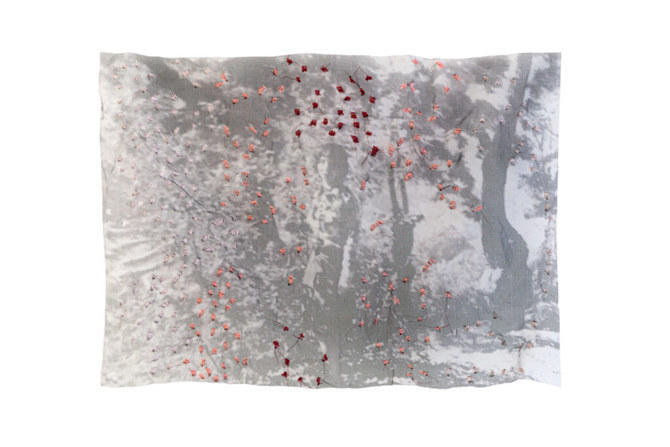
Through the earth, I come back home by Hana Almilli. (Supplied)
While in her third year studying abroad for a bachelor’s degree in architecture, Almilli had an epiphany that would soon change her educational track.
She said: “I wanted to delve into my artistic practice and also regain the textile practice that was always a part of my childhood. I decided to take a knitting course to regain the memories I had with my grandmother when I was little, as she was a knitter and loved crocheting as well.”
Almilli then switched to studying a bachelor’s degree in textiles.
“I knew this was what I wanted to do for my degree. Something that is a form of revival of heritage was a revival of my nostalgia and healing,” she said.
It was during this time that Almilli dived deep into researching her Saudi heritage.
“I am a Saudi. When I traveled abroad for my studies, I felt alienated and longed for my home, family, friends and life. I wanted to feel close while I was far away. Whether researching patterns, looking for books about Saudi, Sadu weaving, or indirectly incorporating it within my work through contemporary patterns, it will always exist in my work in some form,” she said.
She graduated from California College of the Arts in 2019 with a bachelor’s degree in textiles with a minor in creative writing.
In 2022, she received a master’s degree in arts and culture management from Rome Business School in Italy.
Belonging to Turkish, Syrian, Kurdish and Saudi lineage, Almilli’s path is persuaded by “questions of identity.”
She said: “Enquiring perpetual alienation, my ideology developed into discovering and representing the term Al-Ghorba (estrangement in a foreign land). Consequently, my visual structure interrogates nostalgia through weaving, dyeing, embroidering and photography techniques.
“My art practice is research-based, and within it, I explore the idea of recreating affected and rediscovering identities through the material culture of textiles and assemblages,” she added.
Almilli said her work is driven by memory, nostalgia, identity, emotion and more.
“Those elements always combine to create a curiosity to research my heritage further and write poetry pieces in response, which eventually leads to visualizations of my works,” she said.
“It is something I hold close to my heart, and which I take immense pride in. Being able to intertwine tradition with my artistic expression is a truly rewarding experience. It’s like breathing life into the past while simultaneously creating something new and innovative.”
The art of weaving, Sadu, has been added to UNESCO’s Intangible Heritage list.
The Saudi Heritage Commission told Arab News that it strives to launch programs aimed at preserving and highlighting Saudi culture.
“These programs and projects promote three main values and goals, which are: Enhancing awareness among citizens of the importance of heritage, establishing rules and regulations and issuing licenses, and protecting the portfolio of cultural wealth and archaeological sites, and managing them effectively,” the commission said.
The Heritage Commission launched six projects that highlight elements of intangible heritage. One of the projects involves preparing intangible heritage files for registration on UNESCO lists.
“From this standpoint comes the importance of preserving the intangible cultural heritage with its cultural components. Therefore, the Heritage Authority works, through its strategy to develop the sector, to align with the goals of Saudi Vision 2030.”


