

Pakistan stresses on ‘early conclusion’ of free trade negotiations with GCC

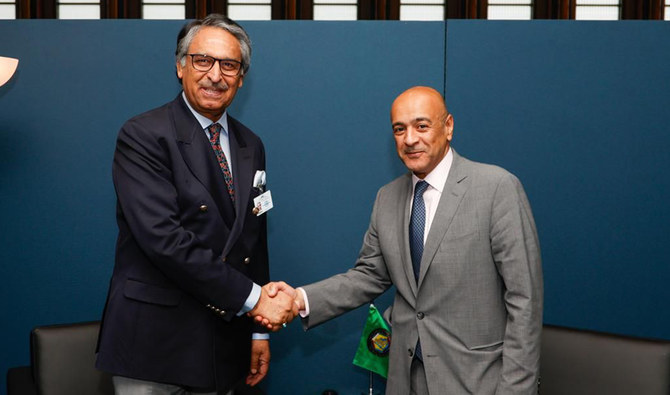
Pakistan's Foreign Minister, Jalil Abbas Jilani (left), shakes hands with Jassem Mohamed Albudaiwi, Secretary General of the Gulf Cooperation Council (GCC) on the sidelines of 78th session of the UN General Assembly (UNGA) in New York, USA on September 23, 2023. (Photo courtesy: Ministry of Foreign Affairs)
Short Url
Updated 24 September 2023
Follow

Pakistan stresses on ‘early conclusion’ of free trade negotiations with GCC

  • Pakistan’s FM meets GCC general-secretary at sidelines of UNGA in New York 
  • Pakistan, six-member GCC resumed free trade agreement talks in 2021

ISLAMABAD: Pakistan’s Caretaker Foreign Minister Jalil Abbas Jilani met the Gulf Cooperation Council’s (GCC) Secretary-General Jassem Mohamed Albudaiwi on Saturday to discuss free trade agreement negotiations between the two sides, calling for its “early conclusion,” Pakistan’s foreign office said. 

Pakistan and the six-member GCC bloc signed a framework agreement to discuss the free trade agreement in August 2004 but only a few rounds of negotiations took place in subsequent years. However, the GCC and Pakistan resumed the conversation in 2021 after a significantly long period.

Last year, both sides held technical-level talks to examine the possibility of signing the free trade agreement that could help Pakistan boost its exports to the six-country bloc, which includes Saudi Arabia, the United Arab Emirates, Bahrain, Oman, Qatar, and Kuwait. 

In March this year, a delegation of senior Pakistani diplomats met top GCC officials in Riyadh to discuss the agreement’s modalities. 

“The Foreign Minister expressed satisfaction on the progress made in the negotiations on Pakistan-GCC Free Trade Agreement and reiterated the need for its early conclusion,” the Ministry of Foreign Affairs (MoFA) said, adding that the two representatives met at the sideline of the 78th UN General Assembly in New York.

MoFA said Albudaiwi agreed to “cooperate closely” to conclude the Pakistan-GCC free trade agreement at the earliest.

The statement added that Jilani expressed Pakistan’s desire to strengthen institutional linkages with the GCC and its member states 

“He underscored that Pakistan would be ready to host a GCC Foreign Ministers’ Conference in Islamabad as proposed during the 1st meeting of the Political Dialogue held in March this year,” MoFA added. 

Jilani said Pakistan viewed the GCC as an important player in the region that could play a vital role in expanding the South Asian country’s political and economic ties with the Gulf states. 

“Both agreed to further strengthening cooperation to forge a comprehensive partnership, with renewed focus on promotion of bilateral trade and business relations,” the statement added. 

Pakistan has been facing a severe economic crisis that has seen its foreign exchange reserves fall to critically low levels while its national currency has weakened considerably against the US dollar over the past one year. 

While the country secured a last-gasp $3 billion deal with the International Monetary Fund (IMF) in June, Pakistan still needs to increase its exports as it grapples with an acute balance of payments crisis. 

Currently, Pakistan has free trade agreements with China, Malaysia, and Sri Lanka, though it also wants to export more to other trade destinations.


ADB, Pakistan sign over $300 million agreements to undertake climate resilience initiatives

Updated 30 December 2025
Follow

ADB, Pakistan sign over $300 million agreements to undertake climate resilience initiatives

  • Pakistan ranks among nations most vulnerable to climate change and has seen erratic changes in weather patterns
  • The projects in Sindh and Punjab will restore nature-based coastal defenses and enhance agricultural productivity

ISLAMABAD: The Pakistani government and the Asian Development Bank (ADB) have signed more than $300 million agreements to undertake two major climate resilience initiatives, Pakistan’s Press Information Department (PID) said on Tuesday.

The projects include the Sindh Coastal Resilience Sector Project (SCRP), valued at Rs50.5 billion ($180.5 million), and the Punjab Climate-Resilient and Low-Carbon Agriculture Mechanization Project (PCRLCAMP), totaling Rs34.7 billion ($124 million).

Pakistan ranks among nations most vulnerable to climate change and has seen erratic changes in its weather patterns. In 2022, monsoon floods killed over 1,700 people, displaced another 33 million and caused over $30 billion losses, while another 1,037 people were killed in floods this year.

The South Asian country is ramping up climate resilience efforts, with support from the ADB and World Bank, and investing in climate-resilient infrastructure, particularly in vulnerable areas.

“Both sides expressed their commitment to effectively utilize the financing for successful and timely completion of the two initiatives,” the PID said in a statement.

The Sindh Coastal Resilience Project (SCRP) will promote integrated water resources and flood risk management, restore nature-based coastal defenses, and strengthen institutional and community capacity for strategic action planning, directly benefiting over 3.8 million people in Thatta, Sujawal, and Badin districts, according to ADB.

The Punjab project will enhance agricultural productivity and climate resilience across 30 districts, improving small farmers’ access to climate-smart machinery, introducing circular agriculture practices to reduce residue burning, establishing testing and training facilities, and empowering 15,000 women through skills development and livelihood diversification.

Earlier this month, the ADB also approved $381 million in financing for Pakistan’s Punjab province to modernize agriculture and strengthen education and health services, including concessional loans and grants for farm mechanization, Science, Technology, Engineering and Mathematics (STEM) education, and nursing sector reforms.